
伴有睡眠障碍的慢性耳鸣患者的脑淋巴系统功能障碍
Glymphatic system dysfunction in chronic tinnitus patients with sleep disturbance.
作者信息
Du Yinjuan, Huang Zhichun, Xu Jin-Jing, Xue Yuan, Che Zigang
机构信息
Department of Otolaryngology-Head and Neck Surgery, Zhongda Hospital, Southeast University, Nanjing, China.
Department of Otolaryngology, Nanjing First Hospital, Nanjing Medical University, Nanjing, China.
出版信息
Front Neurol. 2025 Jun 10;16:1504645. doi: 10.3389/fneur.2025.1504645. eCollection 2025.
PURPOSE
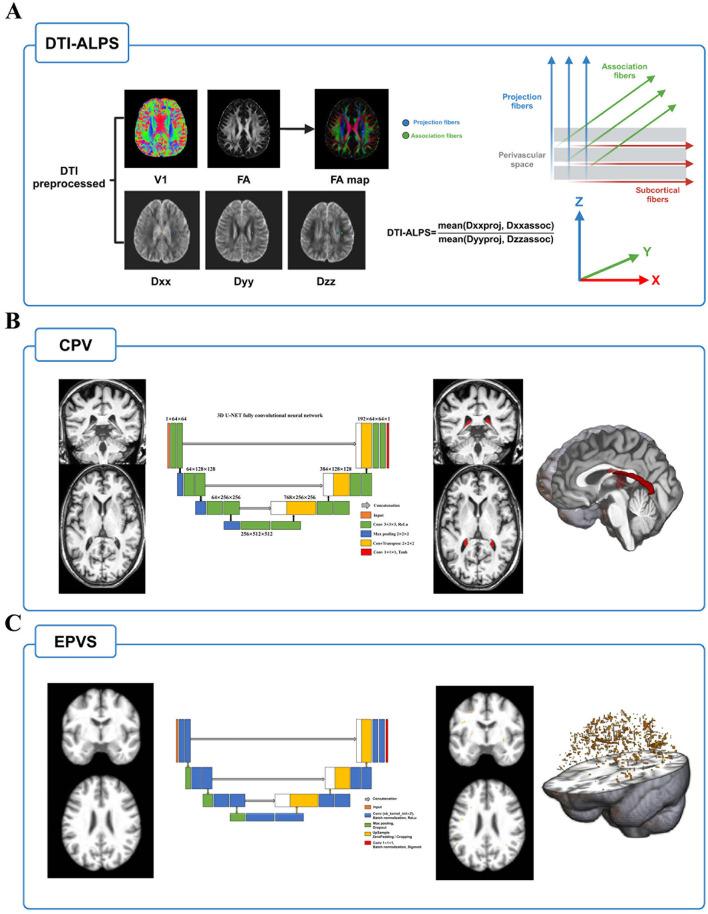
The neural mechanisms of sleep disturbance associated with chronic tinnitus remains unknown. To investigate this issue, multimodal magnetic resonance imaging (MRI) was used to detect glymphatic system dysfunctions in chronic tinnitus patients with sleep disturbance.
METHODS
This prospective study included 30 tinnitus with sleep disturbance (TSD), 30 tinnitus with no sleep disturbance (TNSD) and 38 age, sex, and education-matched healthy controls (HCs). All the subjects underwent MRI scans of the glymphatic indexes and clinical assessment. Multimodal MRI indices were used as proxies of glymphatic function and the relationships between the glymphatic function and sleep disturbance were further evaluated.
RESULTS
TSD group exhibited significantly higher choroid plexus volume (CPV) and enlarged perivascular spaces (EPVS) values than the HCs group ( < 0.0001). Moreover, the TNSD group revealed significantly lower diffusion tensor image analysis along the perivascular space (DTI-ALPS) values than the HCs group ( = 0.044). In chronic tinnitus patients, the decreased DTI-ALPS index was negatively associated with the Pittsburgh Sleep Quality Index (PSQI) scores ( = -0.428, = 0.001). In addition, the increased CPV and EPVS values were positively correlated with the PSQI scores ( = 0.374, = 0.005; = 0.335, = 0.013; respectively). Furthermore, reduced ALPS values were negatively associated with the Tinnitus Handicap Questionnaires (THQ) scores ( = -0.378, = 0.005).
CONCLUSION
Using multimodal MRI approaches, this study provides preliminary evidence for disrupted glymphatic function in chronic tinnitus patients, which may be associated with sleep disturbance. CPV, EPVS, and ALPS could serve as neuroimaging markers and shed new light on neuropathological mechanisms for chronic tinnitus comorbid with sleep disturbance.
目的
与慢性耳鸣相关的睡眠障碍的神经机制尚不清楚。为了研究这个问题,采用多模态磁共振成像(MRI)来检测伴有睡眠障碍的慢性耳鸣患者的类淋巴系统功能障碍。
方法
这项前瞻性研究纳入了30名伴有睡眠障碍的耳鸣患者(TSD)、30名无睡眠障碍的耳鸣患者(TNSD)以及38名年龄、性别和教育程度匹配的健康对照者(HCs)。所有受试者均接受了类淋巴指数的MRI扫描和临床评估。使用多模态MRI指标作为类淋巴功能的替代指标,并进一步评估类淋巴功能与睡眠障碍之间的关系。
结果
TSD组的脉络丛体积(CPV)和血管周围间隙扩大(EPVS)值显著高于HCs组(<0.0001)。此外,TNSD组沿血管周围间隙的扩散张量图像分析(DTI-ALPS)值显著低于HCs组(=0.044)。在慢性耳鸣患者中,DTI-ALPS指数降低与匹兹堡睡眠质量指数(PSQI)评分呈负相关(=-0.428,=0.001)。此外,CPV和EPVS值升高与PSQI评分呈正相关(分别为=0.374,=0.005;=0.335,=0.013)。此外,ALPS值降低与耳鸣障碍问卷(THQ)评分呈负相关(=-0.378,=0.005)。
结论
本研究采用多模态MRI方法,为慢性耳鸣患者类淋巴功能紊乱提供了初步证据,这可能与睡眠障碍有关。CPV、EPVS和ALPS可作为神经影像学标志物,为慢性耳鸣合并睡眠障碍的神经病理机制提供新的线索。


 Zotero 插件