
全血细胞计数衍生的炎症指标与类风湿关节炎全因死亡率之间的相关性:一项基于人群的研究。
Correlation between CBC-derived inflammatory indicators and all-cause mortality with rheumatoid arthritis: a population-based study.
作者信息
Liu Yu, Liu Yiping, Fan Shao, Yang Jing, Xu Mingxi, Zhao Lin, Liu Changyan, Xing Yida, Kong Xiaodan
机构信息
Department of Rheumatology, The Second Affiliated Hospital of Dalian Medical University, Dalian, China.
Dalian Key Laboratory of Autoantibody Detection, The Second Affiliated Hospital of Dalian Medical University, Dalian, China.
出版信息
Front Med (Lausanne). 2025 Jun 10;12:1538710. doi: 10.3389/fmed.2025.1538710. eCollection 2025.
OBJECTIVES
We investigated the relationship between inflammatory indicators derived from complete blood cell (CBC) counts and all-cause mortality in individuals with rheumatoid arthritis (RA).
METHODS
Data were collected from the National Health and Nutrition Examination Survey (NHANES) database from 2007 to 2018, with a median follow-up duration of 78 months. The inflammatory indicators derived from CBC included several types: the systemic inflammatory response index (SIRI), the systemic immune-inflammation index (SII), the neutrophil-to-lymphocyte ratio (NLR), the platelet-to-lymphocyte ratio (PLR), and the monocyte-to-lymphocyte ratio (MLR). The multiple COX regression models were used to estimate adjusted hazard ratios (HRs) and 95% CIs concerning all-cause mortality of participants with RA, which focused on CBC-derived inflammatory indicators. Additionally, restricted cubic spline (RCS) curve was utilized to investigate non-linear associations.
RESULTS
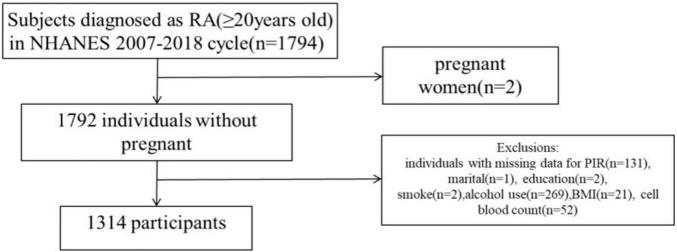
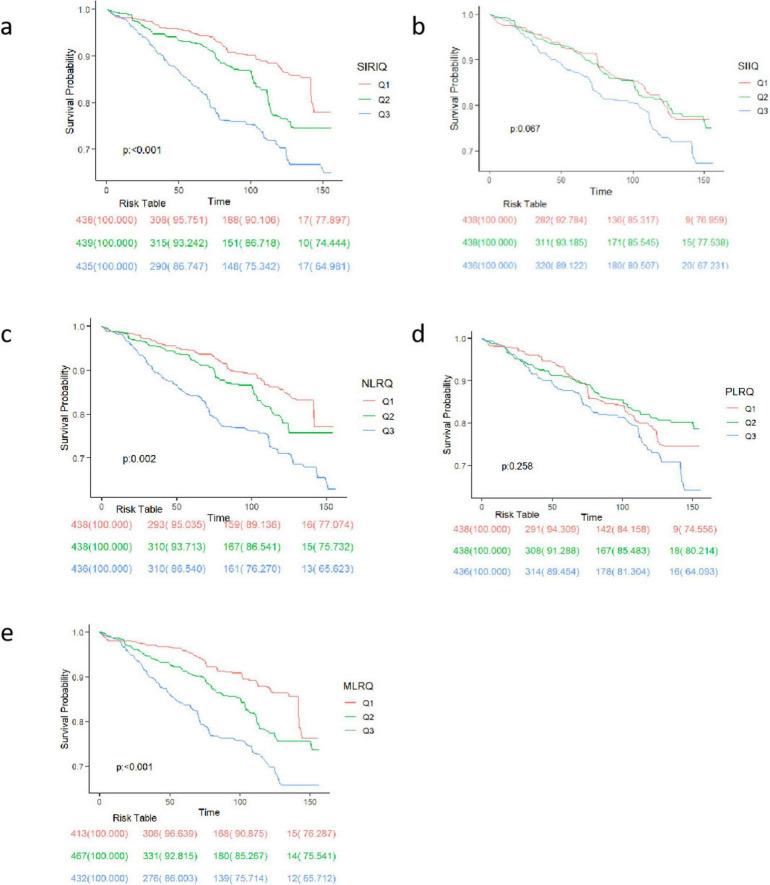
The research comprised a cohort of 1,314 individuals, among whom 246 with RA succumbed during a median follow-up duration of 78 months. After adjusting for key covariates, the mortality rate in patients with RA who had high SIRI, NLR, and MLR levels was considerably higher than in those with medium or low SIRI, NLR, and MLR levels. Compared with the lowest tertile, the highest tertiles of SIRI (HR 1.87, 95% CI: 1.12-3.13), NLR (HR 1.79, 95% CI: 1.10-2.92), and MLR (HR 1.88, 95% CI: 1.17-3.02) were associated with an increased risk of all-cause mortality. The Kaplan-Meier analysis indicated a significant decrease in the survival probability among individuals with elevated SIRI, NLR, and MLR levels. The RCS analysis revealed a linear association between SIRI, NLR, MLR, and RA-related all-cause mortality, whereas a non-linear relationship was identified between the SII, PLR, and mortality.
CONCLUSION
This investigation revealed that the SIRI, NLR, and MLR are novel, valuable, and convenient inflammatory indicators. In the United States adults with RA, higher SIRI, NLR, and MLR were independently associated with an increased long-term mortality risk. These findings not only assist in uncovering the potential utility of predicting RA outcomes but also provide rheumatologists valuable guidance for disease management.
目的
我们研究了全血细胞计数(CBC)得出的炎症指标与类风湿关节炎(RA)患者全因死亡率之间的关系。
方法
数据收集自2007年至2018年的美国国家健康与营养检查调查(NHANES)数据库,中位随访时间为78个月。CBC得出的炎症指标包括几种类型:全身炎症反应指数(SIRI)、全身免疫炎症指数(SII)、中性粒细胞与淋巴细胞比值(NLR)、血小板与淋巴细胞比值(PLR)以及单核细胞与淋巴细胞比值(MLR)。使用多重COX回归模型来估计关于RA患者全因死亡率的调整后风险比(HR)和95%置信区间(CI),重点关注CBC得出的炎症指标。此外,利用受限立方样条(RCS)曲线来研究非线性关联。
结果
该研究纳入了1314名个体的队列,其中246名RA患者在中位随访78个月期间死亡。在调整关键协变量后,SIRI、NLR和MLR水平高的RA患者的死亡率显著高于SIRI、NLR和MLR水平中等或低的患者。与最低三分位数相比,SIRI(HR 1.87,95% CI:1.12 - 3.13)、NLR(HR 1.79,95% CI:1.10 - 2.92)和MLR(HR 1.88,95% CI:1.17 - 3.02)的最高三分位数与全因死亡风险增加相关。Kaplan - Meier分析表明,SIRI、NLR和MLR水平升高的个体的生存概率显著降低。RCS分析显示SIRI、NLR、MLR与RA相关的全因死亡率之间存在线性关联,而SII、PLR与死亡率之间存在非线性关系。
结论
本研究表明,SIRI、NLR和MLR是新的、有价值且方便的炎症指标。在美国患有RA的成年人中,较高的SIRI、NLR和MLR与长期死亡风险增加独立相关。这些发现不仅有助于揭示预测RA预后的潜在效用,还为风湿病学家进行疾病管理提供了有价值的指导。


 Zotero 插件