
评估金属有机化合物ZIF-8和F300在膜过滤-吸附过程中从水中去除抗生素的潜力。
Evaluation of the Potential of Metal-Organic Compounds ZIF-8 and F300 in a Membrane Filtration-Adsorption Process for the Removal of Antibiotics from Water.
作者信息
Polak Daniel, Kamocki Szymon, Szwast Maciej
机构信息
Faculty of Chemical and Process Engineering, Warsaw University of Technology, Warynskiego 1, 00-645 Warsaw, Poland.
出版信息
Antibiotics (Basel). 2025 Jun 18;14(6):619. doi: 10.3390/antibiotics14060619.
BACKGROUND/OBJECTIVES: Antibiotic contamination in water sources is a growing global concern, contributing to environmental degradation and the proliferation of antimicrobial resistance. Traditional treatment methods, such as advanced oxidation or high-pressure membrane processes, are often energy-intensive and economically unsustainable for large-scale or decentralized applications. This study explores the potential of two cost-effective, commercially available metal-organic frameworks (MOFs), ZIF-8 and F300, to improve the performance of membrane-based filtration-adsorption systems for removing tetracycline and sulfadiazine from water.
METHODS
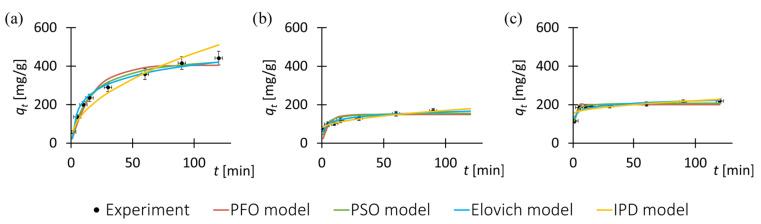
Batch adsorption experiments were performed to evaluate the uptake capacities, kinetics, and isotherms of both MOFs toward the selected antibiotics. The membranes were modified using a low-cost silane-assisted deposition of MOF particles and tested in a microfiltration system. Removal efficiencies and water permeability were assessed and kinetic and isotherm models were applied to understand the adsorption mechanisms.
RESULTS
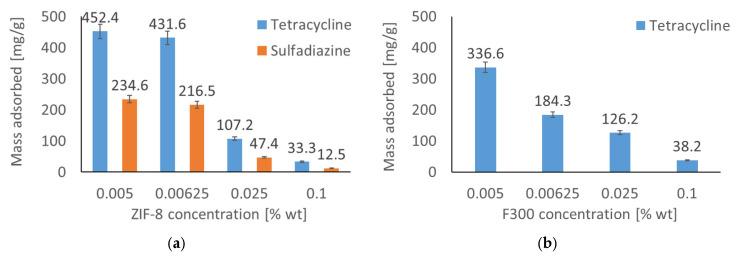
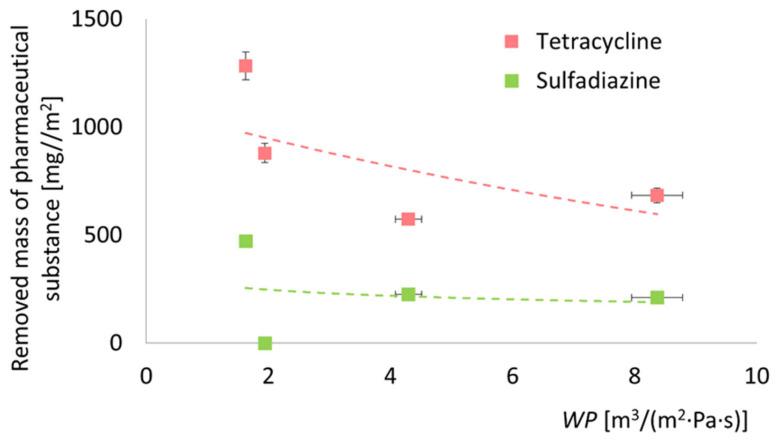
ZIF-8 showed superior adsorption performance, with maximum capacities of 442.2 mg/g for tetracycline and 219.3 mg/g for sulfadiazine. F300 was effective only for tetracycline. Membranes modified with ZIF-8 improved pharmaceutical removal by 187% (tetracycline) and 224% (sulfadiazine) compared to unmodified membranes. Although permeability decreased due to increased hydrophobicity, the materials and processes remained economically favorable.
CONCLUSIONS
This study demonstrates that MOF-modified ceramic membranes, particularly those incorporating ZIF-8, offer a low-cost, scalable, and energy-efficient alternative for pharmaceutical removal from water. The approach combines strong environmental impact with economic viability, making it attractive for broader implementation in water treatment systems.
背景/目的:水源中的抗生素污染日益引起全球关注,这导致了环境退化和抗菌药物耐药性的扩散。传统的处理方法,如高级氧化或高压膜工艺,对于大规模或分散式应用来说,往往能源密集且在经济上不可持续。本研究探讨了两种具有成本效益的市售金属有机框架材料(MOF),即ZIF-8和F300,用于改善基于膜的过滤吸附系统从水中去除四环素和磺胺嘧啶性能的潜力。
方法
进行了批量吸附实验,以评估两种MOF对所选抗生素的吸附容量、动力学和等温线。使用低成本的硅烷辅助沉积MOF颗粒对膜进行改性,并在微滤系统中进行测试。评估了去除效率和水渗透性,并应用动力学和等温线模型来理解吸附机制。
结果
ZIF-8表现出优异的吸附性能,对四环素的最大吸附容量为442.2 mg/g,对磺胺嘧啶的最大吸附容量为219.3 mg/g。F300仅对四环素有效。与未改性的膜相比,用ZIF-8改性的膜对药物的去除率提高了187%(四环素)和224%(磺胺嘧啶)。尽管由于疏水性增加导致渗透率下降,但材料和工艺在经济上仍然有利。
结论
本研究表明,MOF改性的陶瓷膜,特别是那些包含ZIF-8的膜,为从水中去除药物提供了一种低成本、可扩展且节能的替代方案。该方法将强大的环境影响与经济可行性相结合,使其在水处理系统中更广泛实施具有吸引力。




 Zotero 插件