
基于凝胶的自供电纳米发电机:材料、机制及新兴机遇
Gel-Based Self-Powered Nanogenerators: Materials, Mechanisms, and Emerging Opportunities.
作者信息
Singh Aditya Narayan, Nam Kyung-Wan
机构信息
Department of Energy and Materials Engineering, Dongguk University-Seoul, Seoul 04620, Republic of Korea.
Center for Next Generation Energy and Electronic Materials, Dongguk University-Seoul, Seoul 04620, Republic of Korea.
出版信息
Gels. 2025 Jun 12;11(6):451. doi: 10.3390/gels11060451.
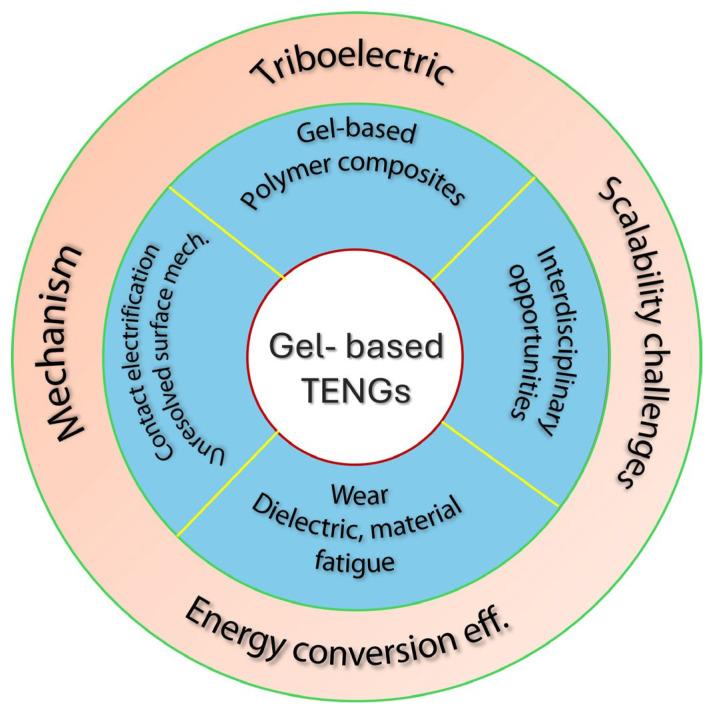
With the rapid rise in Internet of Things (IoT) and artificial intelligence (AI) technologies, there is an increasing need for portable, wearable, and self-powered flexible sensing devices. In such scenarios, self-powered nanogenerators have emerged as promising energy harvesters capable of converting ambient mechanical stimuli into electrical energy, enabling the development of autonomous flexible sensors and sustainable systems. This review highlights recent advances in nanogenerator technologies-particularly those based on piezoelectric and triboelectric effects-with a focus on soft, flexible, and gel-based polymer materials. Key mechanisms of energy conversion are discussed alongside strategies to enhance performance through material innovation, structural design, and device integration. Special attention is given to the role of gel-type composites, which offer unique advantages such as mechanical tunability, self-healing ability, and biocompatibility, making them highly suitable for next-generation wearable, biomedical, and environmental sensing applications. We also explore the evolving landscape of energy applications, from microscale sensors to large-area systems, and identify critical challenges and opportunities for future research. By synthesizing progress across materials, mechanisms, and application domains, this review aims to guide the rational design of high-performance, sustainable nanogenerators for the next era of energy technologies.
随着物联网(IoT)和人工智能(AI)技术的迅速崛起,对便携式、可穿戴和自供电的柔性传感设备的需求日益增长。在这种情况下,自供电纳米发电机已成为有前景的能量收集器,能够将周围的机械刺激转化为电能,推动了自主柔性传感器和可持续系统的发展。本综述重点介绍了纳米发电机技术的最新进展,特别是基于压电和摩擦电效应的技术,重点关注柔软、柔性和凝胶基聚合物材料。在讨论能量转换关键机制的同时,还探讨了通过材料创新、结构设计和器件集成来提高性能的策略。特别关注凝胶型复合材料的作用,它们具有机械可调性、自愈能力和生物相容性等独特优势,使其非常适合下一代可穿戴、生物医学和环境传感应用。我们还探讨了从微尺度传感器到大面积系统的能量应用不断变化的格局,并确定了未来研究的关键挑战和机遇。通过综合材料、机制和应用领域的进展,本综述旨在指导为下一代能源技术合理设计高性能、可持续的纳米发电机。





 Zotero 插件