
材料驱动的疗法:彻底改变骨肉瘤治疗的功能性纳米材料设计范例
Material-Driven Therapeutics: Functional Nanomaterial Design Paradigms Revolutionizing Osteosarcoma Treatment.
作者信息
Zhang Zewei, He Fang, Li Wenqu, Liu Beibei, Deng Cheng, Qin Xiaojuan
机构信息
Department of Ultrasound Medicine, Union Hospital, Tongji Medical College, Huazhong University of Science and Technology, Wuhan 430022, China.
Clinical Research Center for Medical Imaging in Hubei Province, Wuhan 430022, China.
出版信息
J Funct Biomater. 2025 Jun 5;16(6):213. doi: 10.3390/jfb16060213.
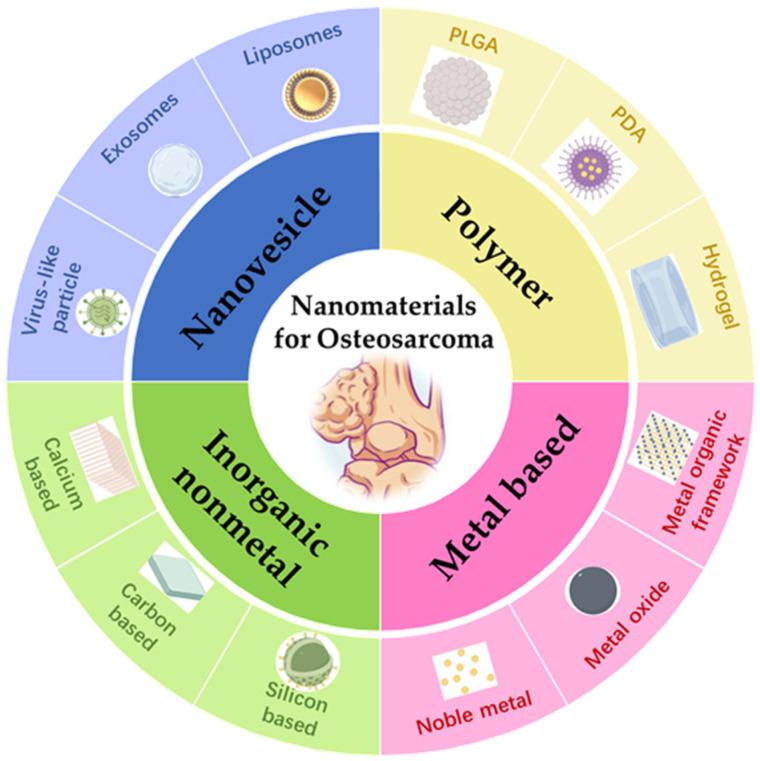
Osteosarcoma (OS), a prevalent primary malignant bone tumor in children and adolescents, has maintained consistent treatment protocols since the 1970s combining surgery, chemotherapy, and radiotherapy. While effective for localized tumors, these strategies show limited efficacy against metastatic or recurrent cases. Although emerging immunotherapies (PD-1 inhibitors, CAR-T-cell therapy) demonstrate therapeutic potential, their clinical impact remains constrained by the tumor's low immunogenicity and immunosuppressive microenvironment, resulting in suboptimal response rates. The disease's aggressive nature and propensity for pulmonary metastasis contribute to poor prognosis, with survival rates showing negligible improvement over five decades despite therapeutic advances, creating substantial clinical and socioeconomic challenges. Recent developments in nanomedicine offer promising solutions for OS treatment optimization. This review systematically examines nanomaterial applications in OS therapy through a materials science lens, analyzing mechanism-specific interventions and highlighting notable advancements from the past five years. We critically evaluate current strategies for enhancing therapeutic efficacy while reducing toxicity profiles, ultimately outlining translational pathways and key challenges in clinical adaptation. The analysis establishes a framework for developing next-generation nanotherapeutic platforms to address persistent limitations in OS management.
骨肉瘤(OS)是儿童和青少年中一种常见的原发性恶性骨肿瘤,自20世纪70年代以来,其治疗方案一直是手术、化疗和放疗相结合。虽然这些策略对局限性肿瘤有效,但对转移性或复发性病例的疗效有限。尽管新兴的免疫疗法(PD-1抑制剂、嵌合抗原受体T细胞疗法)显示出治疗潜力,但其临床效果仍受到肿瘤低免疫原性和免疫抑制微环境的限制,导致缓解率不理想。该疾病的侵袭性本质和肺转移倾向导致预后不良,尽管治疗取得了进展,但五十年间生存率几乎没有提高,这带来了重大的临床和社会经济挑战。纳米医学的最新进展为优化骨肉瘤治疗提供了有前景的解决方案。本综述通过材料科学的视角系统地研究了纳米材料在骨肉瘤治疗中的应用,分析了针对特定机制的干预措施,并突出了过去五年的显著进展。我们批判性地评估了当前提高治疗效果同时降低毒性的策略,最终概述了临床转化途径和临床应用中的关键挑战。该分析为开发下一代纳米治疗平台建立了一个框架,以解决骨肉瘤治疗中持续存在的局限性。


 Zotero 插件