
钛牙种植体的杀菌纳米形貌:体外和体内研究
Bactericidal nanotopography of titanium dental implants: in vitro and in vivo studies.
作者信息
Gil Javier, Sanz Mariano
机构信息
Bioinspired Oral Biomaterials and Interfaces, Department Ciencia e Ingeniería de Materiales, Escola d'Enginyeria Barcelona Est, Technical University of Catalonia, Barcelona, Spain.
ETEP (Etiology and Therapy of Periodontal and Peri-implant Diseases) Research Group, Faculty of Dentistry, Complutense University, Madrid, Spain.
出版信息
Clin Oral Investig. 2025 Jun 25;29(7):351. doi: 10.1007/s00784-025-06424-z.
OBJECTIVE
A new passivation method for titanium dental implants has been studied, where the nanotextured layer features spikes that provide a high bactericidal capacity without compromising the degree of osseointegration of the dental implants.
MATERIALS AND METHODS
This layer has been obtained through a sulfuric acid treatment with hydrogen peroxide. It has been characterized using electron microscopy, the roughness was determined by confocal microscopy and wettability and surface energy assessed through contact angle. The incorporation of hydrogen was assessed using a fusion spectrometer. Fatigue behavior was evaluated with a servo-hydraulic testing machine. The adhesion of human osteoblastic cells SaOs-2 at 3 and 7 days was measured, and the level of mineralization was analyzed by alkaline phosphatase levels. Bacterial colonization assays were conducted using four strains to assess their bactericidal capacity. Implants were inserted into rabbit tibiae. After 21 days, the animals were sacrificed, and bone index contact determined.
RESULTS
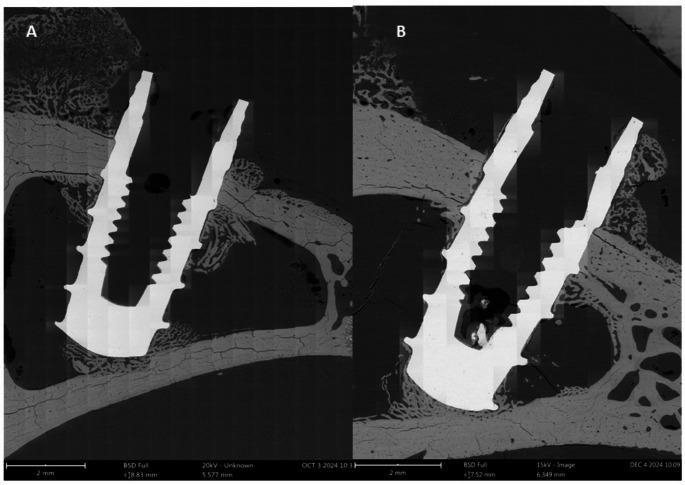
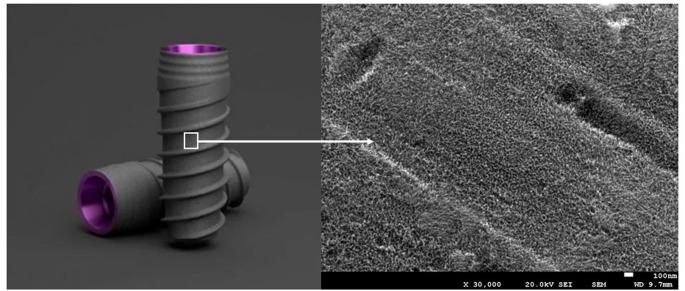
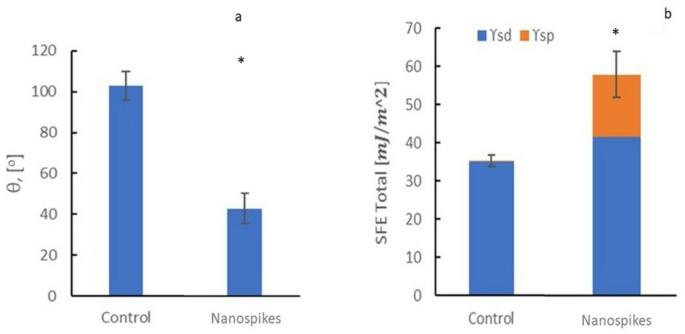
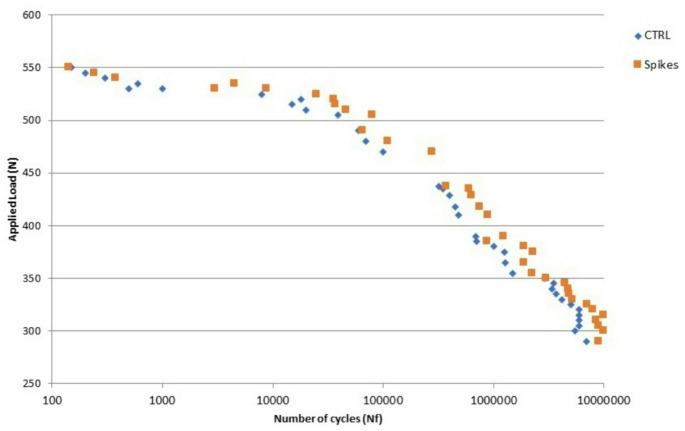
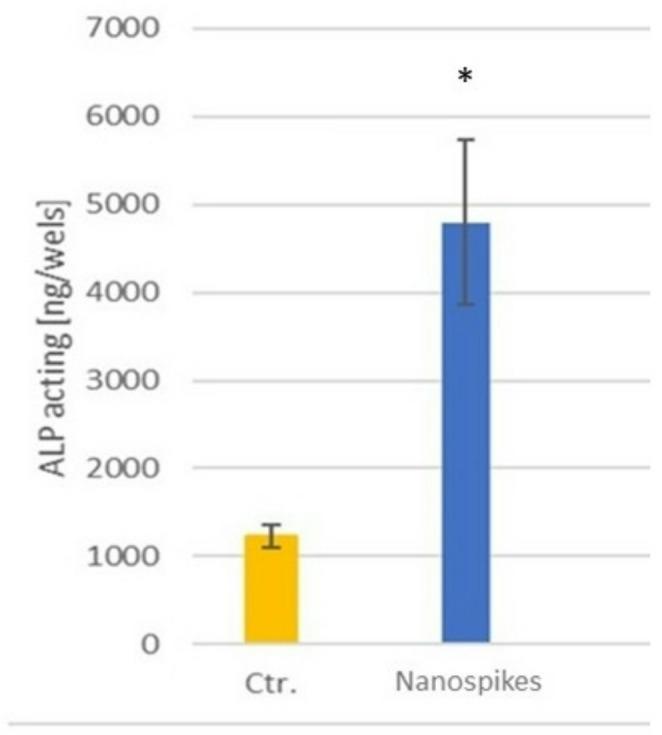
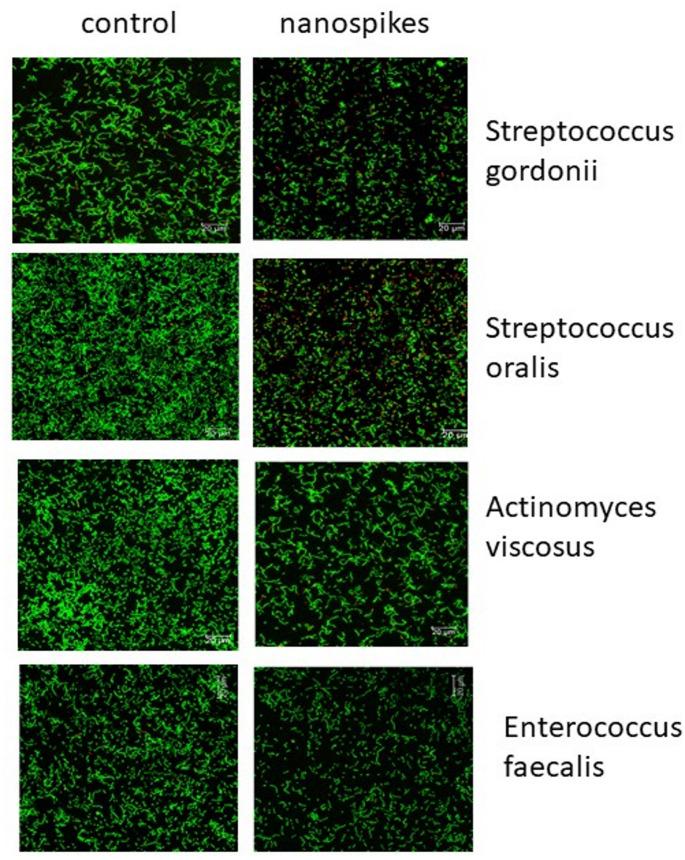
A uniform surface created by nanospikes was obtained, exhibiting the same roughness as the control implant, no hydrogen was incorporated inside the titanium. The fatigue behavior showed no variation compared to the control. An increased wettability and higher surface energy compared to the control implant were noted. Enhanced osteoblastic adhesion was observed for the nanospikes surface in comparison with control at 3 days, with a significant level of alkaline phosphatase at 14 days, indicating a good degree of mineralization. The bactericidal capacity of nanospike surface is evidenced showing reductions ranging from 70 to 90%. In vivo tests demonstrate higher bone contact index values for dental implants with nanospikes (56%) compared to the control (41%).
CONCLUSIONS
The surface formed by nanospikes maintains the mechanical properties of the control and improves the wettability of the surface which improves the behavior of the osteoblasts generating a better osseointegration. At the same time, it has a high bactericidal capacity that prevents microbiological colonization.
CLINICAL RELEVANCE
Peri-implantitis has become one of the major problems for the success of implant dentistry and this new surface may be a solution for the prevention of the disease.
目的
研究了一种用于牙科钛植入物的新型钝化方法,该方法形成的纳米纹理层具有尖刺结构,在不影响牙科植入物骨整合程度的情况下具有较高的杀菌能力。
材料与方法
该层通过用硫酸和过氧化氢处理获得。使用电子显微镜对其进行了表征,通过共聚焦显微镜测定粗糙度,并通过接触角评估润湿性和表面能。使用熔融光谱仪评估氢的掺入情况。用伺服液压试验机评估疲劳行为。测量人成骨细胞SaOs-2在3天和7天时的黏附情况,并通过碱性磷酸酶水平分析矿化程度。使用四种菌株进行细菌定植试验以评估其杀菌能力。将植入物插入兔胫骨。21天后,处死动物并测定骨指数接触情况。
结果
获得了由纳米尖刺形成的均匀表面,其粗糙度与对照植入物相同,钛内部未掺入氢。与对照相比,疲劳行为没有变化。与对照植入物相比,润湿性增加且表面能更高。与对照相比,纳米尖刺表面在3天时观察到成骨细胞黏附增强,在14天时碱性磷酸酶水平显著升高,表明矿化程度良好。纳米尖刺表面的杀菌能力得到证明,杀菌率在70%至90%之间。体内试验表明,具有纳米尖刺的牙科植入物的骨接触指数值(56%)高于对照(41%)。
结论
纳米尖刺形成的表面保持了对照的机械性能,改善了表面润湿性,从而改善了成骨细胞的行为,产生了更好的骨整合。同时,它具有较高的杀菌能力,可防止微生物定植。
临床意义
种植体周围炎已成为种植牙科成功的主要问题之一,这种新表面可能是预防该疾病的一种解决方案。



 Zotero 插件