
美国心脏协会预防方程在不同种族和族裔亚组中的表现。
Performance of the American Heart Association's PREVENT Equations Among Disaggregated Racial and Ethnic Subgroups.
作者信息
Yan Xiaowei, Bacong Adrian M, Huang Qiwen, Husby Hannah, Dudum Ramzi, Jose Powell, Palaniappan Latha, Rodriguez Fatima
机构信息
Center for Health Systems Research, Sutter Health, Walnut Creek, California.
Palo Alto Medical Foundation Institute, Sutter Health, Palo Alto, California.
出版信息
JAMA Cardiol. 2025 Jun 25. doi: 10.1001/jamacardio.2025.1865.
IMPORTANCE
In the original validation, the Predicting Risk of Cardiovascular Disease (CVD) Events (PREVENT) equations demonstrated good discrimination and calibration among racial and ethnic groups, but the model performance among Asian and Hispanic disaggregated subgroups has not been previously described.
OBJECTIVE
To assess the performance of the PREVENT equations by race and ethnicity, including disaggregated Asian and Hispanic subgroups.
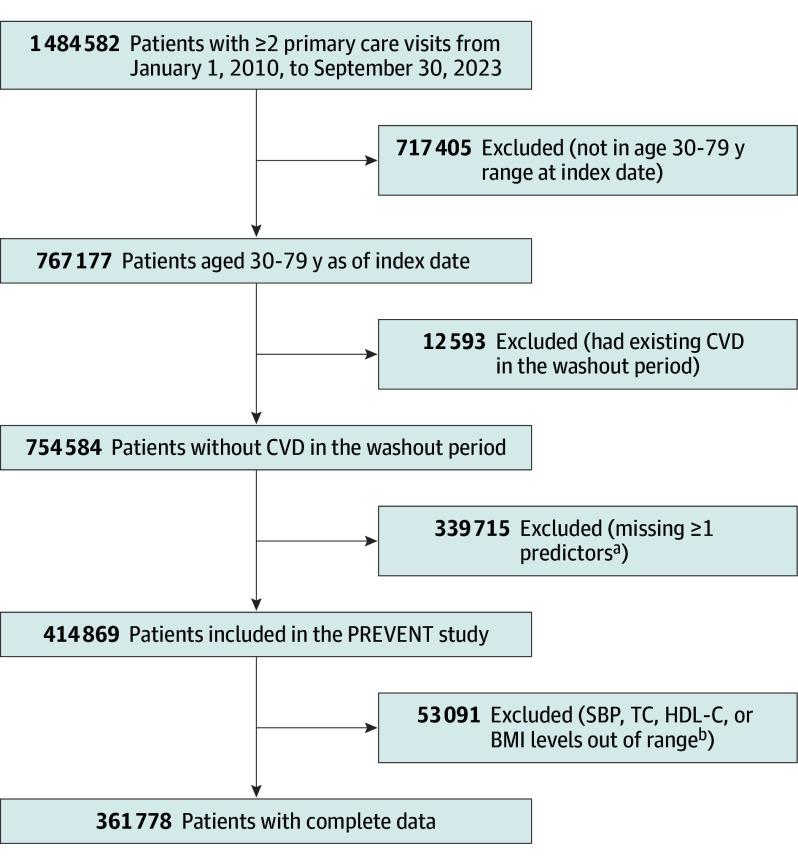
DESIGN, SETTING, AND PARTICIPANTS: This was an electronic health record-based retrospective cohort study of primary care patients aged 30 to 79 years across Sutter Health, a large integrated health system in Northern California, from January 2010 to September 2023. Patients who had at least 2 primary care visits during the study period were eligible for the study (1 484 582). Those outside of the study age range, with prior CVD events in the washout period, missing key predictors, or having at least 1 predictor out of the allowed normal range for the American Heart Association's PREVENT equations, were excluded, leaving a study population of 361 778.
EXPOSURE
Eligible patients had complete baseline data required for the PREVENT equations, including non-high-density lipoprotein cholesterol, high-density lipoprotein cholesterol, systolic blood pressure, body mass index, estimated glomerular filtration rate (or creatinine), diabetes, and current smoking status, and were free from CVD at baseline.
MAIN OUTCOMES AND MEASURES
The primary outcomes were CVD events, identified using International Classification of Diseases, Ninth and Tenth Revisions, codes described in the PREVENT derivation.
RESULTS
Among 361 778 patients who met the inclusion criteria, mean (SD) age was 54.6 (12.2) years; 191 151 (53%) were female; and 81 424 (22%) were non-Hispanic Asian and 40 897 (11%) were Hispanic. Over a mean (SD) follow-up of 8.1 (3.2) years, there were 22 648 (6.3%) CVD events. The C statistic for total CVD was 0.83 (95% CI, 0.82-0.84) for the Asian population and 0.80 (95% CI, 0.79-0.81) for the Hispanic population. The calibration slopes were 0.84 (95% CI, 0.78-0.90) and 1.02 (95% CI, 0.94-1.10) for Asian and Hispanic patients, respectively. Within the Asian population, C statistics for total CVD among disaggregated Asian subgroups ranged from 0.79 (95% CI, 0.77-0.81) in Filipino patients to 0.85 (95% CI, 0.83-0.87) in Asian Indian patients. The calibration slope for total CVD was less than 1 for all Asian subgroups except Asian Indian. Among disaggregated Hispanic subgroups, the C statistics were similar and between 0.80 and 0.82 for total CVD, and the calibration slope for total CVD included 1 for all subgroups. There were small differences in the performance of atherosclerotic CVD and heart failure PREVENT equations among racial and ethnic groups and subgroups.
CONCLUSIONS AND RELEVANCE
The PREVENT equations appropriately predicted risk in contemporary diverse Asian and Hispanic subgroups with modest variation in performance across disaggregated subgroups.
重要性
在最初的验证中,预测心血管疾病(CVD)事件(PREVENT)方程在不同种族和族裔群体中显示出良好的区分度和校准效果,但此前尚未描述过该模型在亚洲和西班牙裔细分亚组中的表现。
目的
按种族和族裔评估PREVENT方程的性能,包括细分的亚洲和西班牙裔亚组。
设计、背景和参与者:这是一项基于电子健康记录的回顾性队列研究,研究对象为2010年1月至2023年9月期间加利福尼亚州北部大型综合医疗系统萨特健康中心30至79岁的初级保健患者。在研究期间至少有2次初级保健就诊的患者符合研究条件(1484582人)。排除研究年龄范围之外、在洗脱期有既往CVD事件、缺少关键预测指标或至少有1个预测指标超出美国心脏协会PREVENT方程允许的正常范围的患者,最终研究人群为361778人。
暴露因素
符合条件的患者拥有PREVENT方程所需的完整基线数据,包括非高密度脂蛋白胆固醇、高密度脂蛋白胆固醇、收缩压、体重指数、估计肾小球滤过率(或肌酐)、糖尿病和当前吸烟状况,且基线时无CVD。
主要结局和测量指标
主要结局为CVD事件,通过国际疾病分类第九版和第十版中PREVENT推导中描述的代码进行识别。
结果
在361778名符合纳入标准的患者中,平均(标准差)年龄为54.6(12.2)岁;191151名(53%)为女性;81424名(22%)为非西班牙裔亚洲人,40897名(11%)为西班牙裔。在平均(标准差)8.1(3.2)年的随访中,有22648名(6.3%)发生CVD事件。亚洲人群中总CVD的C统计量为0.83(95%置信区间,0.82 - 0.84),西班牙裔人群为0.80(95%置信区间,0.79 - 0.81)。亚洲和西班牙裔患者的校准斜率分别为0.84(95%置信区间,0.78 - 0.90)和1.02(95%置信区间,0.94 - 1.10)。在亚洲人群中,细分亚洲亚组中总CVD的C统计量范围从菲律宾患者的0.79(95%置信区间,0.77 - 0.81)到印度裔亚洲患者的0.85(95%置信区间,0.83 - 0.87)。除印度裔亚洲人外,所有亚洲亚组中总CVD的校准斜率均小于1。在细分的西班牙裔亚组中,总CVD的C统计量相似,在0.80至0.82之间,所有亚组中总CVD的校准斜率均包含1。不同种族和族裔群体及亚组中动脉粥样硬化性CVD和心力衰竭PREVENT方程的性能存在细微差异。
结论和相关性
PREVENT方程在当代不同的亚洲和西班牙裔亚组中能够合理预测风险,各细分亚组的性能略有差异。

 Zotero 插件