
靶向S-亚硝基化以克服NRAS驱动的黑色素瘤中的治疗耐药性。
Targeting S-Nitrosylation to Overcome Therapeutic Resistance in NRAS-Driven Melanoma.
作者信息
Srivastava Jyoti, Premi Sanjay
机构信息
Department of Tumor Microenvironment and Metastasis, Moffitt Cancer Center, 12902 USF Magnolia Drive, Tampa, FL 33612, USA.
出版信息
Cancers (Basel). 2025 Jun 17;17(12):2020. doi: 10.3390/cancers17122020.
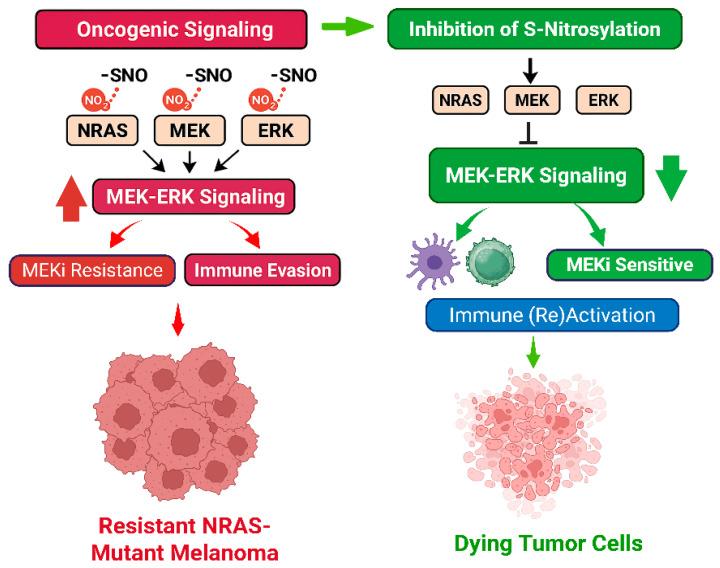
NRAS-mutant melanoma represents a clinically challenging subset of melanoma with limited effective therapies and intrinsic resistance to targeted MEK inhibition. Recent findings highlight protein S-nitrosylation, a redox-dependent post-translational modification as a critical modulator of MEK-ERK signaling and immune evasion in this context. In this commentary, we discuss how S-nitrosylation of MAPK components, including MEK and ERK, sustains oncogenic signaling and attenuates immunogenic cell death. Targeting this modification with nitric oxide synthase (NOS) inhibitors such as L-NAME, L-NMMA and 1400w restore sensitivity of MEK inhibitor, promotes dendritic cell activation, and enhances CD8+ T cell infiltration in preclinical models such as immunogenic mouse models and individual patient derived, primary melanoma cells. We also explore the emerging role of S-nitrosylation in regulating macrophage-mediated immune surveillance and propose translational strategies for combining redox modulation with targeted and immune therapies. These insights offer a compelling framework for overcoming therapeutic resistance and reprogramming the tumor immune microenvironment to activate the cytotoxic T-cells and enhance the responses to immunotherapy in NRAS-driven cancers.
NRAS 突变型黑色素瘤是黑色素瘤中具有临床挑战性的一个亚组,有效治疗方法有限,且对靶向 MEK 抑制具有内在抗性。最近的研究结果强调了蛋白质 S-亚硝基化,一种氧化还原依赖性的翻译后修饰,在此背景下是 MEK-ERK 信号传导和免疫逃逸的关键调节因子。在这篇评论中,我们讨论了包括 MEK 和 ERK 在内的 MAPK 组件的 S-亚硝基化如何维持致癌信号传导并减弱免疫原性细胞死亡。在免疫原性小鼠模型和个体患者来源的原发性黑色素瘤细胞等临床前模型中,用一氧化氮合酶(NOS)抑制剂如 L-NAME、L-NMMA 和 1400w 靶向这种修饰可恢复 MEK 抑制剂的敏感性,促进树突状细胞活化,并增强 CD8+ T 细胞浸润。我们还探讨了 S-亚硝基化在调节巨噬细胞介导的免疫监视中的新作用,并提出了将氧化还原调节与靶向治疗和免疫治疗相结合的转化策略。这些见解为克服治疗抗性和重新编程肿瘤免疫微环境以激活细胞毒性 T 细胞并增强对 NRAS 驱动癌症的免疫治疗反应提供了一个有说服力的框架。
 Zotero 插件