
辣椒素补充剂对通过调节新生犊牛免疫球蛋白吸收增强被动免疫转移的影响。
Influence of Capsaicin Supplementation on the Enhancement of Passive Immunity Transfer Through Modulation of Immunoglobulin Absorption in Neonatal Calves.
作者信息
Rodas Ermes R, Ayala Luis E, Dután Jorge B, Gañan Gissela E, Pesántez José L, González-Martín Juan V
机构信息
Faculty of Agriculture Sciences, University of Cuenca, Cuenca 010107, Ecuador.
Department of Animal Medicine and Surgery, Faculty of Veterinary Medicine, Complutense University of Madrid (UCM), Avda Pta. de Hierro s/n, 28040 Madrid, Spain.
出版信息
Animals (Basel). 2025 Jun 6;15(12):1676. doi: 10.3390/ani15121676.
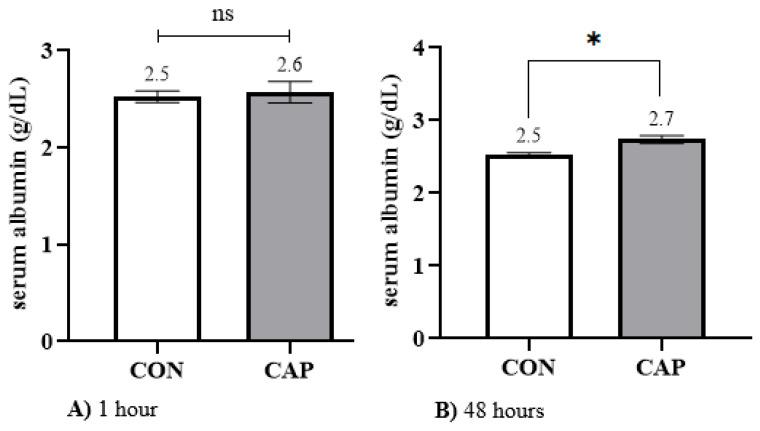
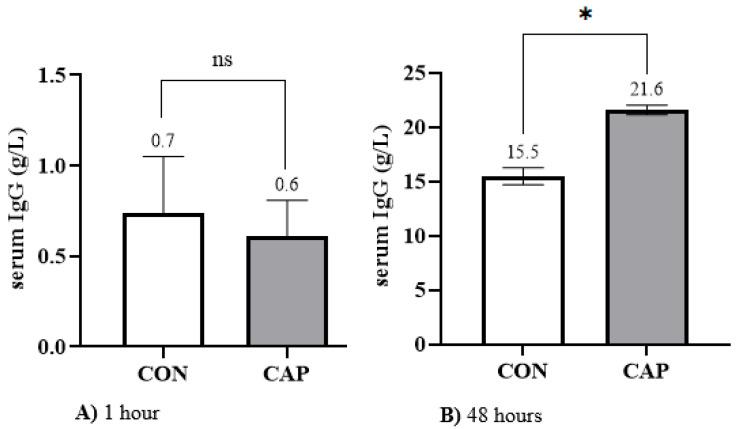
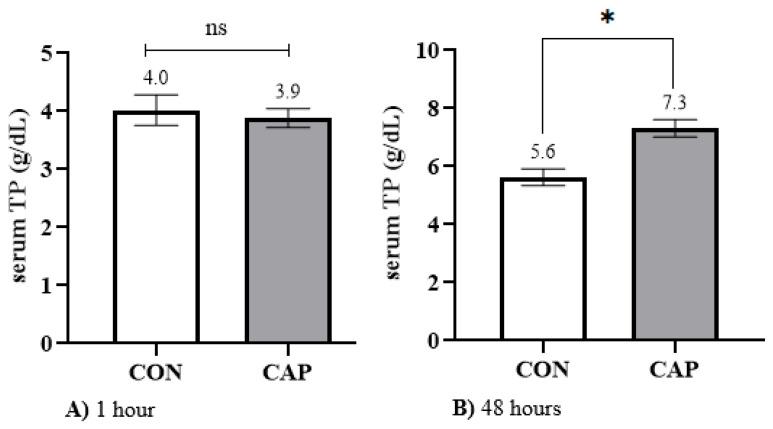
In cattle, the transfer of passive immunity from mother to calf across the placenta is limited. Therefore, providing quality colostrum or supplementing with additives that enhance this attribute is crucial to optimise the transfer of passive immunity (TPI). The objective of the present study was to investigate the effect of capsaicin on the absorption of immunoglobulins, metabolites, and enzymes to optimise TPI in neonatal calves, and to assess its impact on selected physiological parameters. Two experimental groups were established: a control group (CON; = 8), which received colostrum in three feedings (at 1, 12, and 20 h after calving), and a capsaicin group (CAP; = 8) which received 40 mg of capsaicin per kilogram of body weight added to the colostrum. Birth weight (CON = 36.7 ± 1.10 kg; CAP = 36.2 ± 2.64 kg) and weight at 48 h of age (CON = 38.5 ± 1.11 kg; CAP = 38.0 ± 2.82 kg) were similar between the two experimental groups. At 48 h post-colostrum feeding, the CAP group exhibited significantly higher serum concentrations of IgG, total protein, and albumin-up to 23.4 times greater than those observed in the CON group ( < 0.001). Moreover, levels of glucose, cholesterol, and triglycerides were significantly elevated in the CAP group compared to the CON group ( < 0.05). Similarly, higher concentrations of alkaline phosphatase, aspartate aminotransferase, and alanine aminotransferase were observed in the CAP group. These findings suggest that the inclusion of 40 mg of capsaicin per kilogram of body weight in colostrum is safe and contributes positively to improving TPI in crossbred Holstein calves raised at altitudes higher than 2500 m above sea level.
在牛中,母体通过胎盘向犊牛传递被动免疫的能力有限。因此,提供优质初乳或添加能增强这一特性的添加剂对于优化被动免疫传递(TPI)至关重要。本研究的目的是调查辣椒素对新生犊牛免疫球蛋白、代谢物和酶吸收的影响,以优化TPI,并评估其对选定生理参数的影响。设立了两个实验组:对照组(CON;n = 8),在犊牛出生后1小时、12小时和20小时分三次喂食初乳;辣椒素组(CAP;n = 8),在初乳中添加每千克体重40毫克的辣椒素。两个实验组的出生体重(CON = 36.7 ± 1.10千克;CAP = 36.2 ± 2.64千克)和48小时龄体重(CON = 38.5 ± 1.11千克;CAP = 38.0 ± 2.82千克)相似。在初乳喂食后48小时,CAP组的血清免疫球蛋白G、总蛋白和白蛋白浓度显著高于对照组,高达对照组的23.4倍(P < 0.001)。此外,与对照组相比,CAP组的葡萄糖、胆固醇和甘油三酯水平显著升高(P < 0.05)。同样,CAP组的碱性磷酸酶、天冬氨酸氨基转移酶和丙氨酸氨基转移酶浓度也更高。这些结果表明,在海拔高于2500米的杂交荷斯坦犊牛的初乳中添加每千克体重40毫克的辣椒素是安全的,并且对改善TPI有积极作用。

 Zotero 插件