
重症监护中的区块链
Blockchain in Critical Care.
作者信息
Gondode Prakash, Dass Christopher, Kumar Shailendra, Malviya Amit, Ashwin M, Khanna Puneet
机构信息
Department of Anaesthesiology, Pain Medicine and Critical Care, All India Institute of Medical Sciences, New Delhi, India.
出版信息
Indian J Crit Care Med. 2025 Jun;29(6):525-530. doi: 10.5005/jp-journals-10071-24991. Epub 2025 Jun 5.
BACKGROUND AND AIMS
Intensive care units (ICUs) face growing challenges with cybersecurity, data interoperability, medication safety, and resource management in an increasingly digital healthcare environment. This review explores how blockchain technology can address these issues and improve critical care delivery.
DATA SOURCES
Relevant literature was sourced from peer-reviewed journals, healthcare cybersecurity reports, and studies on blockchain applications in medical settings.
STUDY SELECTION
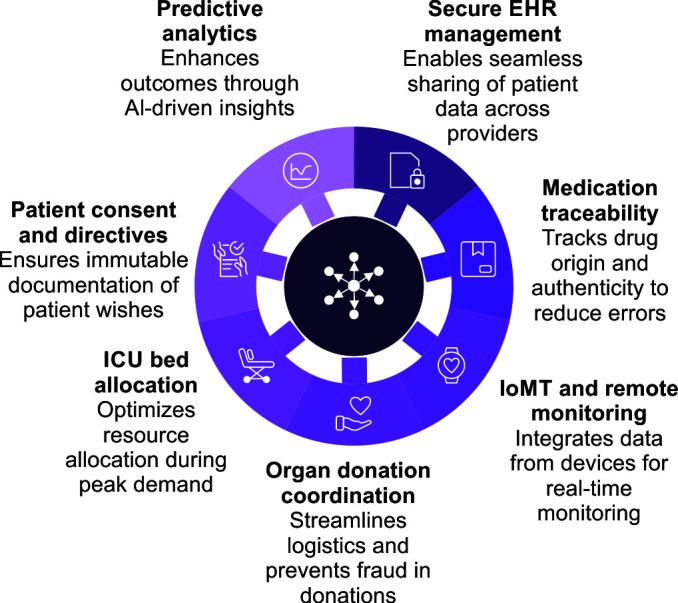
Included works focused on blockchain's role in enhancing data security, drug traceability, consent management, and integration with AI tools in ICU contexts.
DATA SYNTHESIS
Blockchain offers tamper-proof health records, decentralized data sharing, and automated smart contracts, potentially transforming ICU operations. Benefits include improved patient safety, resource efficiency, and decision support. However, challenges such as scalability, regulatory concerns, and implementation costs remain.
CONCLUSION
Blockchain holds strong potential to enhance ICU workflows and patient outcomes. Realizing its impact will require collaborative efforts and further research to overcome current limitations.
HOW TO CITE THIS ARTICLE
Gondode P, Dass C, Kumar S, Malviya A, Ashwin M, Khanna P. Blockchain in Critical Care. Indian J Crit Care Med 2025;29(6):525-530.
背景与目的
在日益数字化的医疗环境中,重症监护病房(ICU)在网络安全、数据互操作性、用药安全和资源管理方面面临着越来越大的挑战。本综述探讨区块链技术如何解决这些问题并改善重症护理服务。
数据来源
相关文献来自同行评审期刊、医疗网络安全报告以及关于区块链在医疗环境中应用的研究。
研究选择
纳入的作品聚焦于区块链在加强重症监护病房环境中的数据安全、药物可追溯性、同意管理以及与人工智能工具集成方面的作用。
数据综合
区块链提供防篡改的健康记录、去中心化的数据共享和自动化智能合约,有可能改变重症监护病房的运作。其好处包括提高患者安全性、资源效率和决策支持。然而,诸如可扩展性、监管问题和实施成本等挑战依然存在。
结论
区块链在增强重症监护病房工作流程和改善患者结局方面具有巨大潜力。要实现其影响,需要各方共同努力并进行进一步研究以克服当前的局限性。
如何引用本文
贡多德P、达斯C、库马尔S、马尔维亚A、阿什温M、坎纳P。重症监护中的区块链。《印度重症监护医学杂志》2025年;29(6):525 - 530。

 Zotero 插件