
非洲植原体引起的病害现状与分布
Status and Distribution of Diseases Caused by Phytoplasmas in Africa.
作者信息
Kazeem Shakiru Adewale, Zwolińska Agnieszka, Mulema Joseph, Ogunfunmilayo Akindele Oluwole, Salihu Shina, Nwogwugwu Joy Oluchi, Ajene Inusa Jacob, Ogunsola Justina Folasayo, Adediji Adedapo Olutola, Oduwaye Olubusola Fehintola, Kra Kouamé Daniel, Jibrin Mustafa Ojonuba, Wei Wei
机构信息
Post-Entry Quarantine, Diagnostic and Surveillance Station, Nigeria Agricultural Quarantine Service, Ibadan 200273, Oyo State, Nigeria.
Department of Plant Physiology, Faculty of Biology, Adam Mickiewicz University, 61-712 Poznan, Poland.
出版信息
Microorganisms. 2025 May 27;13(6):1229. doi: 10.3390/microorganisms13061229.
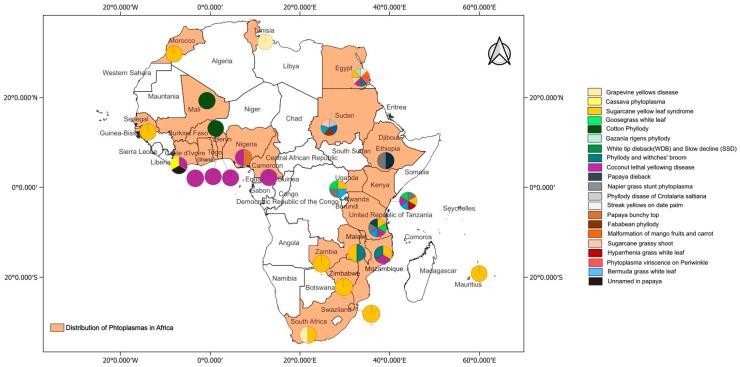
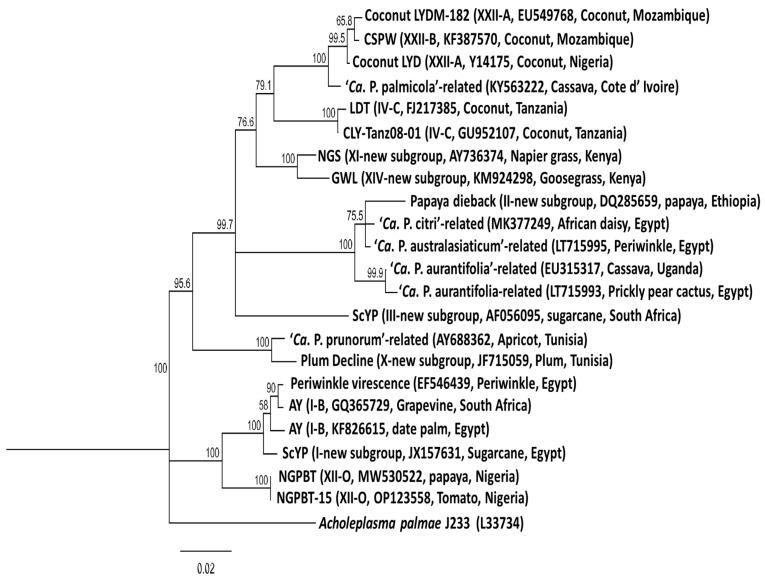
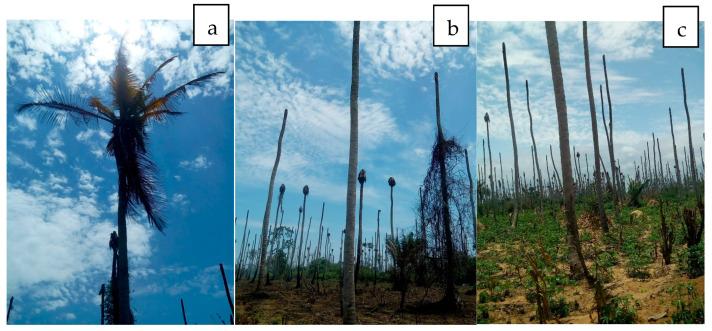
Phytoplasma (" Phytoplasma" species) diseases have been reported globally to severely limit the productivity of a wide range of economically important crops and wild plants causing different yellows-type diseases. With new molecular detection techniques, several unknown and known diseases with uncertain etiologies or attributed to other pathogens have been identified as being caused by Phytoplasmas. In Africa, Phytoplasmas have been reported in association with diseases in a broad range of host plant species. However, the few reports of Phytoplasma occurrence in Africa have not been collated together to determine the status in different countries of the continent. Thus, this paper discusses the geographical distribution, detection techniques, insect vectors, alternative hosts and socio-economic impacts of Phytoplasma diseases in Africa. This is to create research perspectives on the disease's etiology in Africa for further studies towards identifying and limiting their negative effects on the continent's agricultural economy. In Africa, Phytoplasmas recorded in different countries affecting different crops belong to eight groups (16SrI, 16SrII, 16SrIII, 16SrIV, 16SrVI, 16SrXI, 16SrXIV and 16SrXXII) out of the 37 groups and over 150 subgroups reported worldwide on the basis of their 16S rRNA RFLP profile. Lethal yellow disease was the most destructive Phytoplasma reported in Africa and has a high socio-economic impact.
植原体(“植原体”物种)病害在全球范围内均有报道,严重限制了多种具有重要经济价值的作物以及引发不同黄化类病害的野生植物的生产力。借助新的分子检测技术,一些病因不明或曾被归因于其他病原体的已知和未知病害已被确定为由植原体引起。在非洲,已有报道称植原体与多种寄主植物物种的病害有关。然而,非洲有关植原体发生情况的少数报道尚未汇总在一起,以确定该大陆不同国家的状况。因此,本文讨论了非洲植原体病害的地理分布、检测技术、昆虫传播媒介、替代寄主以及社会经济影响。这是为了开创关于非洲该病害病因的研究视角,以便进一步开展研究,识别并限制其对非洲农业经济的负面影响。在非洲,不同国家记录的影响不同作物的植原体,根据其16S rRNA RFLP图谱,属于全球报道的37个组和150多个亚组中的8个组(16SrI、16SrII、16SrIII、16SrIV、16SrVI、16SrXI、16SrXIV和16SrXXII)。致死性黄化病是非洲报道的最具破坏性的植原体病害,具有很高的社会经济影响。
 Zotero 插件