
静脉注射sRNA纳米颗粒用于治疗小鼠骨质疏松症
Intravenous Administration of sRNA Nanoparticles for Treatment of Osteoporosis in Mice.
作者信息
Mu Xuemeng, Du Xinyi, Han Huitian, Liu Fei, Zheng Zhifa, Hao Jing, Liu Lijin, Liu Su, Wei Ze, Huang Changfa, Liang Annan, Zou Wei, Zhao Lina, Wu Zhihong, Zhang Jia
机构信息
Department of Orthopedic Surgery, Peking Union Medical College Hospital, Peking Union Medical College and Chinese Academy of Medical Sciences, Beijing 100730, China.
Department of Laboratory Medicine, Beijing Chaoyang Hospital, Capital Medical University, Beijing 100020, China.
出版信息
Pharmaceutics. 2025 Jun 17;17(6):789. doi: 10.3390/pharmaceutics17060789.
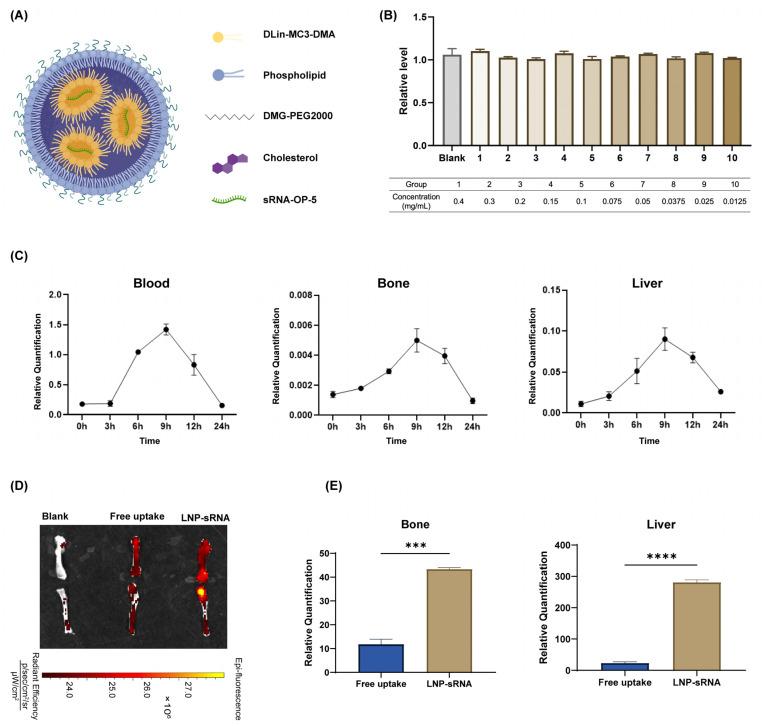
: With the intensification of population aging, osteoporosis has become one of the significant public health issues affecting human health. Currently available medications for treating osteoporosis are associated with various adverse effects and resistance issues. Oligonucleotide drugs show great potential. Effective delivery systems are essential to enhance the stability, bioavailability, and targeting of sRNA drugs. Lipid nanoparticles (LNPs) show promise as alternative osteoporosis therapeutics. This study explores the potential of LNPs as an effective delivery system to treat osteoporosis. : LNPs were prepared using microfluidic techniques with varying lipid compositions, and characterized in terms of size, zeta potential, and entrapment efficiency (EE%). Dynamic light scattering (DLS) was employed to determine the size of the LNPs. The zeta potential was measured using electrophoretic light scattering. The pharmacodynamic effects and safety were then evaluated in a mouse model through intravenous administration. : Several lipid nanoparticle (LNP) formulations with different nitrogen/phosphorus ratios and different DMG-PEG2000 ratios were examined, and a lead candidate that supports delivery of sRNA in animal models of osteoporosis was identified. In OVX mice, LNP-sRNA significantly improved bone mineral density (BMD), trabecular microstructure, and biomechanical strength. Safety assessments revealed no systemic toxicity. It is shown that the optimized LNPs can serve as a promising delivery system to mediate sRNA delivery to bone tissue. : After comparison of in vitro and in vivo properties, the optimized LNPs demonstrated good comprehensive performance as a delivery system for osteoporosis treatment. These results highlight the potential of the optimized LNPs as an ideal delivery system for osteoporosis, offering improved therapeutic efficacy and reduced systemic side effects.
随着人口老龄化的加剧,骨质疏松症已成为影响人类健康的重大公共卫生问题之一。目前用于治疗骨质疏松症的药物存在各种不良反应和耐药性问题。寡核苷酸药物显示出巨大潜力。有效的递送系统对于提高sRNA药物的稳定性、生物利用度和靶向性至关重要。脂质纳米颗粒(LNPs)有望成为治疗骨质疏松症的替代疗法。本研究探讨了LNPs作为治疗骨质疏松症的有效递送系统的潜力。:使用微流控技术制备了具有不同脂质组成的LNPs,并对其大小、zeta电位和包封率(EE%)进行了表征。采用动态光散射(DLS)测定LNPs的大小。使用电泳光散射测量zeta电位。然后通过静脉给药在小鼠模型中评估其药效学作用和安全性。:研究了几种具有不同氮/磷比和不同DMG-PEG2000比的脂质纳米颗粒(LNP)制剂,并确定了一种在骨质疏松症动物模型中支持sRNA递送的先导候选物。在去卵巢(OVX)小鼠中,LNP-sRNA显著改善了骨矿物质密度(BMD)、小梁微结构和生物力学强度。安全性评估显示无全身毒性。结果表明,优化后的LNPs可作为一种有前景的递送系统,介导sRNA递送至骨组织。:在比较体外和体内特性后,优化后的LNPs作为骨质疏松症治疗的递送系统表现出良好的综合性能。这些结果突出了优化后的LNPs作为骨质疏松症理想递送系统的潜力,具有提高治疗效果和减少全身副作用的优点。




 Zotero 插件