
人类SFPQ中IDR相互作用的结构动力学及其对液-液相分离的影响
Structural dynamics of IDR interactions in human SFPQ and implications for liquid-liquid phase separation.
作者信息
Koning Heidar J, Lai Valerie, Sethi Ashish, Chakraborty Shatabdi, Ang Ching Seng, Fox Archa H, Duff Anthony P, Whitten Andrew E, Marshall Andrew C, Bond Charles S
机构信息
School of Molecular Sciences, The University of Western Australia, Crawley, WA 6009, Australia.
Australian Nuclear Science and Technology Organisation, The Australian Synchrotron, 800 Blackburn Road, Clayton, VIC 3168, Australia.
出版信息
Acta Crystallogr D Struct Biol. 2025 Jul 1;81(Pt 7):357-379. doi: 10.1107/S2059798325005303. Epub 2025 Jun 27.
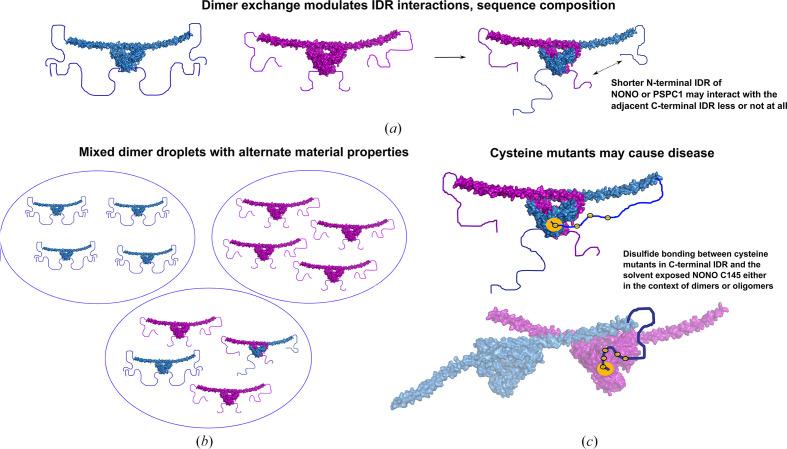
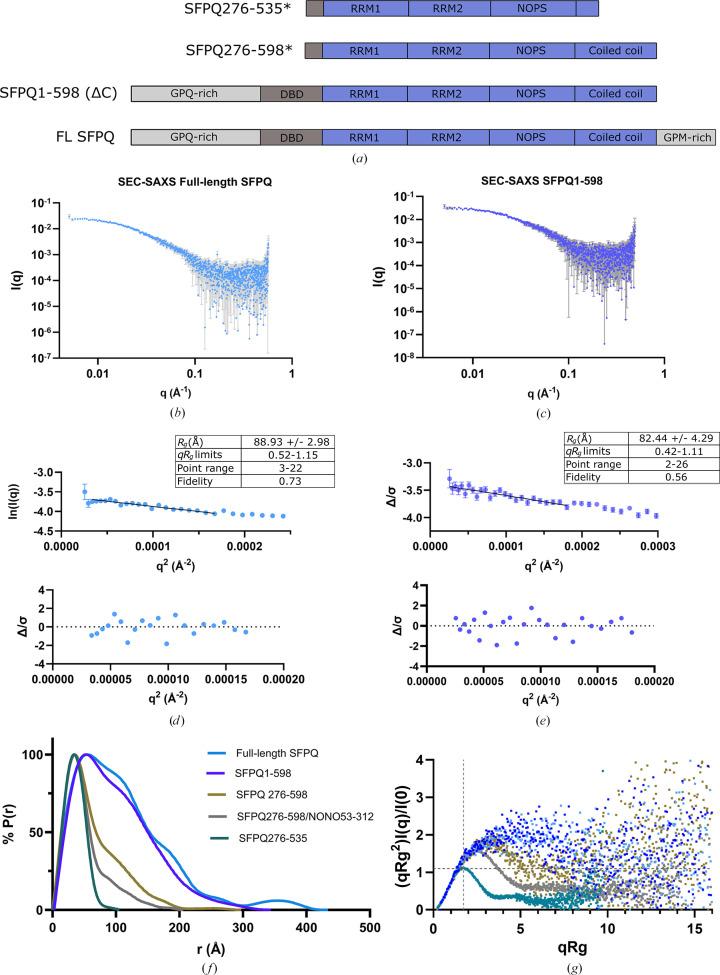
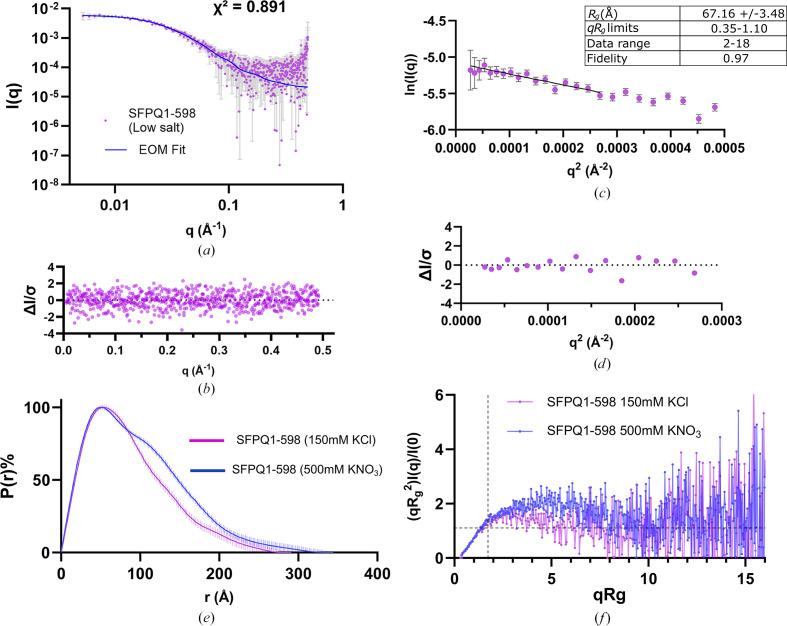
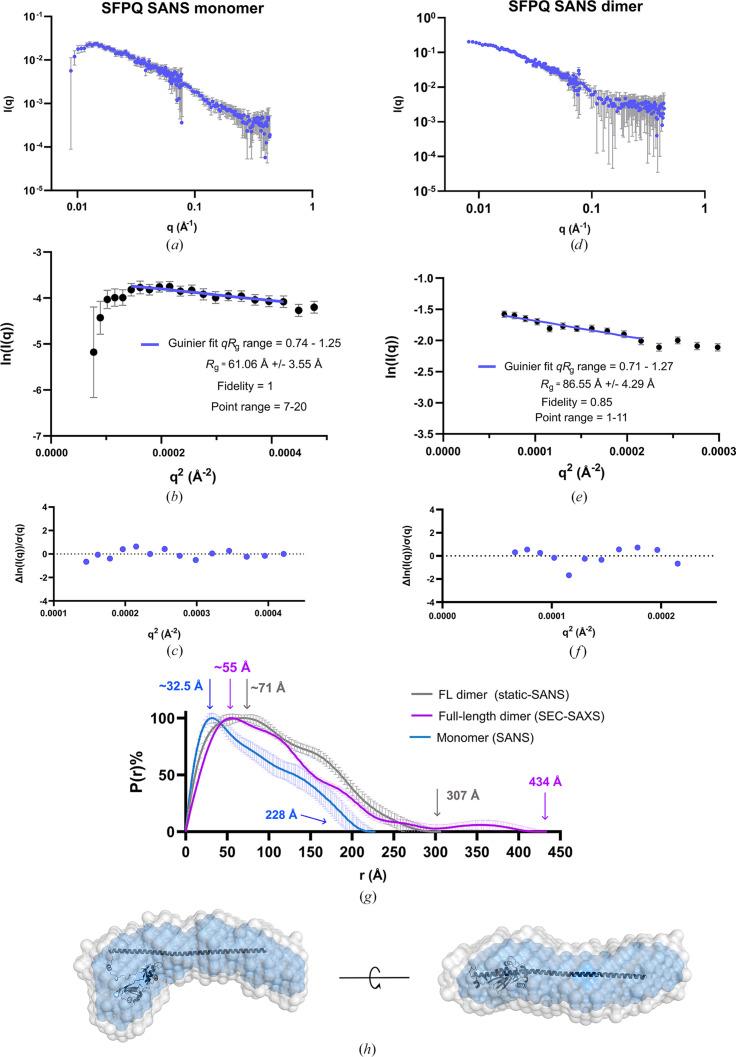
The proteins SFPQ (splicing factor proline- and glutamine-rich) and NONO (non-POU domain-containing octamer-binding protein) are members of the Drosophila behaviour/human splicing (DBHS) protein family, sharing 76% sequence identity in their conserved DBHS domain. These proteins are critical for elements of pre- and post-transcriptional regulation in mammals and are primarily located in paraspeckles: ribonucleoprotein bodies templated by NEAT1 long noncoding RNA. Regions that are structured and predicted to be disordered (IDRs) in DBHS proteins facilitate various interactions, including dimerization, polymerization, nucleic acid binding and liquid-liquid phase separation, all of which have consequences for cell health, the pathology of some neurological diseases and cancer. To date, very limited structural work has been carried out on characterizing the IDRs of the DBHS proteins, largely due to their predicted disordered nature and the fact that this is often a bottleneck for conventional structural techniques. This is a problem worth addressing, as the IDRs have been shown to be critical to the material state of the protein as well as its function. In this study, we used small-angle X-ray scattering (SAXS) and small-angle neutron scattering (SANS), together with lysine cross-linking mass spectrometry (XL-MS), to investigate the regions of SFPQ flanking the structured DBHS domain and the possibility of dimer partner exchange of full-length proteins. Our results demonstrate experimentally that the N- and C-terminal regions on either side of the folded DBHS domain are long, disordered and flexible in solution. Realistic modelling of disordered chains to fit the scattering data and the compaction of the different protein variants suggests that it is physically possible for the IDRs to be close enough to interact. The mass-spectrometry data additionally indicate that the C-terminal IDR can potentially interact with the folded DBHS domain and also shares some conformational space with the N-terminal IDR. Our small-angle neutron scattering (SANS) experiments reveal that full-length SFPQ is capable of swapping dimer partners with itself, which has implications for our understanding of the combinatorial dimerization of DBHS proteins within cells. Our study provides insight into possible interactions between different IDRs either in cis or in trans and how these may relate to protein function, and the possible impact of mutations in these regions. The dynamic dimer partner exchange of a full-length protein inferred from this study is a phenomenon that is integral to the function of DBHS proteins, allowing changes in gene-regulatory activity by altering levels of the various heterodimers or homodimers.
蛋白质SFPQ(富含脯氨酸和谷氨酰胺的剪接因子)和NONO(含非POU结构域的八聚体结合蛋白)是果蝇行为/人类剪接(DBHS)蛋白家族的成员,在其保守的DBHS结构域中具有76%的序列同一性。这些蛋白质对哺乳动物转录前和转录后的调控元件至关重要,主要位于旁斑中:由NEAT1长链非编码RNA模板化的核糖核蛋白体。DBHS蛋白中结构化和预测为无序的区域(IDR)促进了各种相互作用,包括二聚化、聚合、核酸结合和液-液相分离,所有这些都对细胞健康、某些神经疾病和癌症的病理学产生影响。迄今为止,对DBHS蛋白IDR的结构研究非常有限,这主要是由于它们预测的无序性质以及这通常是传统结构技术的一个瓶颈。这是一个值得解决的问题,因为IDR已被证明对蛋白质的物质状态及其功能至关重要。在本研究中,我们使用小角X射线散射(SAXS)和小角中子散射(SANS),以及赖氨酸交联质谱(XL-MS),来研究结构化DBHS结构域两侧的SFPQ区域以及全长蛋白二聚体伙伴交换的可能性。我们的结果通过实验证明,折叠的DBHS结构域两侧的N端和C端区域在溶液中是长的、无序的且灵活的。对无序链进行逼真建模以拟合散射数据以及不同蛋白质变体的压实表明,IDR在物理上有可能足够接近以相互作用。质谱数据还表明,C端IDR可能与折叠的DBHS结构域相互作用,并且还与N端IDR共享一些构象空间。我们的小角中子散射(SANS)实验表明,全长SFPQ能够与自身交换二聚体伙伴,这对我们理解细胞内DBHS蛋白的组合二聚化具有重要意义。我们的研究深入了解了不同IDR之间可能的顺式或反式相互作用,以及这些相互作用如何与蛋白质功能相关,以及这些区域突变可能产生的影响。从本研究推断出的全长蛋白的动态二聚体伙伴交换是DBHS蛋白功能不可或缺的一种现象,它通过改变各种异二聚体或同二聚体的水平来改变基因调控活性。




 Zotero 插件