
腰椎手术中术前硬膜外类固醇注射与手术部位感染风险:一项回顾性队列研究
Preoperative Epidural Steroid Injections and Surgical Site Infection Risk in Lumbar Spine Surgery: A Retrospective Cohort Study.
作者信息
Waheed Muhammad, Henry Brandon, Ehsan Abdurrahman, Geamanu Andreea, Chen Chaoyang, Vaidya Rahul, Sethi Anil
机构信息
Orthopaedic Surgery, Detroit Medical Center Wayne State University, Detroit, USA.
Orthopaedic Surgery, Michigan State University College of Osteopathic Medicine, East Lansing , USA.
出版信息
Cureus. 2025 May 27;17(5):e84892. doi: 10.7759/cureus.84892. eCollection 2025 May.
BACKGROUND
Low back pain is a leading cause of work-related disability worldwide. Epidural steroid injections (ESIs) are commonly used as nonoperative treatments for patients with degenerative lumbar spine pathology. It is imperative to further elucidate the association between preoperative ESIs and postoperative outcomes in this population. This study seeks to evaluate the association between the timing of preoperative ESIs and the incidence of surgical site infections (SSIs) in patients undergoing lumbar spine surgery.
METHODS
This retrospective study analyzed patients who underwent lumbar spine surgery from January 2020 to December 2021. Patients were stratified based on ESI status: no ESI, most recent ESI within three months preoperatively (early group), and most recent ESI equal to or greater than three months preoperatively (late group). All patients were followed for at least one year postoperatively to monitor for SSI. Bivariate correlation analysis using Spearman's rank correlation coefficient was performed to identify risk factors for SSI. Infection rates across ESI groups were compared using Pearson's chi-square test, Fisher's exact test, or the chi-square test of independence, selected based on sample size and expected cell counts.
RESULTS
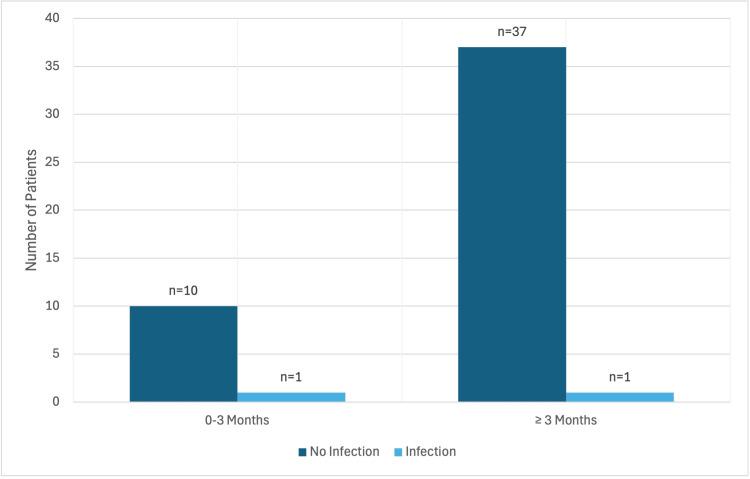
Among 94 patients, 49 received a preoperative ESI. Of these, 11 patients were in the early ESI group and 38 in the late ESI group. The overall infection rate was 2.2%, with one infection in each ESI subgroup. No significant difference in SSI rates was observed between the early and late ESI groups (p=0.171). Higher BMI, use of Disease-Modifying Antirheumatic Drugs (DMARDs), and higher American Society of Anesthesiologists (ASA) scores were associated with an increased SSI risk (p<0.05).
CONCLUSIONS
The timing of preoperative ESI does not significantly influence SSI risk in lumbar spine surgery. This study also highlights the role of elevated BMI, DMARD use, and ASA scores as potential risk factors for SSI in patients receiving preoperative ESI. Mitigating infection risk should focus on addressing modifiable factors such as BMI, DMARD use, and ASA scores rather than ESI timing.
背景
腰痛是全球与工作相关残疾的主要原因。硬膜外类固醇注射(ESI)通常用作退行性腰椎疾病患者的非手术治疗方法。进一步阐明该人群术前ESI与术后结果之间的关联势在必行。本研究旨在评估腰椎手术患者术前ESI的时间与手术部位感染(SSI)发生率之间的关联。
方法
这项回顾性研究分析了2020年1月至2021年12月接受腰椎手术的患者。患者根据ESI状态分层:未进行ESI、术前三个月内最近一次ESI(早期组)以及术前三个月或更长时间内最近一次ESI(晚期组)。所有患者术后至少随访一年以监测SSI。使用Spearman等级相关系数进行双变量相关性分析以确定SSI的危险因素。根据样本量和预期单元格计数,使用Pearson卡方检验、Fisher精确检验或独立性卡方检验比较各ESI组的感染率。
结果
94例患者中,49例接受了术前ESI。其中,11例患者在早期ESI组,38例在晚期ESI组。总体感染率为2.2%,每个ESI亚组各有1例感染。早期和晚期ESI组之间的SSI发生率无显著差异(p=0.171)。较高的体重指数、使用改善病情抗风湿药(DMARDs)以及较高的美国麻醉医师协会(ASA)评分与SSI风险增加相关(p<0.05)。
结论
术前ESI的时间对腰椎手术中SSI风险没有显著影响。本研究还强调了体重指数升高、使用DMARDs和ASA评分作为接受术前ESI患者发生SSI的潜在危险因素的作用。降低感染风险应侧重于解决可改变的因素,如体重指数、使用DMARDs和ASA评分,而不是ESI时间。

 Zotero 插件