
肌肉骨骼手法治疗在患有肌肉骨骼疾病的老年人群中的疗效和安全性:一项系统评价。
Efficacy and safety of musculoskeletal manipulations in elderly population with musculoskeletal disorders: a systematic review.
作者信息
Bagagiolo Donatella, Persiani Michela, Cicchitti Luca, Vismara Luca, Bruini Irene, Mauro Alessandro, Buffone Francesca
机构信息
Research Department, Scuola Superiore di Osteopatia Italiana, Turin, Italy.
Department of Biomedical and Neuromotor Sciences DIBINEM, Bologna University, Bologna, Italy.
出版信息
BMJ Open. 2025 Jun 26;15(6):e088655. doi: 10.1136/bmjopen-2024-088655.
INTRODUCTION
Non-pharmacological interventions, including musculoskeletal manipulations (MMs), have been proven effective for musculoskeletal disorders.
OBJECTIVES
To evaluate if MMs, including osteopathic manipulation and chiropractic care, are effective to improve quality of life, pain intensity and function in older adults with musculoskeletal disorders.
DESIGN
Systematic review.
DATA SOURCES
A systematic search was conducted on MEDLINE/PubMed, EMBASE, Scopus, Web of Science, CINAHL, Cochrane Library, from database inception up to 2 January 2025.
ELIGIBILITY CRITERIA
Randomised controlled trials, controlled non-randomised trials and open label trials evaluating the efficacy and safety of MM such as osteopathic manipulation, chiropractic manipulation, myofascial release, craniosacral therapy, as monotherapy or adjunctive therapies in older people (age ≥65 years) with musculoskeletal disorders. The main outcomes included pain intensity, functionality and quality of life. Additionally, other related outcomes were considered, such as medical use duration, mood, mobility, motion, strength and endurance. Finally, we considered any adverse events.
DATA EXTRACTION AND SYNTHESIS
Selection and data extraction were performed independently by two authors. The effect estimates for each study were performed using Review Manager V.5.14. Continuous outcomes were analysed using the mean difference (95% CI). The methodological quality of the included studies was assessed using the Cochrane Risk of Bias tool 2 (RoB 2). No meta-analysis was performed.
RESULTS
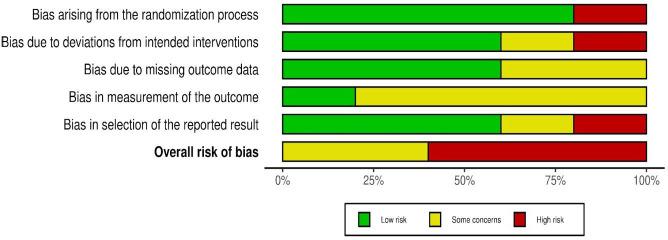
Five parallel randomised controlled trials were included, with a total sample size of 676 participants (41.6% women with a mean age of 77.3 years): 34 with chronic pain, 265 with neck pain and 377 with low back pain. MMs were not effective in patients with chronic pain, neither in pain intensity nor in functionality. For neck pain, considering the main outcomes, only in one of the two studies was there a statistically significant improvement in neck pain intensity only at week 12 for spinal manipulative treatment (SMT)+home exercise (HE) compared with HE alone (ES=-0.90 (95% CI -1.46 to -0.34); p=0.002). For low back pain, SMT+HE showed a statistically significant reduction in pain at 12 weeks compared with HE (ES=-0.79 (95% CI -1.39 to -0.19) p=0.010. For neck pain and low back pain, no statistically significant improvement in functional status and quality of life was observed with MM compared with any control group. RoB 2 showed a high risk of bias in three studies and some concerns in the others. At the domain level, the lowest risk was observed in the randomisation process (80% with some concerns). All five studies reported adverse events, none of which were serious.
CONCLUSIONS
This review provides limited and inconclusive evidence about MM to improve quality of life, pain management and functional status in older adults with musculoskeletal disorders. However, MM appears to be generally safe and well-tolerated.
PROSPERO REGISTRATION NUMBER
CRD42023473203.
引言
包括肌肉骨骼手法治疗(MMs)在内的非药物干预措施已被证明对肌肉骨骼疾病有效。
目的
评估包括整骨手法治疗和脊椎按摩治疗在内的MMs对改善患有肌肉骨骼疾病的老年人的生活质量、疼痛强度和功能是否有效。
设计
系统评价。
数据来源
对MEDLINE/PubMed、EMBASE、Scopus、Web of Science、CINAHL、Cochrane图书馆进行了系统检索,检索时间从数据库建立至2025年1月2日。
纳入标准
随机对照试验、非随机对照试验和开放标签试验,评估MMs(如整骨手法治疗、脊椎按摩治疗、肌筋膜松解术、颅骶疗法)作为单一疗法或辅助疗法,对患有肌肉骨骼疾病的老年人(年龄≥65岁)的疗效和安全性。主要结局包括疼痛强度、功能和生活质量。此外,还考虑了其他相关结局,如医疗使用时长、情绪、活动能力、运动、力量和耐力。最后,我们考虑了任何不良事件。
数据提取与综合分析
由两位作者独立进行筛选和数据提取。使用Review Manager V.5.14对每项研究进行效应估计。连续型结局采用均数差值(95%可信区间)进行分析。采用Cochrane偏倚风险工具2(RoB 2)评估纳入研究的方法学质量。未进行荟萃分析。
结果
纳入了5项平行随机对照试验,总样本量为676名参与者(41.6%为女性,平均年龄77.3岁):34例患有慢性疼痛,265例患有颈部疼痛,377例患有下背部疼痛。MMs对慢性疼痛患者无效,在疼痛强度和功能方面均无效果。对于颈部疼痛,考虑主要结局,仅在两项研究中的一项中,与单纯家庭锻炼(HE)相比,脊柱手法治疗(SMT)+家庭锻炼(HE)在第12周时仅颈部疼痛强度有统计学显著改善(效应量=-0.90(95%可信区间-1.46至-0.34);p=0.002)。对于下背部疼痛,与HE相比,SMT+HE在12周时疼痛有统计学显著减轻(效应量=-0.79(95%可信区间-1.39至-0.19),p=0.010)。对于颈部疼痛和下背部疼痛,与任何对照组相比,MMs在功能状态和生活质量方面均未观察到统计学显著改善。RoB 2显示三项研究存在高偏倚风险,其他研究存在一些问题。在领域层面,随机化过程中的风险最低(80%存在一些问题)。所有五项研究均报告了不良事件,均不严重。
结论
本综述提供了有限且不确定的证据,证明MMs对改善患有肌肉骨骼疾病的老年人的生活质量、疼痛管理和功能状态有效。然而,MMs总体上似乎是安全且耐受性良好的。
PROSPERO注册号:CRD42023473203。


 Zotero 插件