
爆炸所致创伤性脑损伤血清生物标志物的鉴定:大鼠模型中的低、高强度暴露
Identification of Serum Biomarkers for Blast-induced Traumatic Brain Injuries: Low . High-intensity Exposure in a Rat Model.
作者信息
Bera Alakesh, Subhramanian Madhan, Sharma Pushpa
机构信息
Department of Anesthesiology, School of Medicine, Uniformed Services University of the Health Sciences, Bethesda, MD, U.S.A.
出版信息
In Vivo. 2025 Jul-Aug;39(4):1840-1851. doi: 10.21873/invivo.13984.
BACKGROUND/AIM: Traumatic brain injury (TBI), particularly from blast exposures, is a growing global health concern due to increasing international conflicts and terrorist attacks. Blast exposure involves whole-body impact; however, the specific effects on the brain remain inadequately defined. This study aimed to identify serum-based protein biomarkers that could serve as non-invasive indicators for early detection and prediction of long-term outcomes of blast-induced TBI (bTBI), and to assess other organ-specific responses. Focus was given to proteins associated with inflammation, mitochondrial dysfunction, and brain-specific injury.
MATERIALS AND METHODS
Adult male Sprague Dawley rats were exposed to repeated blast waves at either 10 pounds per square inch (PSI) or 20 PSI, while sham animals underwent identical procedures without blast exposure (n=8 per group). Serum samples were collected on day 0 (pre-injury) and day 28 (post-injury/sham). Protein levels were quantified using high-throughput western blotting and Meso Scale Discovery (MSD) multiplex assays. Key proteins analyzed included hypoxia-inducible factor 1-alpha (HIF-1α), glial fibrillary acidic protein (GFAP), brain-derived neurotrophic factor (BDNF), C-peptide, fibroblast growth factor 21 (FGF-21), ghrelin, and glucagon-like peptide 1 (GLP-1).
RESULTS
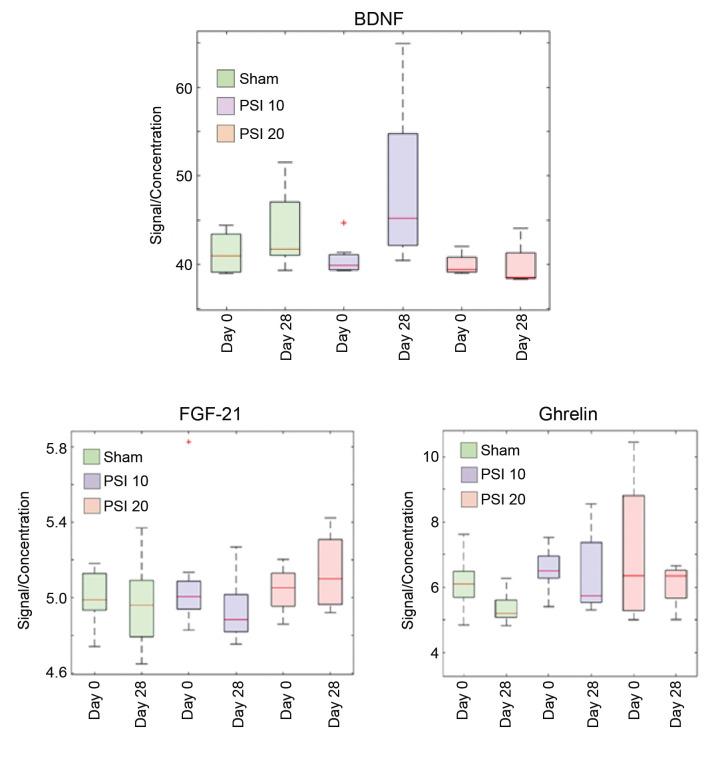
Significant elevations in serum HIF-1α (=0.017) and GFAP (=0.011) were observed at day 28 following 20 PSI blast, indicating hypoxic stress and astrocyte activation. Levels of FGF-21 (<0.035), ghrelin (<0.05), and BDNF (<0.05) were also significantly altered, whereas C-peptide and GLP-1 showed no significant changes (>0.05).
CONCLUSION
Serum HIF-1α, GFAP, and BDNF may serve as brain-specific biomarkers, while FGF-21 and ghrelin represent potential systemic markers for differentiating blast intensity and guiding therapeutic development.
背景/目的:由于国际冲突和恐怖袭击的增加,创伤性脑损伤(TBI),尤其是爆炸暴露导致的创伤性脑损伤,已成为全球日益关注的健康问题。爆炸暴露涉及全身冲击;然而,对大脑的具体影响仍未得到充分界定。本研究旨在确定基于血清的蛋白质生物标志物,这些标志物可作为非侵入性指标,用于早期检测和预测爆炸诱导的创伤性脑损伤(bTBI)的长期预后,并评估其他器官特异性反应。重点关注与炎症、线粒体功能障碍和脑特异性损伤相关的蛋白质。
材料和方法
成年雄性Sprague Dawley大鼠分别接受10磅每平方英寸(PSI)或20 PSI的重复冲击波暴露,而假手术动物接受相同程序但无爆炸暴露(每组n = 8)。在第0天(损伤前)和第28天(损伤后/假手术)采集血清样本。使用高通量蛋白质印迹法和Meso Scale Discovery(MSD)多重检测法定量蛋白质水平。分析的关键蛋白质包括缺氧诱导因子1-α(HIF-1α)、胶质纤维酸性蛋白(GFAP)、脑源性神经营养因子(BDNF)、C肽、成纤维细胞生长因子21(FGF-21)、胃饥饿素和胰高血糖素样肽1(GLP-1)。
结果
在20 PSI爆炸后第28天,观察到血清HIF-1α(=0.017)和GFAP(=0.011)显著升高,表明存在缺氧应激和星形胶质细胞活化。FGF-21(<0.035)、胃饥饿素(<0.05)和BDNF(<0.05)水平也有显著改变,而C肽和GLP-1无显著变化(>0.05)。
结论
血清HIF-1α、GFAP和BDNF可能作为脑特异性生物标志物,而FGF-21和胃饥饿素代表区分爆炸强度和指导治疗发展的潜在全身标志物。


 Zotero 插件