
用于直肠癌肝转移早期预测的可解释多模态放射组学:一项多中心研究
Explainable multi-modal radiomics for early prediction of liver metastasis in rectal cancer: a multicentric study.
作者信息
Feng Yaru, Gong Jing, Wang Yanyan, Cui Yanfen, Tong Tong
机构信息
Department of Radiology, Fudan University Shanghai Cancer Center and Department of Oncology, Shanghai Medical College, Fudan University, Shanghai, P. R. China.
Department of Radiology, Shanxi Province Cancer Hospital/Shanxi Hospital Affiliated to Cancer Hospital, Chinese Academy of Medical Sciences/Cancer Hospital Affiliated to Shanxi Medical University, Taiyuan, P. R. China.
出版信息
Insights Imaging. 2025 Jun 27;16(1):142. doi: 10.1186/s13244-025-02010-9.
OBJECTIVES
To enhance liver metastasis (LM) risk prediction for rectal cancer (RC) patients using a multi-modal, explainable radiomics model based on rectal MRI and whole-liver CT, and to assess its prognostic value for survival.
METHODS
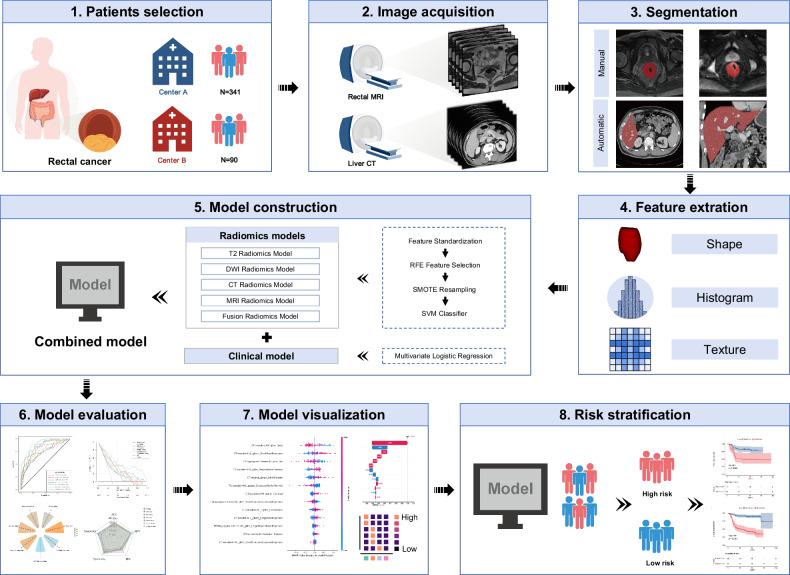
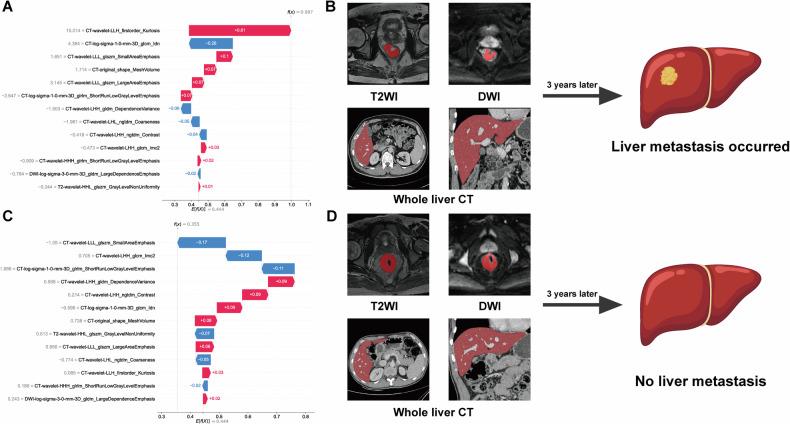
This retrospective study enrolled patients with pathologically confirmed RC from two medical centers. Radiomics features were extracted from rectal MRI as well as pre-metastatic liver CT. Feature selection was performed using ANOVA F-value and recursive feature elimination. The SHAP method elucidated the model's functionality by highlighting key feature contributions. Finally, Kaplan-Meier survival analysis and Cox regression assessed the prognostic utility of the model's prediction score.
RESULTS
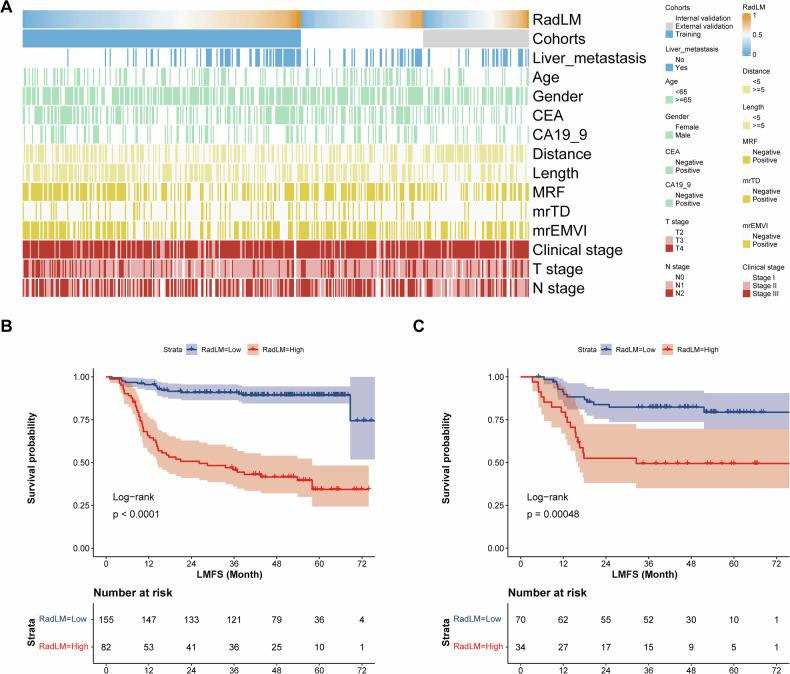
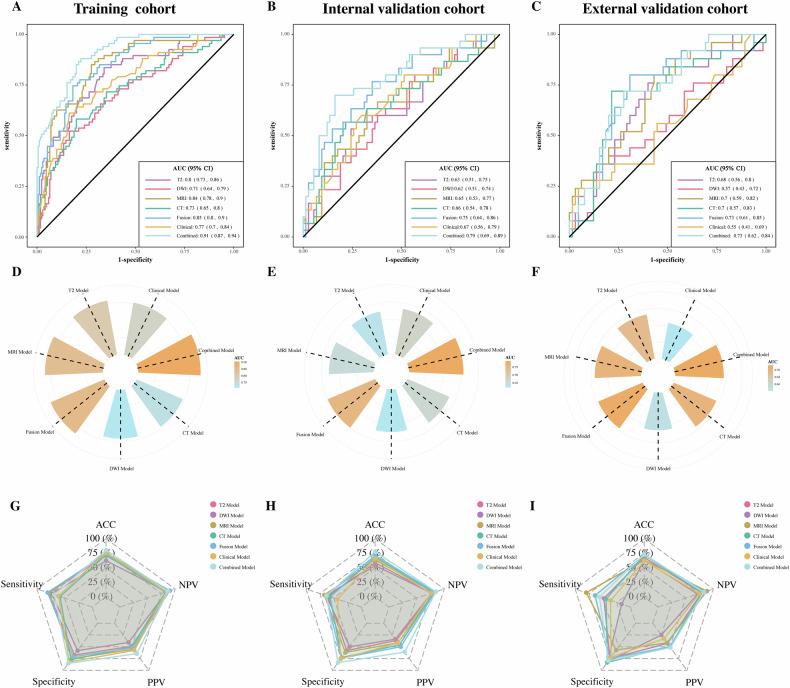
A total of 431 patients were enrolled from two centers in our study. The radiomics model developed from baseline whole-liver CT features alone could predict LM development in all cohorts. A fusion model integrating liver CT with primary tumor MRI features provided synergetic effect and was more efficient in predicting LM, displaying an area under the receiver operating curve (AUC) of 0.85 (95% CI: 0.80-0.90) in the training cohort, and AUC values of 0.75 (95% CI: 0.64-0.86) and 0.73 (95% CI: 0.61-0.85) in the internal and external validation cohorts, respectively. SHAP summary plots illustrated how feature values influenced their impact on the model. The risk score generated by our model demonstrated significant prognostic value for LM-free survival (LMFS).
CONCLUSIONS
The multi-modal, explainable radiomics model integrating primary tumor and pre-metastatic liver radiomics enhances the prediction of LM development and provides prognostic value in RC patients.
CRITICAL RELEVANCE STATEMENT
This study demonstrates that integrating radiomics features from pre-metastatic liver and primary tumors enhances the predictive performance for liver metastasis development in rectal cancer patients, highlighting its potential for personalized treatment planning and follow-up strategies for rectal cancer patients.
KEY POINTS
Pre-metastatic liver CT radiomics features could predict the liver metastasis development of rectal cancer. Integrating primary tumor and pre-metastatic liver radiomics improved liver metastasis prediction accuracy. The model demonstrated favorable interpretability through SHAP method.
目的
使用基于直肠MRI和全肝CT的多模态、可解释的放射组学模型,提高直肠癌(RC)患者肝转移(LM)风险预测,并评估其对生存的预后价值。
方法
这项回顾性研究纳入了来自两个医疗中心的病理确诊为RC的患者。从直肠MRI以及转移前肝脏CT中提取放射组学特征。使用方差分析F值和递归特征消除进行特征选择。SHAP方法通过突出关键特征贡献来阐明模型的功能。最后,Kaplan-Meier生存分析和Cox回归评估了模型预测分数的预后效用。
结果
我们的研究共从两个中心纳入了431例患者。仅基于基线全肝CT特征开发的放射组学模型可以预测所有队列中的LM发展。将肝脏CT与原发性肿瘤MRI特征相结合的融合模型具有协同效应,在预测LM方面更有效,在训练队列中的受试者操作特征曲线下面积(AUC)为0.85(95%CI:0.80-0.90),在内部和外部验证队列中的AUC值分别为0.75(95%CI:0.64-0.86)和0.73(95%CI:0.61-0.85)。SHAP汇总图说明了特征值如何影响它们对模型的影响。我们的模型生成的风险评分对无肝转移生存期(LMFS)具有显著的预后价值。
结论
整合原发性肿瘤和转移前肝脏放射组学的多模态、可解释的放射组学模型提高了LM发展的预测能力,并为RC患者提供了预后价值。
关键相关性声明
本研究表明,整合转移前肝脏和原发性肿瘤的放射组学特征可提高直肠癌患者肝转移发展的预测性能,突出了其在直肠癌患者个性化治疗规划和随访策略中的潜力。
要点
转移前肝脏CT放射组学特征可预测直肠癌的肝转移发展。整合原发性肿瘤和转移前肝脏放射组学提高了肝转移预测准确性。该模型通过SHAP方法表现出良好的可解释性。

 Zotero 插件