
内镜-组织学基础融合模型:一种用于评估溃疡性结肠炎临床试验中组织学缓解及治疗反应的新型人工智能技术。
Endo-Histo foundational fusion model: a novel artificial intelligence for assessing histologic remission and response to therapy in ulcerative colitis clinical trial.
作者信息
Iacucci Marietta, Santacroce Giovanni, Meseguer Pablo, Diéguez Alejandro, Del Amor Rocio, Kolawole Bisi Bode, Chaudhari Ujwala, Zammarchi Irene, Hayes Brian, Crotty Rory, Zardo Davide, Maeda Yasuharu, Puga-Tejada Miguel, Ditonno Ilaria, Vadori Valentina, Burke Louise, D'Amico Ferdinando, Ghosh Subrata, Grisan Enrico, Naranjo Valery
机构信息
APC Microbiome Ireland, College of Medicine and Health, University College of Cork, Cork, Ireland.
Instituto Universitario de Investigación e Innovación en Tecnología Centarada en el Ser Humano, HUMAN-tech, Universitat Politècnica de València, València, Spain.
出版信息
J Crohns Colitis. 2025 Jul 3;19(7). doi: 10.1093/ecco-jcc/jjaf108.
BACKGROUND AND AIMS
Artificial intelligence (AI)-enabled endoscopy and histology offer accurate, objective, and rapid assessment of disease activity in ulcerative colitis (UC). Emerging multi-source AI models may enhance standardized disease evaluation and outcome prediction. This investigation aimed to develop a novel AI model fusing endoscopic and histologic features to improve the assessment of disease remission and response to therapy in UC clinical trials.
METHODS
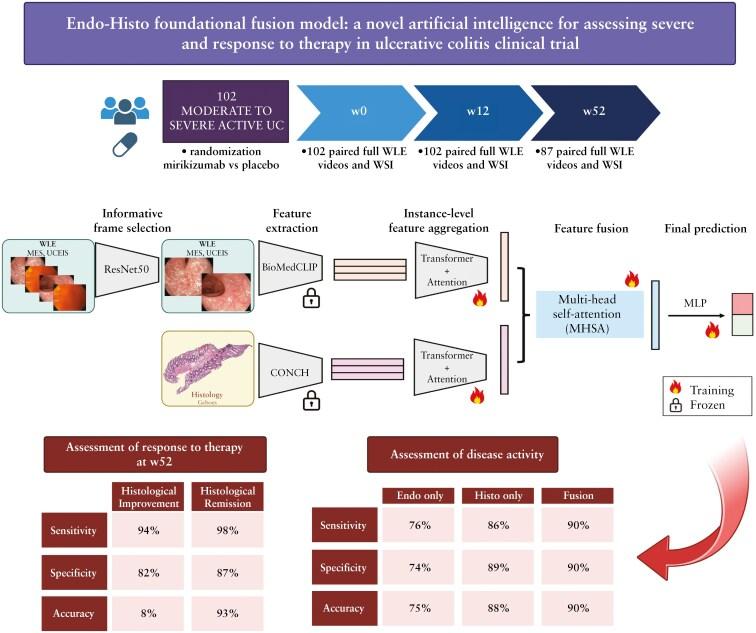
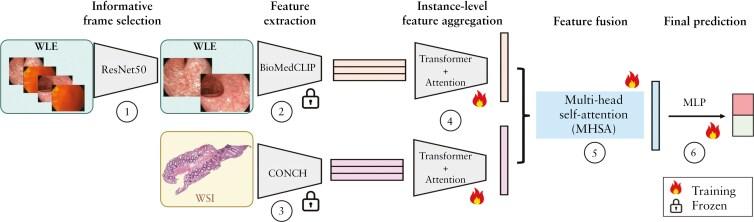
A novel multimodal AI model was developed that fuses endoscopic videos and histologic whole-slide images from a Phase 2 clinical trial of Mirikizumab in UC (NCT02589665). Informative endoscopic frames were predicted using convolutional neural networks and processed with BioMedCLIP, while histologic features were extracted using the CONCH foundational model. Multimodal features were then integrated via multi-head self-attention to generate a patient-level assessment. Model performance for assessing histologic remission (HR) and treatment response at weeks 12 and 52, based on histologic endpoints, was evaluated by cross-validation.
RESULTS
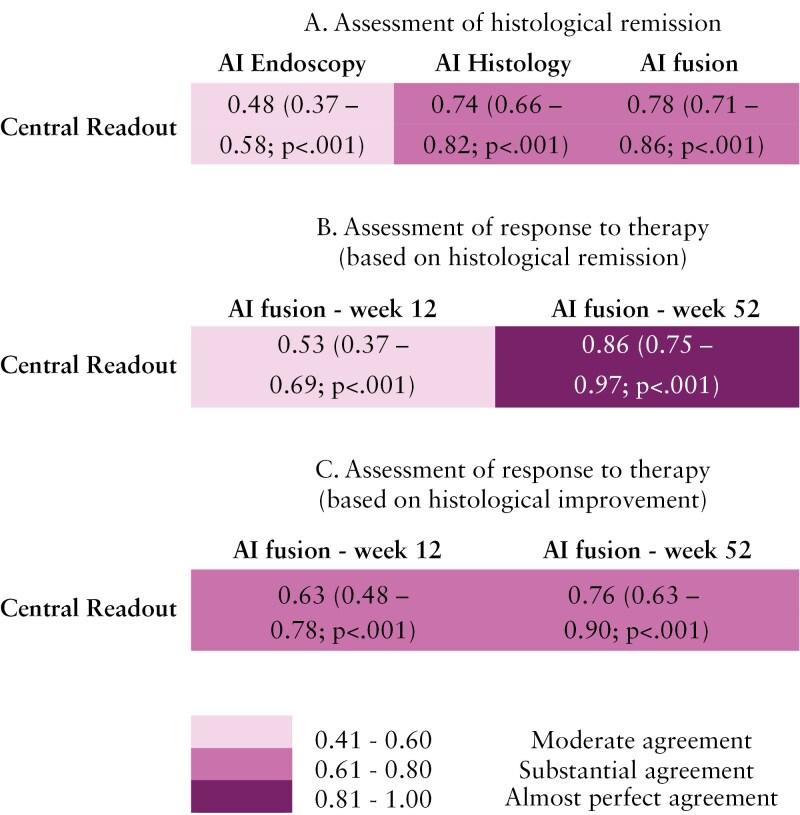
The fusion model outperformed single-modality assessments for HR, achieving a sensitivity of 89.72% (95% CI, 82.35-94.76), specificity of 89.67% (95% CI, 84.34-93.67), and accuracy of 89.69% (95% CI, 85.61-92.94). It showed a sensitivity of 97.96% (95% CI, 89.15-99.95), specificity of 86.84% (95% CI, 71.91-95.59), and accuracy of 93.10% (95% CI, 85.59-97.43) for assessing HR at week 52. Substantial agreement was observed between the AI-fusion model and central readout.
CONCLUSION
This novel tool significantly advances precision medicine in clinical trials by potentially standardizing central readouts and enabling automated disease assessment.
背景与目的
人工智能(AI)辅助的内镜检查和组织学检查能够对溃疡性结肠炎(UC)的疾病活动进行准确、客观且快速的评估。新兴的多源AI模型可能会增强标准化疾病评估和结局预测。本研究旨在开发一种融合内镜和组织学特征的新型AI模型,以改善UC临床试验中疾病缓解和治疗反应的评估。
方法
开发了一种新型多模态AI模型,该模型融合了来自UC中Mirikizumab的一项2期临床试验(NCT02589665)的内镜视频和组织学全切片图像。使用卷积神经网络预测信息丰富的内镜图像帧,并通过BioMedCLIP进行处理,同时使用CONCH基础模型提取组织学特征。然后通过多头自注意力整合多模态特征,以生成患者水平的评估。基于组织学终点,通过交叉验证评估模型在第12周和第52周评估组织学缓解(HR)和治疗反应的性能。
结果
融合模型在评估HR方面优于单模态评估,灵敏度为89.72%(95%CI,82.35 - 94.76),特异性为89.67%(95%CI,84.34 - 93.67),准确性为89.69%(95%CI,85.61 - 92.94)。在评估第52周的HR时,灵敏度为97.96%(95%CI,89.15 - 99.95),特异性为86.84%(95%CI,71.91 - 95.59),准确性为93.10%(95%CI,85.59 - 97.43)。AI融合模型与中心读数之间观察到高度一致性。
结论
这种新型工具通过潜在地标准化中心读数并实现自动化疾病评估,显著推进了临床试验中的精准医学。
 Zotero 插件