
正电子发射断层扫描(PET)在免疫疾病的特征描述及治疗方法的研发中的应用
PET in the characterization of immune diseases and development of therapeutics.
作者信息
Patel Natasha, Bergstrom Mats, Murphy Philip S, Maynard Juliana
机构信息
School of Biomedical Engineering and Imaging Sciences, King's College London, St Thomas' Hospital, London, SE1 7EH, United Kingdom.
OMID Molecular Imaging Consultancy, Uppsala, 75221, Sweden.
出版信息
Oxf Open Immunol. 2025 May 24;6(1):iqaf005. doi: 10.1093/oxfimm/iqaf005. eCollection 2025.
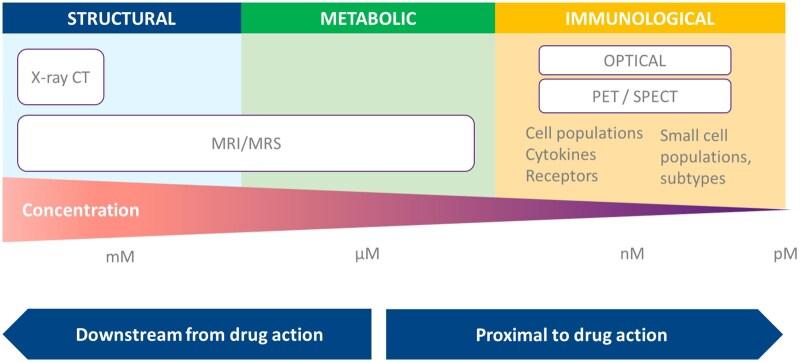
The immune system is a complex network of cells, tissues and organs that protects the body against harmful pathogens. Characterization of the immune system is essential for understanding the complex interactions underlying pathophysiology and providing insights to enable therapeutic targeting for modern drug development. Tissue and peripheral sampling report on important biomarkers, but may not adequately sample complex, heterogeneous systemic diseases. Imaging has been extensively used in the study of immune diseases, largely relying upon structural measurements of disease manifestation (e.g. X-ray for joint space narrowing in rheumatoid arthritis). These measurements are downstream from drug action, offering no insight into the intricacies of the immune system. Molecular imaging, particularly through Positron Emission Tomography has the potential to map the immune system at the whole-body level, providing non-invasive, quantitative readouts. Adoption of PET clinically and for drug development purposes for studying immune processes has been limited to date, lagging use in neuroscience and oncology. Emerging technical developments are likely to create new opportunities for immune system monitoring: (i) A broad set of clinical probes to study immune cells and associated processes are in development, (ii) The advent of TotalBody PET able to capture high-sensitivity measurements from all tissues with reduced radiation dose burden. This review explores the potential applications of PET for immune drug development, the technology advancements and suggests how adoption barriers can be overcome. The immune toolset of the future will likely demand an integrated approach, using tissue and peripheral readouts combined with immune-specific imaging.
免疫系统是一个由细胞、组织和器官组成的复杂网络,可保护身体免受有害病原体的侵害。免疫系统的特征描述对于理解病理生理学背后的复杂相互作用以及为现代药物开发提供治疗靶点的见解至关重要。组织和外周采样报告了重要的生物标志物,但可能无法充分对复杂的、异质性的全身性疾病进行采样。成像技术已广泛应用于免疫疾病的研究,主要依赖于疾病表现的结构测量(例如,类风湿性关节炎中用于关节间隙变窄的X射线)。这些测量是药物作用的下游,无法深入了解免疫系统的复杂性。分子成像,特别是通过正电子发射断层扫描,有可能在全身水平绘制免疫系统图谱,提供非侵入性的定量读数。迄今为止,正电子发射断层扫描在临床和药物开发中用于研究免疫过程的应用有限,落后于神经科学和肿瘤学领域的应用。新兴的技术发展可能会为免疫系统监测创造新机会:(i)一系列用于研究免疫细胞和相关过程的临床探针正在开发中,(ii)全身正电子发射断层扫描的出现能够以降低的辐射剂量负担从所有组织中捕获高灵敏度测量。本综述探讨了正电子发射断层扫描在免疫药物开发中的潜在应用、技术进步,并提出了如何克服应用障碍。未来的免疫工具集可能需要一种综合方法,将组织和外周读数与免疫特异性成像结合使用。





 Zotero 插件