
用于术中输血决策的动态列线图模型的开发与评估
Development and evaluation of a dynamic nomogram model for intraoperative blood transfusion decision-making.
作者信息
Li Min, Jiang Wei, Lin Jialing, Du Hui, Shan Jiawen, Qin Li
机构信息
Department of Blood Transfusion Medicine, Sichuan Tianfu New Area People's Hospital, Chengdu, China.
Department of Clinical Laboratory Medicine, Sichuan Tianfu New Area People's Hospital, Chengdu, China.
出版信息
Front Med (Lausanne). 2025 Jun 13;12:1566325. doi: 10.3389/fmed.2025.1566325. eCollection 2025.
OBJECTIVE
By gathering data on patients with intraoperative blood transfusion and investigating the factors influencing intraoperative blood transfusion in patients, we aimed to construct a dynamic nomogram decision-making model capable of continuously predicting the probability of intraoperative blood transfusion in patients. This was done to explore a new mode of individualized and precise blood transfusion and to guide doctors to make timely and reasonable blood transfusion decisions and save blood resources.
METHODS
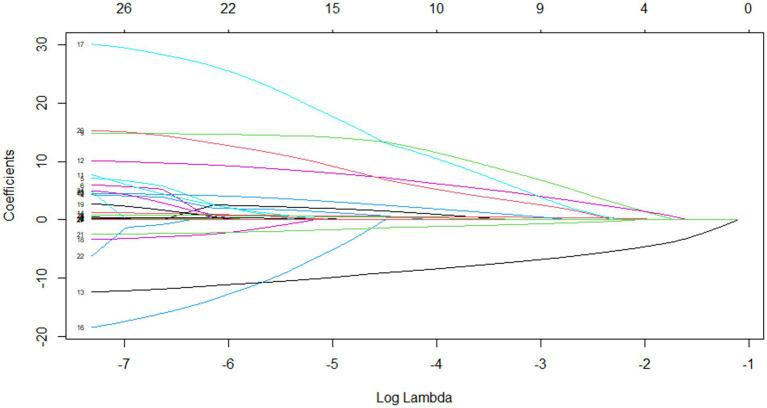
Data of surgical patients in our hospital from 2019 to 2023 were collected. Among them, 705 patients who had blood transfusions were the experimental group, and 705 patients without intraoperative blood transfusions were randomly selected as the control group. Preoperative and intraoperative indicators of 1,410 patients were collected. 80% of the data set was used as the training set and 20% as the test set. In the training set, independent risk factors affecting intraoperative blood transfusion in patients were obtained through Lasso regression and binary logistic regression analysis, and the regression model was established and validated.
RESULTS
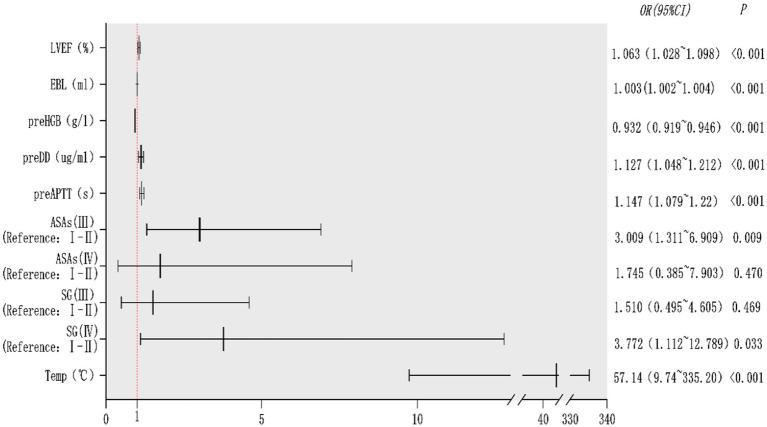
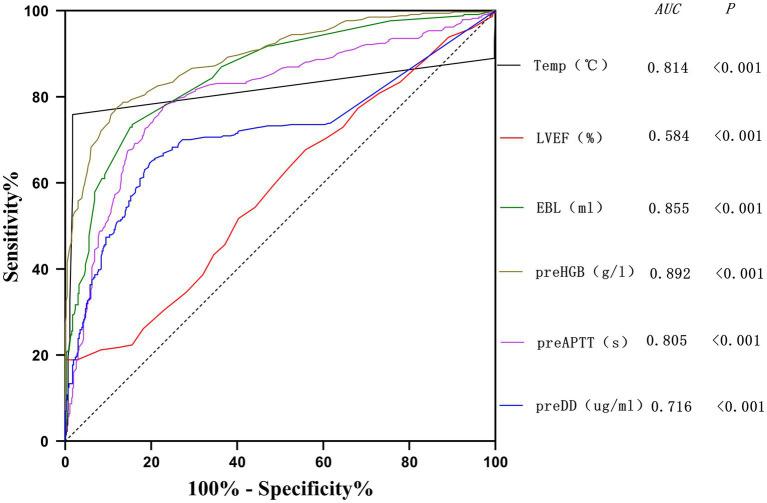
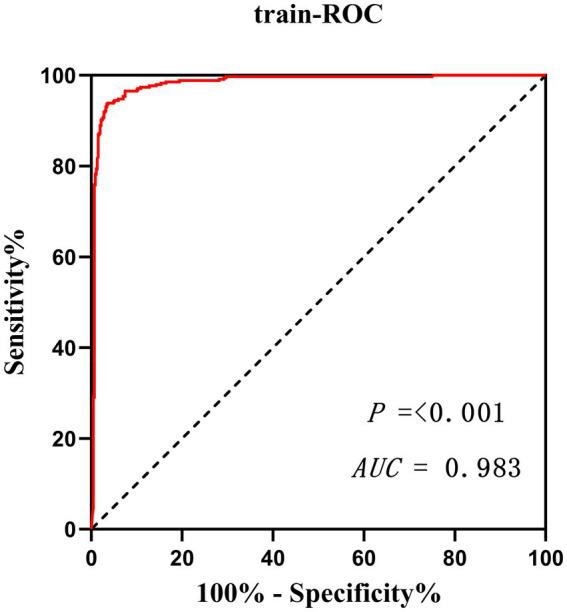
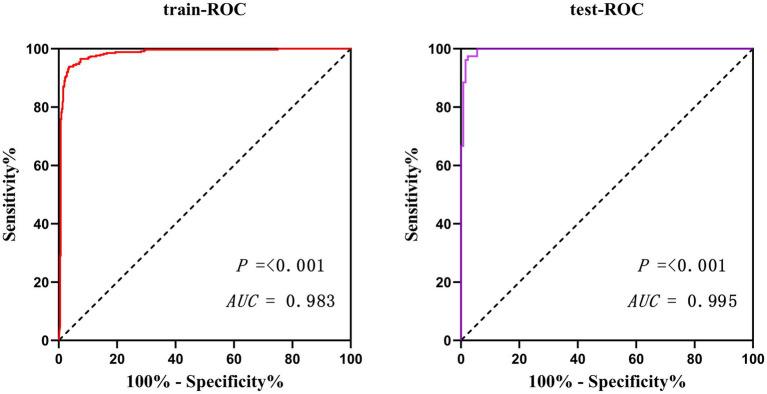
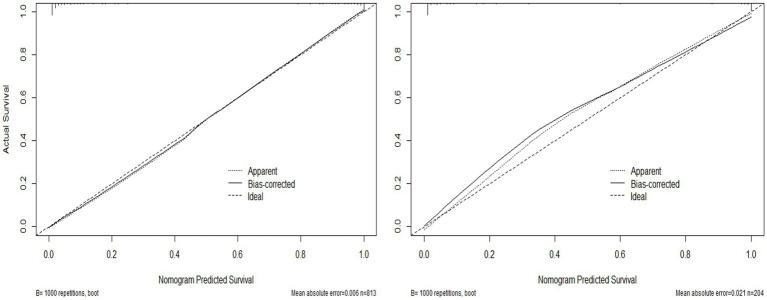
Through Lasso regression with cross-validation and binary logistic regression analysis, the independent risk factors affecting patients' intraoperative blood transfusion decision-making were determined as ASAs (III) (OR = 3.009, 95% CI = 1.311-6.909), surgical grading (IV) (OR = 3.772, 95% CI = 1.112-12.789), EBL (OR = 1.003, 95% CI = 1.002-1.004), preHGB (OR = 0.932, 95% CI = 0.919-0.946), LVEF (OR = 1.063, 95% CI = 1.028-1.098), Temp (OR = 57.14, 95% CI = 9.740-35.204), preAPTT (OR = 1.147, 95% CI = 1.079-1.220), and preDD (OR = 1.127, 95% CI = 1.048-1.212). The area under the curve (AUC) of the receiver operating characteristic curve (ROC) of the training set was 0.983, < 0.05. By calculating the Jordon index, when the Jordon index reached its maximum value, the corresponding diagnostic probability threshold was 0.515. When the model predicted that the probability threshold was 0.515, the sensitivity was 0.939 and the specificity was 0.964. These independent risk factors were introduced into R statistical software to fit the intraoperative blood transfusion decision-making dynamic nomogram model. The goodness of fit test of the model for the training set was = 111.85, < 0.01, and the AUCs of the training set and the testing set were 0.983 and 0.995, respectively, < 0.05. The calibration curve showed that the predicted probability of the model was in good agreement with the observed probability. Clinical decision curves (CDA) and clinical impact curves were plotted to evaluate the clinical utility of the model and the net benefit of the model.
CONCLUSION
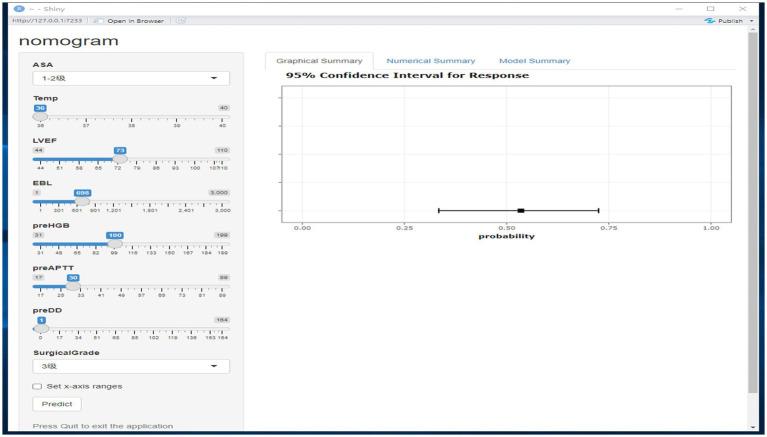
Variables were screened by Lasso regression, the model was developed by binary logistic regression, and a dynamic nomogram model for intraoperative transfusion decision-making was successfully fitted using R software. This model had good goodness of fit, discrimination, and calibration. The model can dynamically and instantaneously predict the probability of blood transfusion and its 95% confidence interval under the current patient indicators by selecting the patient's independent risk factors in the drop-down mode during the operation. It can assist doctors in making a reasonable blood transfusion decision quickly and save blood resources.
目的
通过收集术中输血患者的数据并调查影响患者术中输血的因素,旨在构建一个能够持续预测患者术中输血概率的动态列线图决策模型。这样做是为了探索一种个体化精准输血的新模式,指导医生及时做出合理的输血决策并节约血液资源。
方法
收集我院2019年至2023年手术患者的数据。其中,705例输血患者为实验组,随机选取705例未进行术中输血的患者作为对照组。收集1410例患者的术前和术中指标。数据集的80%用作训练集,20%用作测试集。在训练集中,通过Lasso回归和二元逻辑回归分析获得影响患者术中输血的独立危险因素,并建立和验证回归模型。
结果
通过交叉验证的Lasso回归和二元逻辑回归分析,确定影响患者术中输血决策的独立危险因素为美国麻醉医师协会身体状况分级(III级)(OR = 3.009,95%置信区间 = 1.311 - 6.909)、手术分级(IV级)(OR = 3.772,95%置信区间 = 1.112 - 12.789)、估计失血量(OR = 1.003,95%置信区间 = 1.002 - 1.004)、术前血红蛋白(OR = 0.932,95%置信区间 = 0.919 - 0.946)、左心室射血分数(OR = 1.063,95%置信区间 = 1.028 - 1.098)、体温(OR = 57.14,95%置信区间 = 9.740 - 35.204)、术前活化部分凝血活酶时间(OR = 1.147,95%置信区间 = 1.079 - 1.220)和术前D - 二聚体(OR = 1.127,95%置信区间 = 1.048 - 1.212)。训练集的受试者操作特征曲线(ROC)的曲线下面积(AUC)为0.983,P < 0.05。通过计算约登指数,当约登指数达到最大值时,相应的诊断概率阈值为0.515。当模型预测概率阈值为0.515时,灵敏度为0.939,特异度为0.964。将这些独立危险因素引入R统计软件以拟合术中输血决策动态列线图模型。该模型对训练集的拟合优度检验χ² = 111.85,P < 0.01,训练集和测试集的AUC分别为0.983和0.995,P < 0.05。校准曲线显示模型的预测概率与观察概率吻合良好。绘制临床决策曲线(CDA)和临床影响曲线以评估模型的临床实用性和模型的净效益。
结论
通过Lasso回归筛选变量,采用二元逻辑回归建立模型,并使用R软件成功拟合了术中输血决策动态列线图模型。该模型具有良好的拟合优度、区分度和校准度。该模型可以通过在手术过程中以下拉模式选择患者的独立危险因素,动态即时预测在当前患者指标下输血的概率及其95%置信区间。它可以帮助医生快速做出合理的输血决策并节约血液资源。


 Zotero 插件