
体外冲击波疗法在烧伤瘢痕修复中的作用机制:基于免疫激活的瘢痕重塑研究进展
Mechanisms of extracorporeal shock wave therapy in burn scar repair: Advances in immunoactivation-based scar remodeling research.
作者信息
Jin Yixiang, Meng Zilun, Qin Zhengyuan, Zhu Jin, Hong Linling, Shao Wenqi, Hu Zhihao, Zhang Yiqin, Gu Xinlu, Xu Bin
机构信息
Zhejiang Rehabilitation Medical Center (The Affiliated Rehabilitation Hospital of Zhejiang Chinese Medical University), Hangzhou, Zhejiang, 310053, China.
Hangzhou Clinical Medical College, Zhejiang Chinese Medical University, Hangzhou, Zhejiang, 310053, China.
出版信息
Regen Ther. 2025 Jun 12;30:182-194. doi: 10.1016/j.reth.2025.05.010. eCollection 2025 Dec.
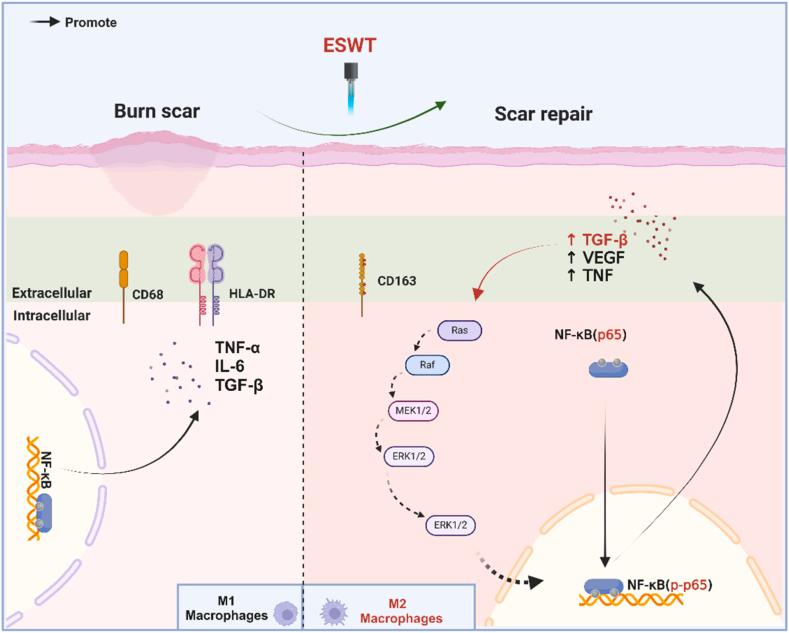
Extracorporeal Shock Wave Therapy (ESWT) plays a key role in burn scar treatment through its immunoregulatory effects, influencing inflammation, fibrosis remodeling, and angiogenesis. These mechanisms collectively mediate scar repair, highlighting the importance of ESWT in restoring tissue homeostasis. However, its clinical efficacy depends on precise optimization of parameters such as energy flux density, pulse frequency, and treatment duration. Without proper adjustments, its therapeutic potential may be limited. This review systematically explores ESWT-mediated immunoregulation in scar formation and repair, addressing its impact on inflammatory responses, tissue fibrosis, and abnormal angiogenesis. Furthermore, we discuss challenges in optimizing treatment parameters, developing personalized strategies, and enhancing clinical translation. By focusing on immunoactivation signaling pathways, this review provides mechanistic insights into ESWT's role in burn scar management and underscores its potential for precision therapy. Ultimately, it offers a theoretical foundation and practical guidance for advancing standardized clinical applications of ESWT.
体外冲击波疗法(ESWT)通过其免疫调节作用在烧伤瘢痕治疗中发挥关键作用,影响炎症、纤维化重塑和血管生成。这些机制共同介导瘢痕修复,凸显了ESWT在恢复组织内环境稳定中的重要性。然而,其临床疗效取决于能量通量密度、脉冲频率和治疗持续时间等参数的精确优化。若未进行适当调整,其治疗潜力可能会受到限制。本综述系统地探讨了ESWT介导的瘢痕形成和修复中的免疫调节,阐述了其对炎症反应、组织纤维化和异常血管生成的影响。此外,我们还讨论了优化治疗参数、制定个性化策略以及加强临床转化方面的挑战。通过关注免疫激活信号通路,本综述提供了关于ESWT在烧伤瘢痕管理中作用的机制性见解,并强调了其精准治疗的潜力。最终,它为推进ESWT的标准化临床应用提供了理论基础和实践指导。


 Zotero 插件