
2型糖尿病患者全身免疫炎症指数与足部溃疡截肢风险的关联:一项横断面研究的见解
Association of Systemic Immune-Inflammatory Index with Risk of Foot Ulcer Amputation in Patients with Type 2 Diabetes Mellitus: Insights from a Cross-Sectional Study.
作者信息
Huang Zhongjie, Zheng Xifan, Liang Hao, Zhong Song Yang, Meng Jinzhi, Yao Jun
机构信息
Bone and Joint Surgery, The First Affiliated Hospital of Guangxi Medical University, Nanning, Guangxi, People's Republic of China.
Bone and Joint Surgery, The Sixth Affiliated Hospital of Guangxi Medical University (The First People's Hospital of Yulin), Yulin, Guangxi, People's Republic of China.
出版信息
J Inflamm Res. 2025 Jun 24;18:8295-8304. doi: 10.2147/JIR.S517693. eCollection 2025.
OBJECTIVE
Diabetic foot ulcer (DFU) is one of the complications of diabetes, which can lead to amputation and death. The systemic immune-inflammatory index (SII), calculated based on platelet, neutrophil, and lymphocyte counts, serves as a cost-effective and practical biomarker. This study aimed to explore the relationship between SII and amputation risk in patients with DFU.
METHODS
In this cross-sectional study, all eligible patients were divided into an amputation group and a non-amputation group based on their amputation status. Laboratory test data obtained on the first day of hospitalization were collected for all patients. SII was calculated from complete blood count parameters. Subgroup analysis, univariate analysis, and multivariate logistic regression were employed to assess the association between SII and amputation in patients with DFUs. Receiver operating characteristic (ROC) curves were used to evaluate the predictive accuracy of SII for amputation risk.
RESULTS
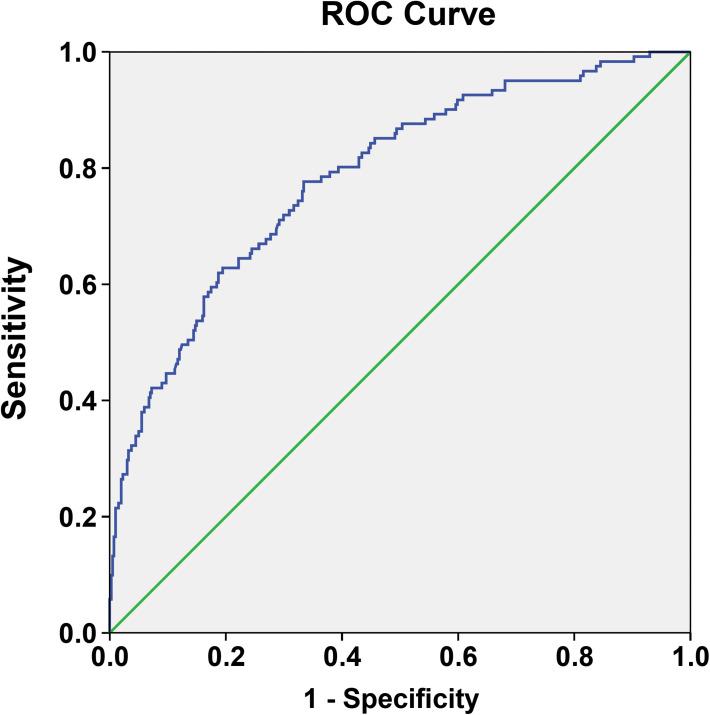
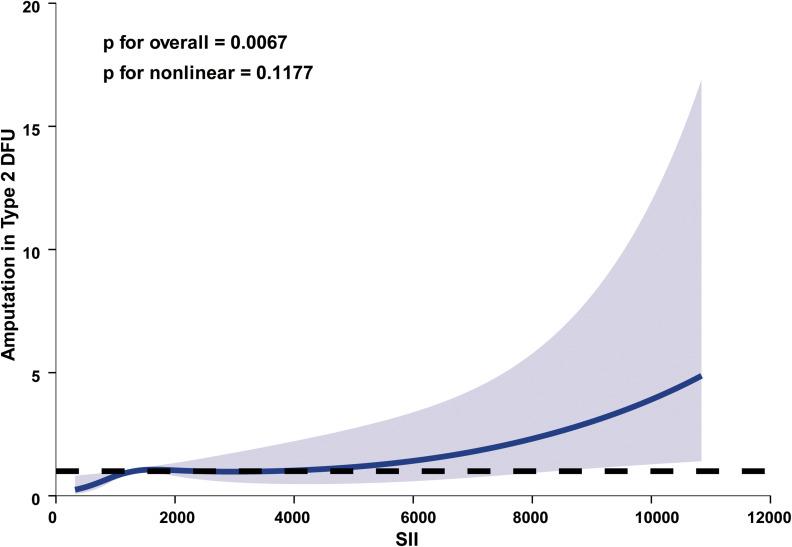
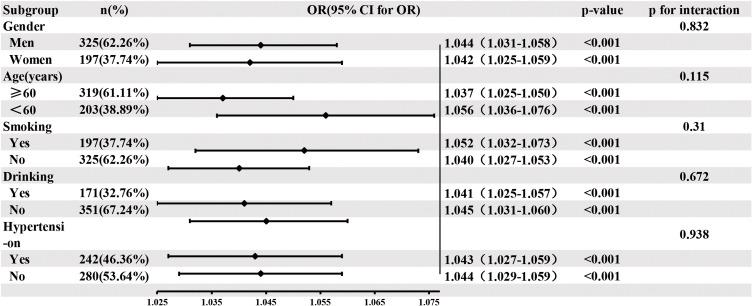
The amputation group exhibited significantly higher SII levels compared to the non-amputation group (p < 0.05). Multivariate logistic regression analysis, after adjusting for all covariates, revealed that SII remained independently associated with DFU-related amputation (OR = 1.019; 95% CI: 1.007-1.031; p = 0.002). Subgroup analyses and interaction tests demonstrated that this positive association was not modified by age, sex, hypertension, smoking, or alcohol consumption (p for interaction > 0.05). In the ROC curve analysis, SII achieved an area under the curve (AUC) of 0.786 with a sensitivity of 77.70%. Reclassification based on propensity score matching showed that SII was significantly higher in the high-risk group than in the low-risk group(p < 0. 05).
CONCLUSION
Higher SII levels in patients with type 2 DFU raise the risk of amputation. For assessing the risk of amputation in patients with DFUs, SII is likely to be a valuable biomarker for DFU amputation.
目的
糖尿病足溃疡(DFU)是糖尿病的并发症之一,可导致截肢和死亡。基于血小板、中性粒细胞和淋巴细胞计数计算的全身免疫炎症指数(SII)是一种经济高效且实用的生物标志物。本研究旨在探讨DFU患者中SII与截肢风险之间的关系。
方法
在这项横断面研究中,所有符合条件的患者根据其截肢状态分为截肢组和非截肢组。收集所有患者在住院第一天获得的实验室检查数据。根据全血细胞计数参数计算SII。采用亚组分析、单因素分析和多因素逻辑回归来评估DFU患者中SII与截肢之间的关联。采用受试者工作特征(ROC)曲线评估SII对截肢风险的预测准确性。
结果
截肢组的SII水平显著高于非截肢组(p<0.05)。在对所有协变量进行调整后的多因素逻辑回归分析显示,SII仍然与DFU相关截肢独立相关(OR=1.019;95%CI:1.007 - 1.031;p=0.002)。亚组分析和交互检验表明,这种正相关不受年龄、性别、高血压、吸烟或饮酒的影响(交互作用p>0.05)。在ROC曲线分析中,SII的曲线下面积(AUC)为0.786,敏感性为77.70%。基于倾向评分匹配的重新分类显示,高危组的SII显著高于低危组(p<0.05)。
结论
2型DFU患者中较高的SII水平会增加截肢风险。对于评估DFU患者的截肢风险,SII可能是DFU截肢的一种有价值的生物标志物。
 Zotero 插件