
意大利人工智能(AI)在早期检测有肝细胞癌风险的肝硬化患者肝脏病变中的成本效益分析。
Cost-effectiveness analysis of artificial intelligence (AI) in earlier detection of liver lesions in cirrhotic patients at risk of hepatocellular carcinoma in Italy.
作者信息
Maas L, Contreras-Meca C, Ghezzo S, Belmans F, Corsi A, Cant J, Vos W, Bobowicz M, Rygusik M, Laski D K, Annemans L, Hiligsmann M
机构信息
Radiomics.bio, Liege, Belgium.
Department of Health Services Research, Care and Public Health Research Institute, Maastricht University, Maastricht, The Netherlands.
出版信息
J Med Econ. 2025 Dec;28(1):1023-1036. doi: 10.1080/13696998.2025.2525006. Epub 2025 Jul 11.
BACKGROUND
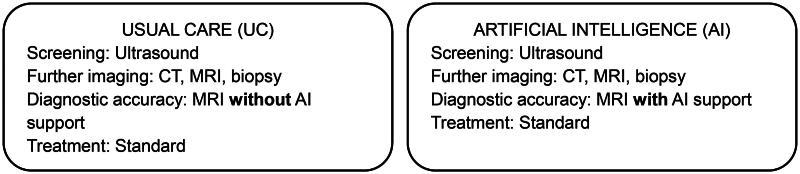
Hepatocellular carcinoma (HCC) is the fifth most common cancer worldwide and the third most common cause of cancer-related death. Cirrhosis is a major contributing factor, accounting for over 90% of HCC cases. With the high mortality rate of HCC, earlier detection of HCC is critical. When added to magnetic resonance imaging (MRI), artificial intelligence (AI) has been shown to improve HCC detection. Nonetheless, to date no cost-effectiveness analyses have been conducted on an AI tool to enhance earlier HCC detection. This study reports on the cost-effectiveness of detection of liver lesions with AI improved MRI in the surveillance for HCC in patients with a cirrhotic liver compared to usual care (UC).
METHODS
The model structure included a decision tree followed by a state-transition Markov model from an Italian healthcare perspective. Lifetime costs and quality-adjusted life years (QALY) were simulated in cirrhotic patients at risk of HCC. One-way sensitivity analyses and two-way sensitivity analyses were performed. Results were presented as incremental cost-effectiveness ratios (ICER).
RESULTS
For patients receiving UC, the average lifetime costs per 1,000 patients were €16,604,800 compared to €16,610,250 for patients receiving the AI approach. With a QALY gained of 0.55 and incremental costs of €5,000 for every 1,000 patients, the ICER was €9,888 per QALY gained, indicating cost-effectiveness with the willingness-to-pay threshold of €33,000/QALY gained. Main drivers of cost-effectiveness included the cost and performance (sensitivity and specificity) of the AI tool.
DISCUSSION
This study suggests that an AI-based approach to detect HCC earlier in cirrhotic patients can be cost-effective. By incorporating cost-effective AI-based approaches in clinical practice, patient outcomes and healthcare efficiency are improved.
背景
肝细胞癌(HCC)是全球第五大常见癌症,也是癌症相关死亡的第三大常见原因。肝硬化是一个主要促成因素,占HCC病例的90%以上。鉴于HCC的高死亡率,早期检测HCC至关重要。当与磁共振成像(MRI)相结合时,人工智能(AI)已被证明可提高HCC检测率。尽管如此,迄今为止尚未对用于增强HCC早期检测的AI工具进行成本效益分析。本研究报告了与常规护理(UC)相比,在肝硬化患者的HCC监测中,使用AI改进的MRI检测肝脏病变的成本效益。
方法
从意大利医疗保健的角度来看,模型结构包括一个决策树,随后是一个状态转换马尔可夫模型。对有HCC风险的肝硬化患者的终身成本和质量调整生命年(QALY)进行了模拟。进行了单向敏感性分析和双向敏感性分析。结果以增量成本效益比(ICER)表示。
结果
对于接受UC的患者,每1000名患者的平均终身成本为16,604,800欧元,而接受AI方法的患者为16,610,250欧元。每1000名患者获得的QALY为0.55,增量成本为5000欧元,ICER为每获得一个QALY 9888欧元,表明在支付意愿阈值为每获得一个QALY 33,000欧元的情况下具有成本效益。成本效益的主要驱动因素包括AI工具的成本和性能(敏感性和特异性)。
讨论
本研究表明,在肝硬化患者中早期检测HCC的基于AI的方法具有成本效益。通过在临床实践中纳入具有成本效益的基于AI的方法,可以改善患者预后和医疗效率。


 Zotero 插件