
乙二胺四乙酸(EDTA)管适用于资源有限环境下的胰岛素和C肽检测,且可在室温下储存长达24小时。
EDTA tubes are suitable for insulin and C-peptide measurement in resource-limited settings and can be stored at room temperature for up to 24 hours.
作者信息
Mubiru Nathan, Mukasa Rogers, Sekitoleko Isaac, Balungi Priscilla A, Kakumba Ronald M, Ongaria Terry, Nkabura Hubert, Nyirenda Moffat, Niwaha Anxious J, Nakanga Wisdom P
机构信息
Clinical Diagnostic Laboratory Medical Research Council/ Uganda Virus Research Institute and LSHTM Uganda Research Unit, Entebbe, Uganda.
Non-communicable diseases Theme, Medical Research Council/Uganda Virus Research Institute and LSHTM Uganda Research Unit, Entebbe, Uganda.
出版信息
PLoS One. 2025 Jun 30;20(6):e0312065. doi: 10.1371/journal.pone.0312065. eCollection 2025.
INTRODUCTION
Insulin and C-peptide assessment are important in characterization and management of diabetes. However, their adoption and increased clinical use in low resource settings (LRSs) is partly hindered by logistical factors including supplies required for pre-analytical sample handling and limited infrastructure. We aimed to determine the effects of altered sample processing conditions on stability of insulin and C-peptide at the pre-analytical stage.
METHODS
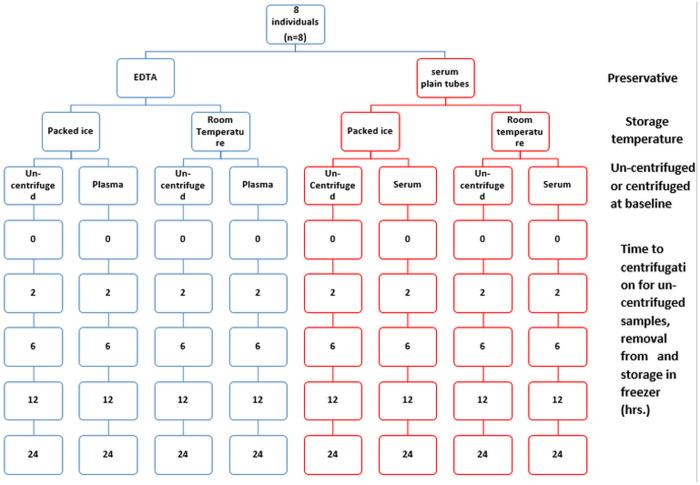
Random (non-fasted) blood samples were drawn from ten healthy (glucose range 4.1-8.0 mmol/L) participants. We investigated the mean % change from baseline of C-peptide and insulin in serum (plain tubes) vs plasma (K2EDTA tubes), centrifuged vs uncentrifuged, room vs cool box temperature on the stability of C-peptide and insulin up to 24 hours using Wilcoxon signed rank test. Results were considered clinically significant if the percentage change was > 10% and if the p-value was < 0.05.
RESULTS
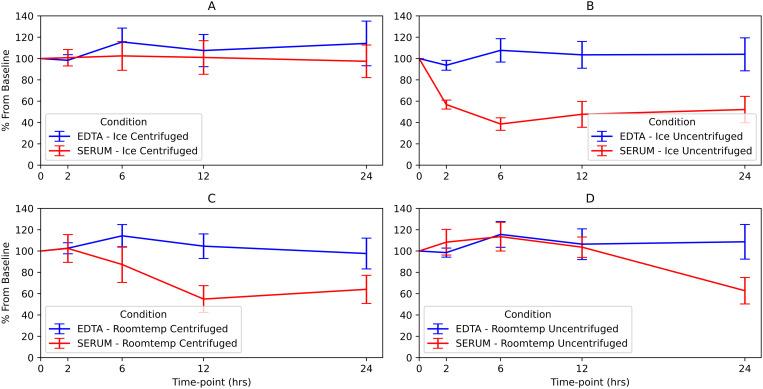
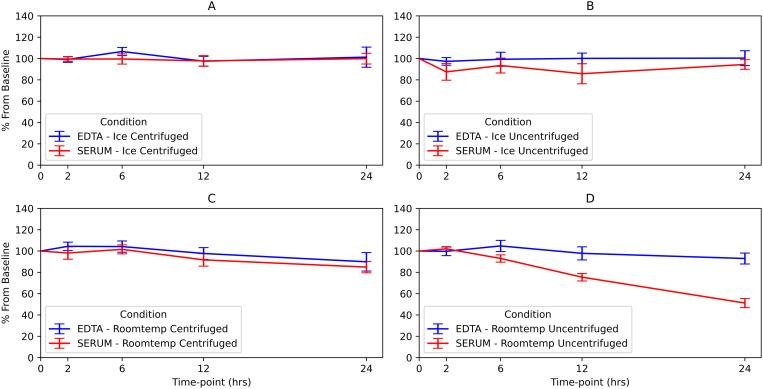
Eight patients were included in the final analysis, while two were excluded due to hemolysis. C-peptide and insulin levels stayed above 90% of the baseline concentration in K2EDTA tubes across all storage and processing conditions for up to 24 hours. In contrast, samples collected in plain serum tubes kept at room temperature and uncentrifuged, C-peptide and insulin levels decreased significantly to 51% (p = 0.006) and 62% (p = 0. 083) respectively, similarly insulin levels for centrifuged samples declined to 64% (p = 0.083). All iced and centrifuged serum samples remained above 90% of baseline concentration.
CONCLUSIONS
In resource-limited settings where insulin and C-peptide tests are limited to central laboratories and highly dependent on sample referral systems, these tests can be reliably measured without the need for immediate centrifugation or processing from samples collected in whole blood K2EDTA tubes uncentrifuged kept at room temperature and processed within 24hours.
引言
胰岛素和C肽评估在糖尿病的特征描述和管理中很重要。然而,在资源匮乏地区(LRSs),其应用及临床使用的增加部分受到后勤因素的阻碍,包括分析前样本处理所需的用品和有限的基础设施。我们旨在确定分析前阶段样本处理条件改变对胰岛素和C肽稳定性的影响。
方法
从10名健康(血糖范围4.1 - 8.0 mmol/L)参与者中采集随机(非空腹)血样。我们使用Wilcoxon符号秩检验,研究血清(普通试管)与血浆(K2EDTA试管)、离心与未离心、室温与冷藏箱温度条件下,C肽和胰岛素从基线的平均变化百分比,以评估长达24小时内C肽和胰岛素的稳定性。如果变化百分比>10%且p值<0.05,则结果被认为具有临床意义。
结果
最终分析纳入8例患者,2例因溶血被排除。在所有储存和处理条件下,K2EDTA试管中的C肽和胰岛素水平在长达24小时内保持在基线浓度的90%以上。相比之下,保存在室温且未离心的普通血清试管中采集的样本,C肽和胰岛素水平分别显著下降至51%(p = 0.006)和62%(p = 0.083),同样,离心样本的胰岛素水平下降至64%(p = 0.083)。所有冷冻并离心的血清样本仍保持在基线浓度的90%以上。
结论
在资源有限的环境中,胰岛素和C肽检测仅限于中心实验室且高度依赖样本送检系统,对于从室温下未离心保存且在24小时内处理的全血K2EDTA试管中采集的样本,无需立即离心或处理即可可靠地进行这些检测。
 Zotero 插件