
拟南芥CNL受体SUT1赋予水孔对维管束病原体野油菜黄单胞菌野油菜致病变种的免疫能力。
Arabidopsis CNL receptor SUT1 confers immunity in hydathodes against the vascular pathogen Xanthomonas campestris pv. campestris.
作者信息
Taks Nanne W, van Hulten Marieke, van Splunter-Berg Jeroen A, Chatterjee Sayantani, Stevens Floris D, Paauw Misha, Pfeilmeier Sebastian, van den Burg Harrold A
机构信息
Molecular Plant Pathology, Swammerdam Institute for Life Sciences, Faculty of Science, University of Amsterdam, Amsterdam, the Netherlands.
Rijk Zwaan Zaadteelt en Zaadhandel B.V. De Lier, The Netherlands.
出版信息
PLoS Pathog. 2025 Jun 30;21(6):e1013256. doi: 10.1371/journal.ppat.1013256. eCollection 2025 Jun.
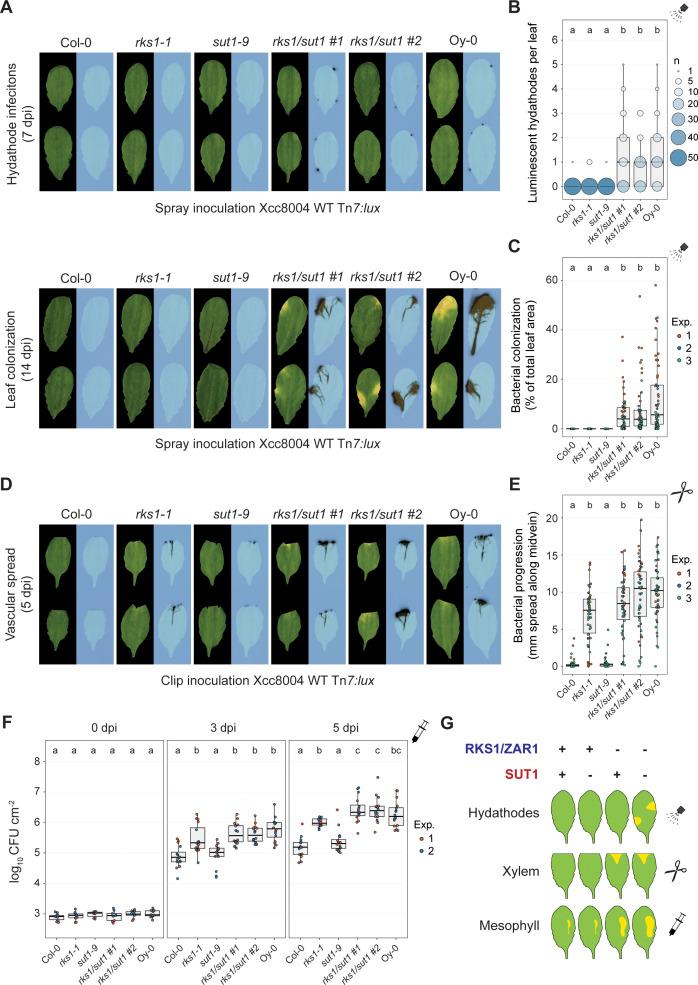
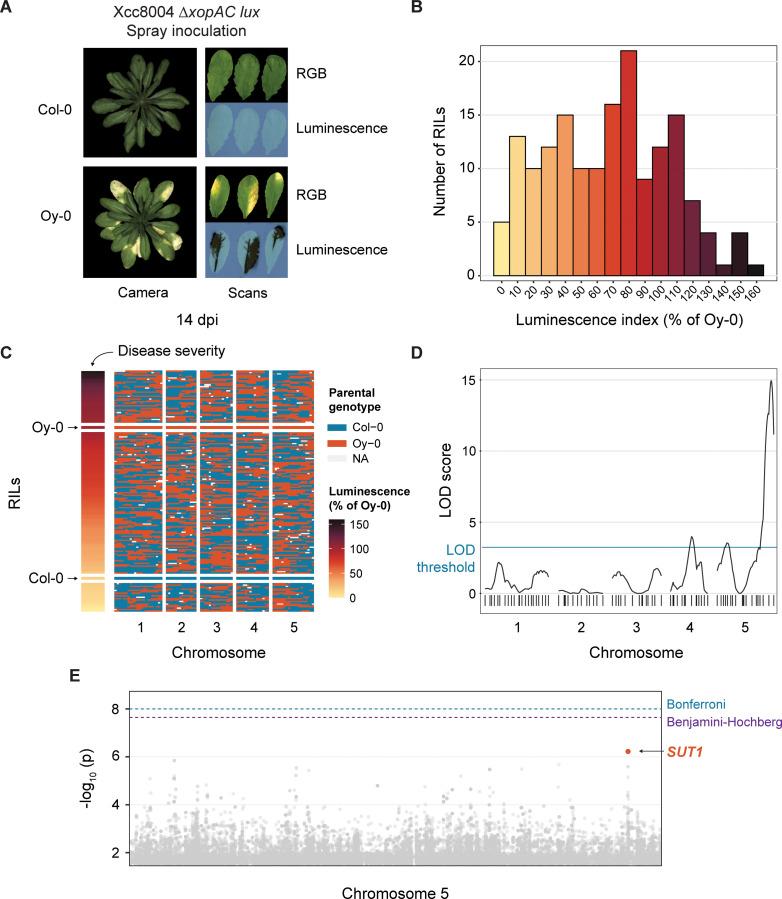
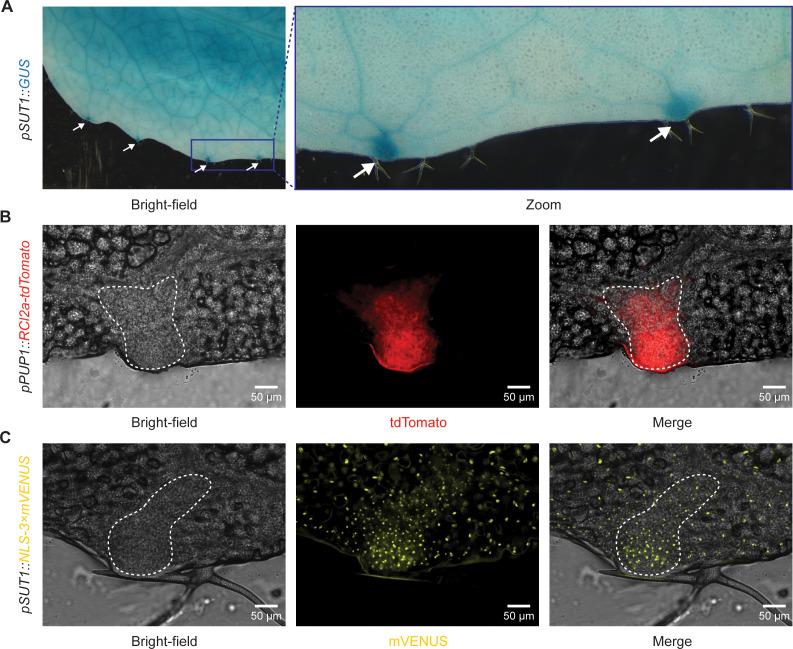
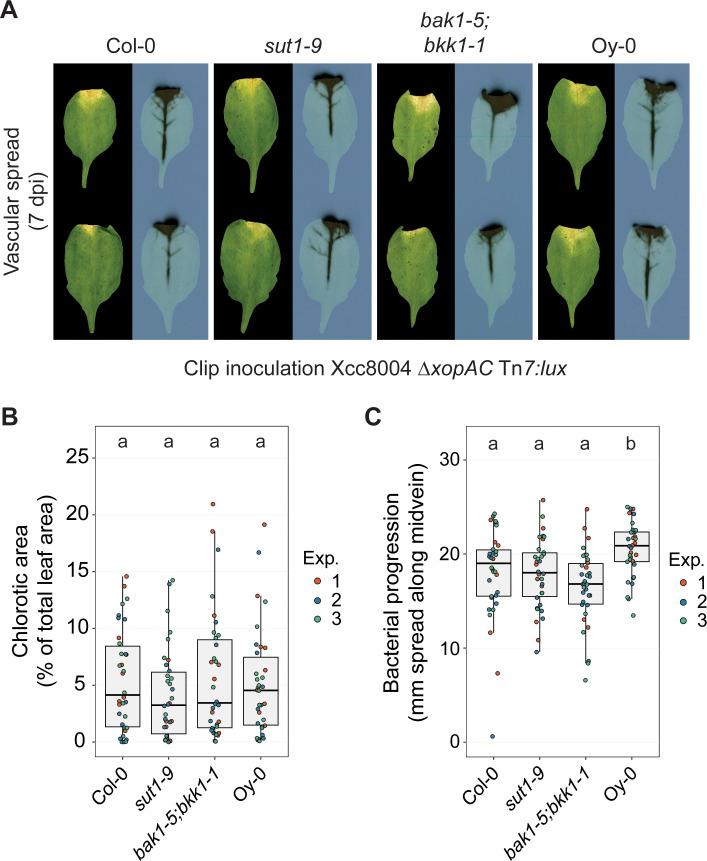
Bacterial plant pathogens exploit natural openings, such as pores or wounds, to enter the plant interior and cause disease. Plants guard these openings through defense mechanisms. However, bacteria from the genus Xanthomonas have specialized in that they enter their host via a special entry point, the hydathode-an organ at the leaf margin involved in xylem sap guttation. Hydathodes can mount an immune response against bacteria, including non-adapted and adapted pathogens like X. campestris pv. campestris (Xcc) that cause vascular disease. Previously, it was shown that the RKS1/ZAR1 immune complex confers vascular resistance against Xcc by recognizing XopAC activity, a type III effector (T3E). However, in absence of XopAC recognition, Arabidopsis Col-0 hydathodes still display resistance against Xcc. Here we mapped the causal gene using an inoculation method that promotes Xcc hydathode entry. Using a population of Recombinant Inbred Lines (RILs) of a cross between a susceptible (Oy-0) and resistant accession (Col-0), a major QTL for Xcc resistance was found on the right arm of Chromosome 5 in Col-0. Combining this result with a genome-wide association analysis yielded a single candidate gene encoding a coiled-coil nucleotide-binding leucine-rich repeat (CNL-type) immune receptor protein called SUPPRESSOR OF TOPP4 1 (SUT1). Expression of SUT1 was confirmed in hydathodes. We reveal that RKS1/ZAR1 and SUT1 confer different levels of Xcc resistance in different tissue types. Both RKS1/ZAR1 and SUT1 are alone sufficient for Xcc resistance in Col-0 hydathodes. However, RKS1/ZAR1 resistance is also effective in tissue types that represent late infection stages, i.e., xylem and mesophyll. In contrast, SUT1 resistance is not effective in the xylem, while weakly additive to RKS1/ZAR1 in the mesophyll. We thus identify a novel R gene, SUT1, that confers Xcc resistance primarily early in the infection during hydathode colonization.
细菌性植物病原菌利用自然开口,如气孔或伤口,进入植物内部并引发病害。植物通过防御机制保护这些开口。然而,黄单胞菌属的细菌具有特殊性,它们通过一个特殊的入口点——排水器(一种位于叶缘、参与木质部汁液吐水的器官)进入宿主。排水器能够对细菌产生免疫反应,包括对非适应性和适应性病原菌,如引起维管束病害的野油菜黄单胞菌野油菜致病变种(Xcc)。此前研究表明,RKS1/ZAR1免疫复合物通过识别III型效应子(T3E)XopAC的活性赋予对Xcc的维管束抗性。然而,在缺乏对XopAC识别的情况下,拟南芥Col-0排水器仍对Xcc表现出抗性。在此,我们使用一种促进Xcc进入排水器的接种方法定位了致病基因。利用易感品系(Oy-0)和抗性品系(Col-0)杂交产生的重组自交系(RIL)群体,在Col-0的第5号染色体右臂上发现了一个对Xcc抗性的主要数量性状位点(QTL)。将这一结果与全基因组关联分析相结合,得到了一个单一的候选基因,该基因编码一种卷曲螺旋核苷酸结合富含亮氨酸重复序列(CNL型)免疫受体蛋白,称为TOPP4 1抑制因子(SUT1)。SUT1在排水器中的表达得到了证实。我们发现RKS1/ZAR1和SUT1在不同组织类型中赋予不同水平的Xcc抗性。RKS1/ZAR1和SUT1单独都足以使Col-0排水器对Xcc产生抗性。然而,RKS1/ZAR1抗性在代表后期感染阶段的组织类型,即木质部和叶肉中也有效。相比之下,SUT1抗性在木质部中无效,而在叶肉中对RKS1/ZAR1具有微弱的累加作用。因此,我们鉴定出一个新的抗病基因SUT1,它主要在感染早期排水器定殖期间赋予对Xcc的抗性。

 Zotero 插件