
2型糖尿病患者发生高血压的危险因素:一项横断面研究。
Risk factors for developing hypertension in patients with type 2 diabetes: A cross-sectional study.
作者信息
Liu Lu, Mu Jie, Wang Xixiang, Gu Yiyao, Zhou Shaobo, Ma Xiaojun, Xu Jingjing, Liu Yu, Ren Xiuwen, Duan Zhi, Yuan Linhong, Wang Ying
机构信息
Beijing Key Laboratory of environment and aging, School of Public Health, Capital Medical University, Beijing, PR China.
Suzhou Research Center of Medical School, Suzhou Hospital, Affiliated Hospital of Medical School, Nanjing University, Suzhou, PR China.
出版信息
Medicine (Baltimore). 2025 Jun 27;104(26):e43104. doi: 10.1097/MD.0000000000043104.
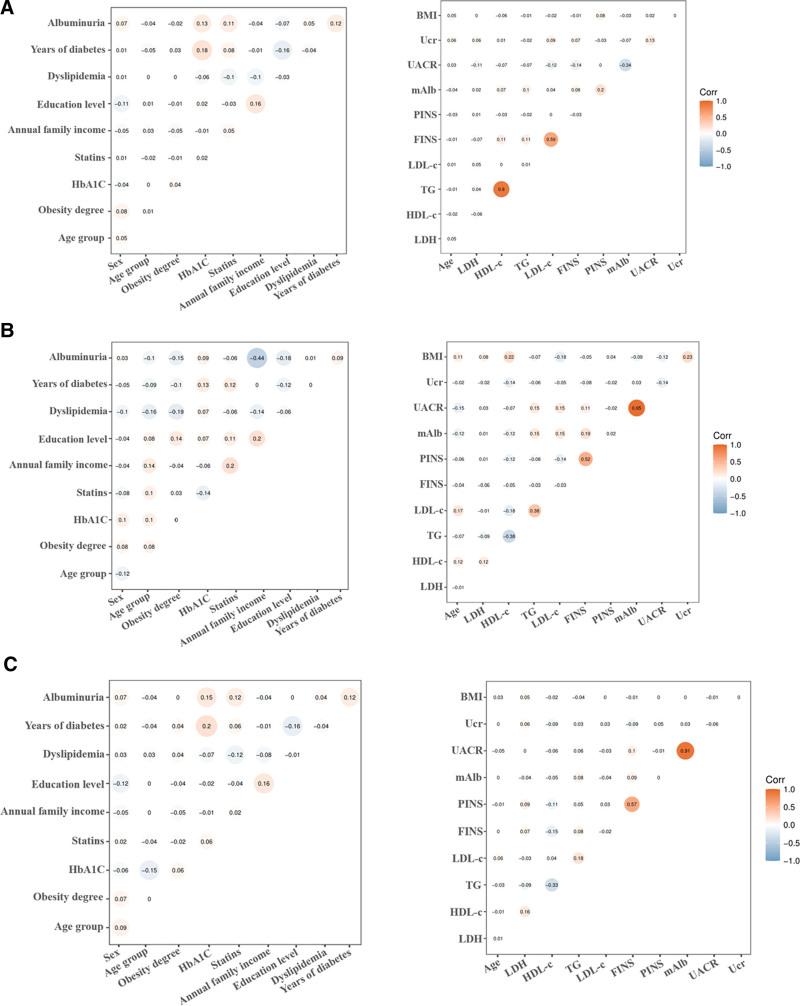
This study explores the prevalence of hypertension in patients with type 2 diabetes mellitus (T2DM) and identifies the potential risk factors associated with the development of hypertension. A cross-sectional study was conducted among 699 T2DM patients. Demographic data and clinical parameters were collected using structured questionnaires and physical examinations. Binary logistic regression was used to assess associations between hypertension and potential risk factors, adjusting for confounders. Body mass index was positively associated with uric acid levels and high-density lipoprotein cholesterol (HDL-c) in the non-hypertensive group. In the hypertensive group, HDL-c was positively correlated with fasting insulin, postprandial insulin, and triglycerides. The primary factors associated with hypertension in patients with T2DM include glycosylated hemoglobin A1C (odds ratio [OR] = 0.54, 95% confidence interval [CI]: 0.32-0.92, P = .02), HDL-c (OR = 0.54, 95% CI: 0.23-0.86, P = .02), education level (OR = 0.44, 95% CI: 0.23-0.82, P = .01), lactate dehydrogenase (OR = 1.01, 95% CI: 1.00-1.02, P = .01), urinary albumin-to-creatinine ratio (OR = 0.97, 95% CI: 0.94-1.00, P = .03), and microalbumin (OR = 1.01, 95% CI: 1.00-1.01, P = .02). Hemoglobin A1c, HDL-c, lactate dehydrogenase, urinary albumin-to-creatinine ratio, microalbumin, and postprandial insulin are critical predictors of hypertension in individuals with T2DM. In conjunction with lifestyle modifications aimed at weight management and glycemic control, regular monitoring of these biomarkers is recommended to prevent hypertension in diabetes management.
本研究探讨2型糖尿病(T2DM)患者中高血压的患病率,并确定与高血压发生相关的潜在危险因素。对699例T2DM患者进行了一项横断面研究。使用结构化问卷和体格检查收集人口统计学数据和临床参数。采用二元逻辑回归评估高血压与潜在危险因素之间的关联,并对混杂因素进行校正。在非高血压组中,体重指数与尿酸水平和高密度脂蛋白胆固醇(HDL-c)呈正相关。在高血压组中,HDL-c与空腹胰岛素、餐后胰岛素和甘油三酯呈正相关。T2DM患者中与高血压相关的主要因素包括糖化血红蛋白A1C(比值比[OR]=0.54,95%置信区间[CI]:0.32-0.92,P=0.02)、HDL-c(OR=0.54,95%CI:0.23-0.86,P=0.02)、教育水平(OR=0.44,95%CI:0.23-0.82,P=0.01)、乳酸脱氢酶(OR=1.01,95%CI:1.00-1.02,P=0.01)、尿白蛋白与肌酐比值(OR=0.97,95%CI:0.94-1.00,P=0.03)和微量白蛋白(OR=1.01,95%CI:1.00-1.01,P=0.02)。血红蛋白A1c、HDL-c、乳酸脱氢酶、尿白蛋白与肌酐比值、微量白蛋白和餐后胰岛素是T2DM患者高血压的关键预测指标。在进行旨在体重管理和血糖控制的生活方式改变的同时,建议定期监测这些生物标志物,以预防糖尿病管理中的高血压。


 Zotero 插件