
对女性血管舒缩症状体验的质性探索,以支持患者报告结局的内容效度。
Qualitative exploration of women's experiences of vasomotor symptoms to support the content validity of patient-reported outcomes.
作者信息
Haberland Claudia, Barclay Melissa, Whyman Sophie, Lehane Asha, Gater Adam, Gerlinger Christoph, Seitz Christian, Francuski Maja, Schoof Nils, Trigg Andrew, Bradley Helena
机构信息
Bayer AG, Berlin, Germany.
Adelphi Values, Cheshire, UK.
出版信息
J Patient Rep Outcomes. 2025 Jul 1;9(1):79. doi: 10.1186/s41687-025-00914-0.
BACKGROUND
Frequency and severity of vasomotor symptoms (VMS; hot flashes) associated with menopause significantly impact women's health-related quality of life (HRQoL). Treatment benefit in VMS clinical trials is assessed using patient-reported outcome (PRO) measures, which must demonstrate evidence of content validity. This research aimed to establish a conceptual model in VMS and evaluate content validity of the Hot Flash Daily Diary (HFDD), PROMIS Sleep Disturbance Short Form 8b (PROMIS SD SF 8b), and Menopause-Specific Quality of Life (MENQOL) questionnaire for use in VMS clinical trials.
METHODS
Targeted searches were conducted to identify qualitative literature documenting women's VMS experiences. Qualitative concept elicitation (CE) and cognitive interviews (CI) were then conducted with 20 US participants experiencing VMS (n = 10 postmenopause; n = 10 AET-treated). Literature and CE findings were used to develop a conceptual model and confirm conceptual coverage of PRO measures selected for assessing efficacy in VMS clinical trials. CIs assessed the content validity of PRO measures.
RESULTS
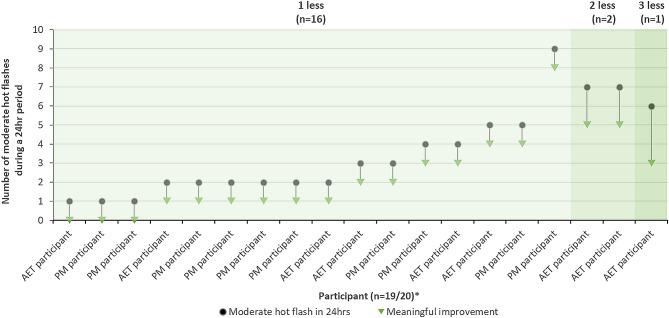
Findings from the literature and CE interviews informed a conceptual model depicting women's experiences of VMS. Thirty-three symptom concepts were identified with key symptoms including sweating, cold sweats/chills and tiredness/fatigue. Impacts of VMS on HRQoL were categorized into seven domains: sleep, emotional wellbeing, activities of daily living, social wellbeing, work/education, cognitive and physical functioning. The concepts assessed by the HFDD (VMS severity and frequency), PROMIS SD SF 8b (sleep disturbance) and MENQOL (menopause-related quality of life) aligned with those endorsed by women as relevant to their VMS experience. Instructions, recall periods and response options of the measures were understood. A reduction of one moderate or one severe hot flash in 24-hours (assessed by the HFDD) was considered a meaningful improvement by participants. Similar observations were made across study samples.
CONCLUSIONS
Findings provide detailed insights into women's experience of VMS, supporting the development of a conceptual model and assessment of conceptual coverage of selected PRO measures. Content validity of the HFDD, PROMIS SD SF 8b, and MENQOL for use in VMS clinical trials was supported. CI results suggest that a reduction of one moderate or one severe hot flash in 24-hours is meaningful to women with VMS.
背景
与更年期相关的血管舒缩症状(VMS;潮热)的频率和严重程度对女性的健康相关生活质量(HRQoL)有显著影响。VMS临床试验中的治疗益处是使用患者报告结局(PRO)指标进行评估的,这些指标必须证明具有内容效度的证据。本研究旨在建立VMS的概念模型,并评估潮热每日日记(HFDD)、患者报告结果测量信息系统睡眠障碍简表8b(PROMIS SD SF 8b)和更年期特异性生活质量(MENQOL)问卷在VMS临床试验中的内容效度。
方法
进行有针对性的检索,以识别记录女性VMS经历的定性文献。然后对20名有VMS经历的美国参与者(n = 10名绝经后女性;n = 10名接受激素替代疗法治疗的女性)进行定性概念引出(CE)和认知访谈(CI)。文献和CE结果用于建立概念模型,并确认所选用于评估VMS临床试验疗效的PRO指标的概念覆盖范围。CI评估了PRO指标的内容效度。
结果
文献和CE访谈的结果形成了一个描述女性VMS经历的概念模型。确定了33个症状概念,主要症状包括出汗、冷汗/寒战和疲倦/疲劳。VMS对HRQoL的影响分为七个领域:睡眠、情绪健康、日常生活活动、社交健康、工作/教育、认知和身体功能。HFDD(VMS严重程度和频率)、PROMIS SD SF 8b(睡眠障碍)和MENQOL(更年期相关生活质量)评估的概念与女性认可的与她们的VMS经历相关的概念一致。这些指标的说明、回忆期和回答选项都能被理解。参与者认为24小时内中度或重度潮热减少一次(由HFDD评估)是有意义的改善。在不同研究样本中也有类似的观察结果。
结论
研究结果提供了关于女性VMS经历的详细见解,支持了概念模型的建立以及所选PRO指标概念覆盖范围的评估。支持HFDD、PROMIS SD SF 8b和MENQOL在VMS临床试验中的内容效度。CI结果表明,24小时内中度或重度潮热减少一次对有VMS的女性有意义。


 Zotero 插件