
使用靶向VEGFR2的微泡进行超声造影,以监测联合抗PD-L1/抗CTLA-4免疫疗法在小鼠黑色素瘤模型中的效果,并进行免疫组织化学验证。
Contrast-enhanced ultrasound with VEGFR2-targeted microbubbles for monitoring combined anti-PD-L1/anti-CTLA-4 immunotherapy effects in a murine melanoma model with immunohistochemical validation.
作者信息
Herr Felix L, Antons Melissa J, Blume Larissa V, Hirner-Eppeneder Heidrun, Kloiber-Langhorst Sandra, Cimic Amra, Stueckl Jennifer, Tardy Isabelle, Burkard Tanja, Ricke Jens, Kunz Wolfgang G, Clevert Dirk-Andre, Heimer Maurice M, Cyran Clemens C
机构信息
Department of Radiology, LMU University Hospital Munich, Munich, Germany.
Bracco Suisse South Australia, Geneva, Switzerland.
出版信息
PLoS One. 2025 Jul 1;20(7):e0326675. doi: 10.1371/journal.pone.0326675. eCollection 2025.
BACKGROUND
Immune checkpoint inhibitors (ICIs) have emerged as a highly effective treatment option for patients with metastatic melanoma. As not all patients respond to ICI immunotherapy, imaging biomarkers are required to accurately monitor early response to therapy. Therefore, the aim of this study was to evaluate contrast-enhanced ultrasound (CEUS) with VEGFR2-targeted microbubbles for monitoring the effects of combined anti-PD-L1/anti-CTLA-4 immunotherapy in a murine melanoma model.
METHODS
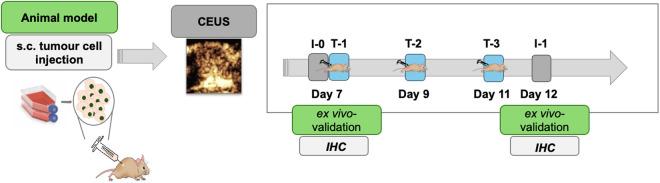
Murine melanoma allografts (B16-F10) were implanted subcutaneously in n = 10 therapy and n = 10 control female C57BL/6 mice. CEUS with VEGFR2-targeted microbubbles was performed on day 7 and 12. The therapy group received 3 intraperitoneal injections on days 7, 9, 11 of combined anti-PD-L1/anti-CTLA-4 immunotherapy, the control group received a placebo. CEUS assessed tumour perfusion during an early vascular phase (wash-in area under the curve = WiAUC) and VEGFR2-specific binding during a late molecular phase (signal intensity at 8 minutes (SI8min) and 10 minutes (SI10min)). For pathophysiological validation immunohistochemistry was performed.
RESULTS
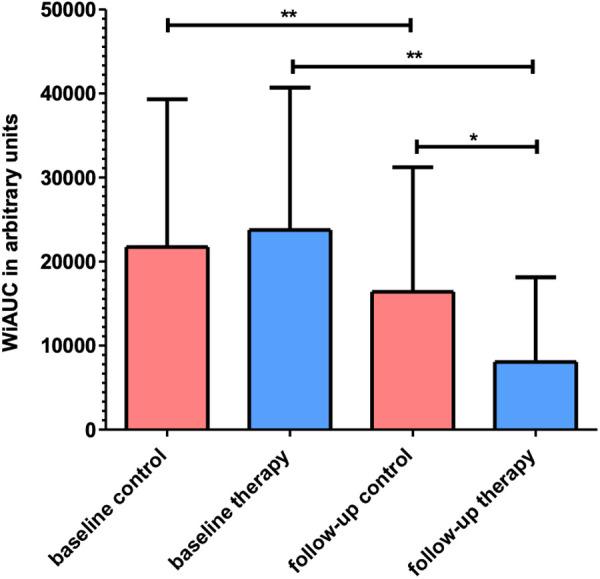
At follow-up, the CEUS perfusion parameter WiAUC demonstrated a significantly higher decrease in the therapy than in the control group (p = 0.021). At follow-up, the signal enhancement in the late phase was significantly lower in the therapy than in the control group (SI8min p = 0.003; SI10min p = 0.002). Immunohistochemistry revealed significantly more apoptotic tumour cells (p = 0.001), more tumour infiltrating lymphocytes (p = 0.049), lower tumour cell proliferation (p = 0.001), lower microvascular density (p = 0.003) and lower VEGFR2 expression (p = 0.003) in the therapy than in the control group.
CONCLUSIONS
CEUS with VEGFR2-targeted microbubbles allowed for monitoring early treatment effects of a combined anti-PD-L1/anti-CTLA-4 immunotherapy on melanoma allografts with significantly lower tumour perfusion and significantly lower binding of VEGFR2-targeted microbubbles in the therapy than in the control group.
背景
免疫检查点抑制剂(ICIs)已成为转移性黑色素瘤患者的一种高效治疗选择。由于并非所有患者都对ICI免疫疗法有反应,因此需要影像学生物标志物来准确监测治疗的早期反应。因此,本研究的目的是评估使用靶向VEGFR2的微泡的超声造影(CEUS)在小鼠黑色素瘤模型中监测联合抗PD-L1/抗CTLA-4免疫疗法的效果。
方法
将小鼠黑色素瘤同种异体移植物(B16-F10)皮下植入n = 10只治疗组和n = 10只对照雌性C57BL/6小鼠体内。在第7天和第12天进行使用靶向VEGFR2的微泡的CEUS检查。治疗组在第7、9、11天接受3次联合抗PD-L1/抗CTLA-4免疫疗法的腹腔注射,对照组接受安慰剂。CEUS评估早期血管期的肿瘤灌注(曲线下冲洗面积=WiAUC)和晚期分子期的VEGFR2特异性结合(8分钟时的信号强度(SI8min)和10分钟时的信号强度(SI10min))。为进行病理生理学验证,进行了免疫组织化学检查。
结果
在随访时,CEUS灌注参数WiAUC显示治疗组的降低幅度明显高于对照组(p = 0.021)。在随访时,治疗组晚期的信号增强明显低于对照组(SI8min p = 0.003;SI10min p = 0.002)。免疫组织化学显示,与对照组相比,治疗组凋亡的肿瘤细胞明显更多(p = 0.001),肿瘤浸润淋巴细胞更多(p = 0.049),肿瘤细胞增殖更低(p = 0.001),微血管密度更低(p = 0.003),VEGFR2表达更低(p = 0.003)。
结论
使用靶向VEGFR2的微泡的CEUS能够监测联合抗PD-L1/抗CTLA-4免疫疗法对黑色素瘤同种异体移植物的早期治疗效果,与对照组相比,治疗组的肿瘤灌注明显更低,靶向VEGFR2的微泡的结合也明显更低。




 Zotero 插件