
护士对人工智能支持的可穿戴健康技术的看法:临床实践中的机遇与挑战
Nurses' perspectives on AI-Enabled wearable health technologies: opportunities and challenges in clinical practice.
作者信息
Alzghaibi Haitham
机构信息
Department of Health Informatics, College of Applied Medical Sciences, Qassim University, Buraydah, Saudi Arabia.
出版信息
BMC Nurs. 2025 Jul 1;24(1):799. doi: 10.1186/s12912-025-03343-y.
BACKGROUND
Wearable health technologies, such as smartwatches, biosensor patches, and fitness trackers, have evolved from basic monitoring tools to advanced medical-grade devices capable of continuous health tracking. The integration of artificial intelligence (AI) enhances their utility by enabling real-time data analysis, early diagnosis, and personalised disease management. Adoption accelerated during the COVID-19 pandemic, reinforcing their role in remote care. However, concerns regarding data privacy, accuracy, cost, and reduced human interaction persist. This study explores nurses' perceptions, awareness, and trust in AI-enabled wearable devices, identifies facilitators and barriers to adoption, and assesses demographic influences on attitudes.
METHODS
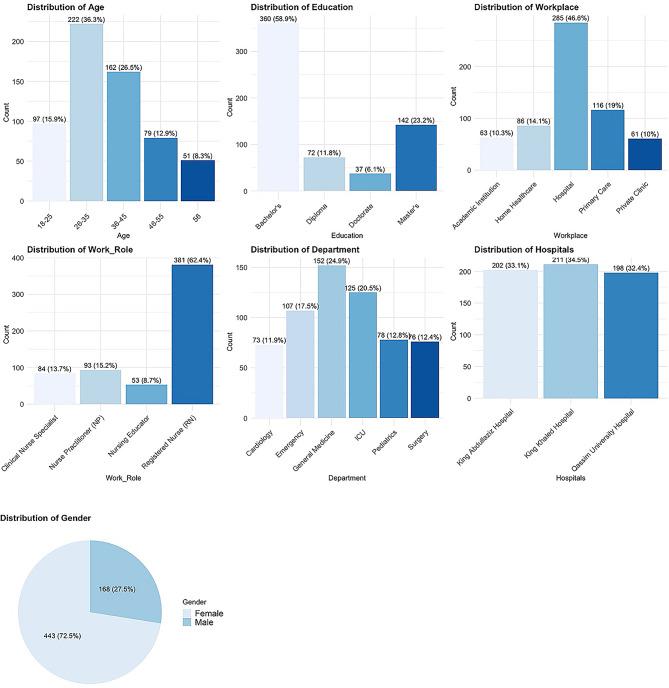
A total of 611 nurses were recruited using purposive sampling from educational hospitals in Saudi Arabia. Data were collected through an online structured questionnaire comprising demographic items, Likert-scale statements, and multiple-choice questions. Descriptive statistics and non-parametric tests (Kruskal-Wallis and Mann-Whitney U) were used to examine group differences.
RESULTS
Findings revealed generally positive attitudes toward AI-enabled wearables, with nurses acknowledging their potential to support personalised care, chronic disease management, and healthcare efficiency. However, data accuracy, affordability, and technical reliability emerged as prevalent concerns. Statistically significant differences were observed based on age (p < 0.001), education level (p = 0.001), and workplace setting (p < 0.05), with younger nurses and those in hospital settings expressing greater confidence in AI-driven health insights.
CONCLUSION
While AI-enabled wearable devices are perceived as promising tools in nursing practice, concerns regarding data reliability, cost, and over-reliance on AI must be addressed. Structured training, institutional support, and clear guidelines are essential to ensure successful integration into clinical workflows and optimise their use in patient-centred care.
CLINICAL TRIAL NUMBER
Not applicable.
背景
可穿戴健康技术,如智能手表、生物传感器贴片和健身追踪器,已从基本监测工具发展成为能够进行连续健康追踪的先进医疗级设备。人工智能(AI)的集成通过实现实时数据分析、早期诊断和个性化疾病管理,提高了它们的效用。在新冠疫情期间,其采用率加速上升,强化了它们在远程护理中的作用。然而,对数据隐私、准确性、成本以及人际互动减少的担忧依然存在。本研究探讨护士对人工智能驱动的可穿戴设备的看法、认识和信任,确定采用的促进因素和障碍,并评估人口统计学因素对态度的影响。
方法
采用目的抽样法从沙特阿拉伯的教学医院招募了611名护士。通过一份在线结构化问卷收集数据,问卷包括人口统计学项目、李克特量表陈述和多项选择题。使用描述性统计和非参数检验(Kruskal-Wallis和Mann-Whitney U)来检验组间差异。
结果
研究结果显示,护士们对人工智能驱动的可穿戴设备总体持积极态度,认可其在支持个性化护理、慢性病管理和医疗效率方面的潜力。然而,数据准确性、可承受性和技术可靠性成为普遍关注的问题。基于年龄(p < 0.001)、教育水平(p = 0.001)和工作场所设置(p < 0.05)观察到了统计学上的显著差异,年轻护士和医院环境中的护士对人工智能驱动的健康见解表现出更大的信心。
结论
虽然人工智能驱动的可穿戴设备在护理实践中被视为有前景的工具,但必须解决对数据可靠性、成本以及过度依赖人工智能的担忧。结构化培训、机构支持和明确的指导方针对于确保成功融入临床工作流程并优化其在以患者为中心的护理中的使用至关重要。
临床试验编号
不适用。

 Zotero 插件