
降低乳腺癌风险的药物:随机对照试验的网状Meta分析
Medications to reduce breast cancer risk: a network meta-analysis of randomized controlled trials.
作者信息
Pourali Ghazaleh, Liu Minglu, Sherpa Supriya S, Hardi Angela, Luo Chongliang, Toriola Adetunji T
机构信息
Division of Public Health Sciences, Department of Surgery, Washington University School of Medicine, 660 South Euclid Avenue, Campus, Box 8100, St. Louis, MO, 63110, USA.
Brown School, Washington University in St. Louis, St. Louis, MO, USA.
出版信息
Breast Cancer Res. 2025 Jul 1;27(1):118. doi: 10.1186/s13058-025-02059-w.
BACKGROUND
Given the rising incidence of breast cancer, especially in premenopausal women, there is an urgent need to identify additional risk-reducing medications to accelerate prevention, as only a few are currently approved. We, therefore, performed network meta-analysis (NMA) to identify and compare the efficacy of medications for primary breast cancer prevention.
METHODS
We performed a literature search completed on November 16, 2023, in Embase, Ovid-Medline, Scopus, and Cochrane Library for randomized controlled trials (RCTs) evaluating risk-reducing medications in women without a history of invasive breast cancer. Two reviewers independently screened and extracted data based on predefined criteria, following the Preferred Reporting Items for Systematic reviews and Meta-Analyses guidelines, and assessed the risk of bias using the Revised Cochrane Risk of Bias tool. The primary outcome was overall breast cancer incidence, with secondary outcomes including invasive breast cancer and ductal carcinoma in situ. NMA was performed using a random-effects model, measuring efficacy with risk ratios (RR) and number needed to treat (NNT). Medications were ranked using the Surface Under the Cumulative RAnking curve (SUCRA). We performed subgroup analyses by menopause status, primary versus secondary/other outcomes, follow-up, and intervention duration.
RESULTS
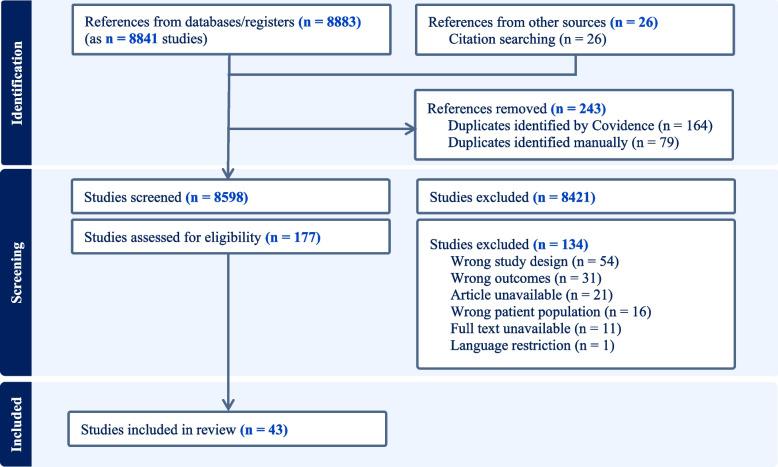
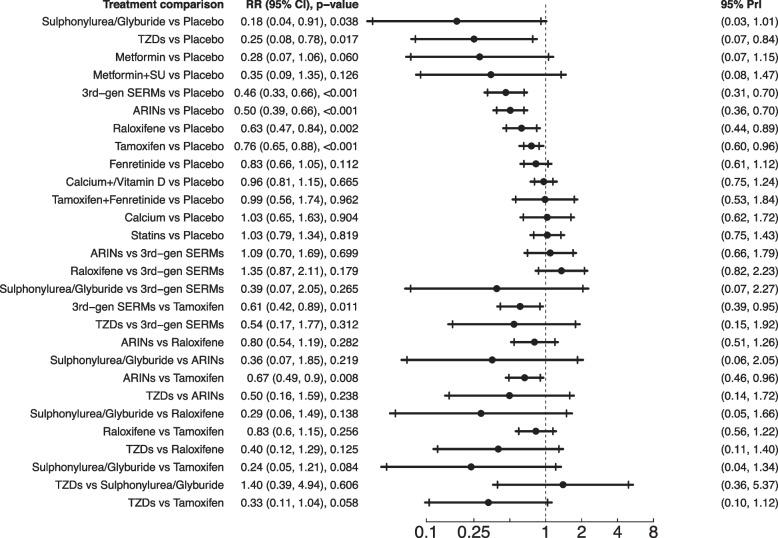
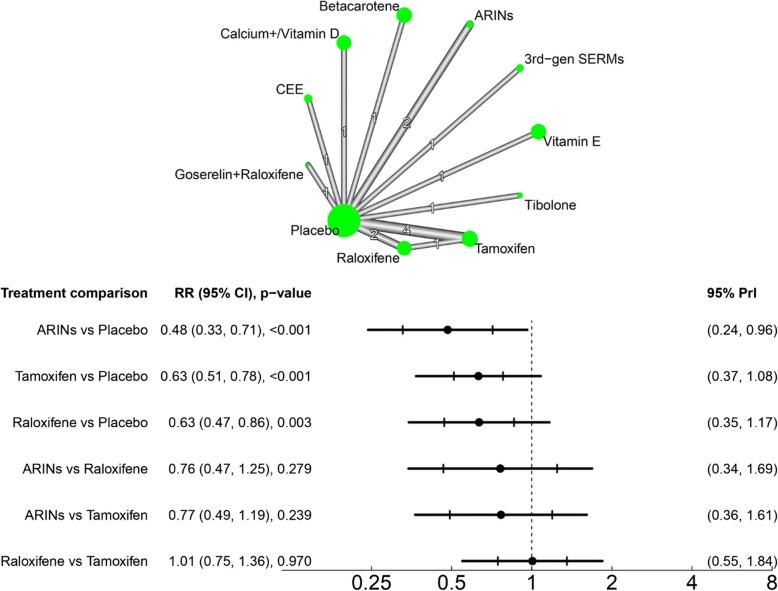
Out of 8,598 studies screened, 43 RCTs (n = 337,240 women) met inclusion criteria. Six medications reduced overall breast cancer risk compared to placebo: sulfonylurea (RR = 0.18, 95% CI = 0.04-0.91, NNT = 44.1, SUCRA = 0.90), thiazolidinediones (RR = 0.25, 95% CI = 0.08-0.78, NNT = 48.3, SUCRA = 0.80), third-generation selective estrogen receptor modulators (SERMs) (RR = 0.46, 95% CI = 0.33-0.66, NNT = 67.3, SUCRA = 0.62), aromatase inhibitors (AIs) (RR = 0.50, 95% CI = 0.39-0.66, NNT = 73.0, SUCRA = 0.55), raloxifene (RR = 0.63, 95% CI = 0.47-0.84, NNT = 96.9, SUCRA = 0.37), and tamoxifen (RR = 0.76, 95% CI = 0.65-0.88, NNT = 149.7, SUCRA = 0.23). AIs (RR = 0.48, 95% CI = 0.33-0.71), tamoxifen (RR = 0.63, 95% CI = 0.51-0.78), and raloxifene (RR = 0.63, 95% CI = 0.47-0.86), were effective for invasive breast cancer. Third-generation SERMs (RR = 0.46, 95% CI = 0.32-0.67), AIs (RR = 0.51, 95% CI = 0.40-0.64), raloxifene (RR = 0.61, 95% CI = 0.46-0.82), and tamoxifen (RR = 0.76, 95% CI = 0.66-0.86) were effective in studies with breast cancer as a primary outcome, while thiazolidinediones (RR = 0.25, 95% CI = 0.07-0.84) were effective in studies with breast cancer as a secondary/other outcome.
CONCLUSIONS
This NMA confirms the efficacy of tamoxifen, raloxifene, and AIs, and identifies thiazolidinediones and third-generation SERMs as promising agents for breast cancer prevention, though not currently included in guidelines. These findings extend prior evidence and highlight the need for trials in premenopausal and racially diverse populations to address existing gaps.
背景
鉴于乳腺癌发病率不断上升,尤其是在绝经前女性中,迫切需要确定更多的降低风险药物以加速预防,因为目前仅有少数药物获得批准。因此,我们进行了网络荟萃分析(NMA),以确定并比较用于原发性乳腺癌预防的药物的疗效。
方法
我们于2023年11月16日在Embase、Ovid-Medline、Scopus和Cochrane图书馆进行了文献检索,以查找评估无浸润性乳腺癌病史女性降低风险药物的随机对照试验(RCT)。两名研究者根据预定义标准独立筛选和提取数据,遵循系统评价和荟萃分析的首选报告项目指南,并使用修订后的Cochrane偏倚风险工具评估偏倚风险。主要结局为总体乳腺癌发病率,次要结局包括浸润性乳腺癌和原位导管癌。使用随机效应模型进行NMA,用风险比(RR)和需治疗人数(NNT)衡量疗效。使用累积排序曲线下面积(SUCRA)对药物进行排序。我们按绝经状态、主要结局与次要/其他结局、随访时间和干预持续时间进行了亚组分析。
结果
在筛选的8598项研究中,43项RCT(n = 337240名女性)符合纳入标准。与安慰剂相比,六种药物可降低总体乳腺癌风险:磺脲类药物(RR = 0.18,95%CI = 0.04 - 0.91,NNT = 44.1,SUCRA = 0.90)、噻唑烷二酮类药物(RR = 0.25,95%CI = 0.08 - 0.78,NNT = 48.3,SUCRA = 0.80)、第三代选择性雌激素受体调节剂(SERM)(RR = 0.46,95%CI = 0.33 - 0.66,NNT = 67.3,SUCRA = 0.62)、芳香化酶抑制剂(AI)(RR = 0.50,95%CI = 0.39 - 0.66,NNT = 73.0,SUCRA = 0.55)、雷洛昔芬(RR = 0.63,95%CI = 0.47 - 0.84,NNT = 96.9,SUCRA = 0.37)和他莫昔芬(RR = 0.76,95%CI = 0.65 - 0.88,NNT = 149.7,SUCRA = 0.23)。AI(RR = 0.48,95%CI = 0.33 - 0.71)、他莫昔芬(RR = 0.63,95%CI = 0.51 - 0.78)和雷洛昔芬(RR = 0.63,95%CI = 0.47 - 0.86)对浸润性乳腺癌有效。第三代SERM(RR = 0.46,95%CI = 0.32 - 0.67)、AI(RR = 0.51,95%CI = 0.40 - 0.64)、雷洛昔芬(RR = 0.61,95%CI = 0.46 - 0.82)和他莫昔芬(RR = 0.76,95%CI = 0.66 - 0.86)在以乳腺癌为主要结局的研究中有效,而噻唑烷二酮类药物(RR = 0.25,95%CI = 0.07 - 0.84)在以乳腺癌为次要/其他结局的研究中有效。
结论
这项NMA证实了他莫昔芬、雷洛昔芬和AI的疗效,并确定噻唑烷二酮类药物和第三代SERM是有前景的乳腺癌预防药物,尽管目前未纳入指南。这些发现扩展了先前的证据,并强调需要在绝经前和种族多样化人群中进行试验以填补现有空白。


 Zotero 插件