
一项调查腹部大手术中急性肾损伤尿液生物标志物的前瞻性诊断研究(急性肾损伤生物标志物研究)。
A prospective diagnostic study investigating urinary biomarkers of AKI in major abdominal surgery (the AKI-biomas study).
作者信息
Singh Rishabh, Maclean William, Singh Toolika, Mackenzie Paul, Rockall Timothy, Forni Lui G
机构信息
Department of Critical Care Medicine, Royal Surrey Hospital NHS Foundation Trust, Guildford, GU2 7XX, UK.
Department of General Surgery, Royal Surrey Hospital Foundation Trust, Guildford, GU2 7XX, UK.
出版信息
Crit Care. 2025 Jul 1;29(1):260. doi: 10.1186/s13054-025-05510-8.
BACKGROUND
Post-operative acute kidney injury (AKI) is associated with increased morbidity and mortality with evidence suggesting that early identification using biomarkers of AKI may impact prognosis. Most studies in surgical patients has focussed on cardiac, vascular and transplant surgery cohorts. Evidence on the utility of biomarkers in major abdominal surgery is sparse.
METHODS
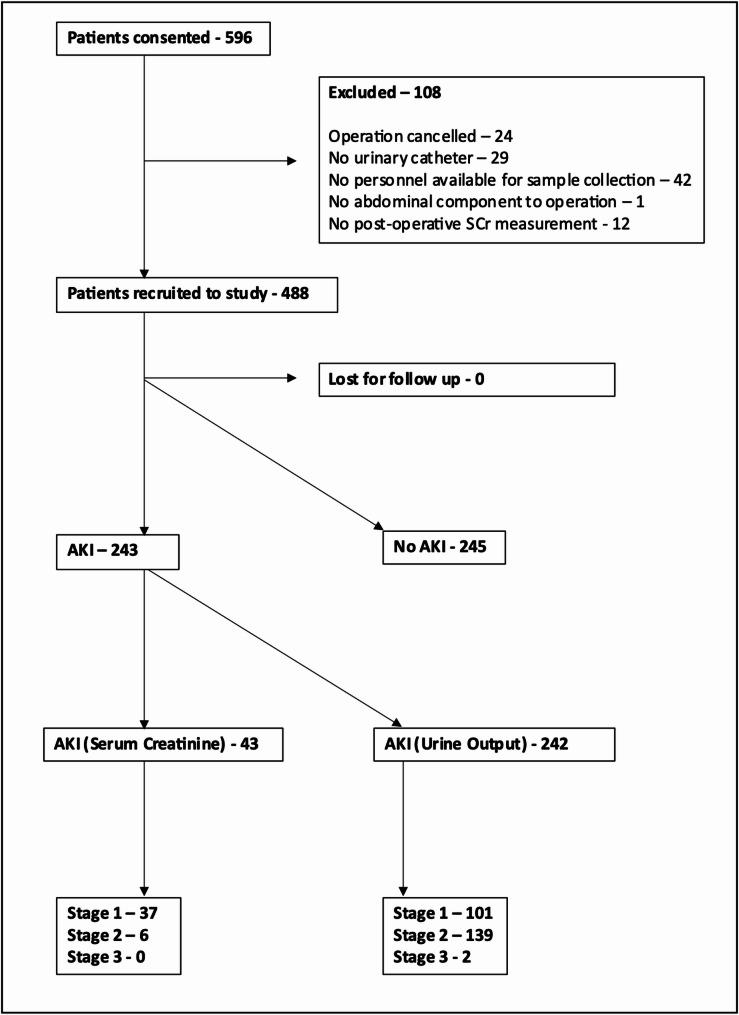
This was a prospective observational single centre diagnostic study conducted on 488 patients undergoing major abdominal surgery. Urine was collected four hours post-surgery. The biomarkers for AKI NGAL, KIM-1, DKK-3 and IGFBP-7*TIMP-2 were measured and diagnostic performance assessed utilising Receiver Operating Characteristic (ROC) curve analysis to predict the development of post operative AKI using serum creatinine and urine output criteria.
RESULTS
242 participants developed AKI by urine output criteria (49.5%) and 43 by serum creatinine criteria (8.8%). The area under the receiver operating characteristic curve values for stage 1 AKI as determined by serum creatinine criteria for NGAL was 0.741 (95%CI 0.699-0.770, p < 0.001) and 0.871 (95%CI 0.838-0.899, p < 0.001) for stage 2. AUC values for IGFBP-7*TIMP-2 for stage 1 were 0.655 (95% CI 0.611-0.697, p0.003) and stage 2 0.803 (95%CI 0.764-0.837 p0.002). The AUC for KIM-1 was statistically significant for stage 1 (0.68, 95%CI 0.637-0.722) but not for stage 2. No AUC values for DKK-3 were statistically significant. Biomarkers performed poorly for prediction of AKI by urine output criteria.
CONCLUSIONS
In this large prospective study of a clinical cohort of 488 patients undergoing major abdominal surgery AKI rates are dependent on the criteria used with 49.5% of patients developed AKI by urine output criteria, compared to only 8.8% by serum creatinine. NGAL and IGFBP-7*TIMP-2 showed reasonable diagnostic performance when diagnosing AKI by serum creatinine criteria, with NGAL returning the highest AUC values.
背景
术后急性肾损伤(AKI)与发病率和死亡率增加相关,有证据表明,使用AKI生物标志物进行早期识别可能会影响预后。大多数针对外科手术患者的研究都集中在心脏、血管和移植手术队列。关于生物标志物在腹部大手术中的应用证据很少。
方法
这是一项对488例接受腹部大手术的患者进行的前瞻性观察性单中心诊断研究。术后4小时收集尿液。测量AKI的生物标志物中性粒细胞明胶酶相关脂质运载蛋白(NGAL)、肾损伤分子-1(KIM-1)、Dickkopf相关蛋白3(DKK-3)和胰岛素样生长因子结合蛋白7金属蛋白酶组织抑制因子2(IGFBP-7TIMP-2),并利用受试者工作特征(ROC)曲线分析评估诊断性能,以血清肌酐和尿量标准预测术后AKI的发生。
结果
根据尿量标准,242名参与者发生了AKI(49.5%),根据血清肌酐标准,43名参与者发生了AKI(8.8%)。以血清肌酐标准确定的1期AKI中,NGAL的受试者工作特征曲线下面积值为0.741(95%CI 0.699-0.770,p<0.001),2期为0.871(95%CI 0.838-0.899,p<0.001)。1期IGFBP-7*TIMP-2的AUC值为0.655(95%CI 0.611-0.697,p=0.003),2期为0.803(95%CI 0.764-0.837,p=0.002)。KIM-1的1期AUC具有统计学意义(0.68,95%CI 0.637-0.722),但2期没有。DKK-3的AUC值均无统计学意义。生物标志物在以尿量标准预测AKI方面表现不佳。
结论
在这项对488例接受腹部大手术的临床队列进行的大型前瞻性研究中,AKI发生率取决于所使用的标准,49.5%的患者根据尿量标准发生了AKI,而根据血清肌酐标准仅为8.8%。当以血清肌酐标准诊断AKI时,NGAL和IGFBP-7*TIMP-2表现出合理的诊断性能,NGAL的AUC值最高。

 Zotero 插件