
日内瓦同源重组缺陷检测可预测奥拉帕利和贝伐单抗维持治疗对卵巢癌患者生存的获益情况。
Geneva Homologous Recombination Deficiency Test Is Predictive of Survival Benefit From Olaparib and Bevacizumab Maintenance in Ovarian Cancer.
作者信息
Christinat Yann, Labidi-Galy Intidhar, Ho Liza, Clément Sophie, Genestie Catherine, Sehouli Jalid, Cinieri Saverio, Gonzalez-Martin Antonio, Kolovetsiou-Kreiner Vassiliki, Fujiwara Keiichi, Von Gorp Toon, Tognon Germana, Hietanen Sakari, Heinzelmann-Schwarz Viola, Ray-Coquard Isabelle, Pujade-Lauraine Eric, McKee Thomas A
机构信息
Department of Clinical Pathology, Hôpitaux Universitaires de Genève, Geneva, Switzerland.
Department of Oncology, Hôpitaux Universitaires de Genève, Geneva, Switzerland.
出版信息
JCO Precis Oncol. 2025 Jul;9:e2400825. doi: 10.1200/PO-24-00825. Epub 2025 Jul 2.
PURPOSE
The ability of the Geneva homologous recombination deficiency (HRD) test to predict progression-free survival (PFS) in patients with high-grade ovarian cancer treated with poly (ADP-ribose) polymerase inhibitors has been demonstrated. Its performance with respect to overall survival (OS) has not been assessed yet.
METHODS
Using the final results of the PAOLA-1/ENGOT-ov25 phase III clinical trial with a median follow-up of 5 years, we evaluated the Geneva HRD test on 468 samples as part of the ENGOT HRD European Initiative. Results were evaluated in terms of final PFS and OS in the olaparib + bevacizumab and placebo + bevacizumab arms and compared with the Myriad MyChoice HRD test.
RESULTS
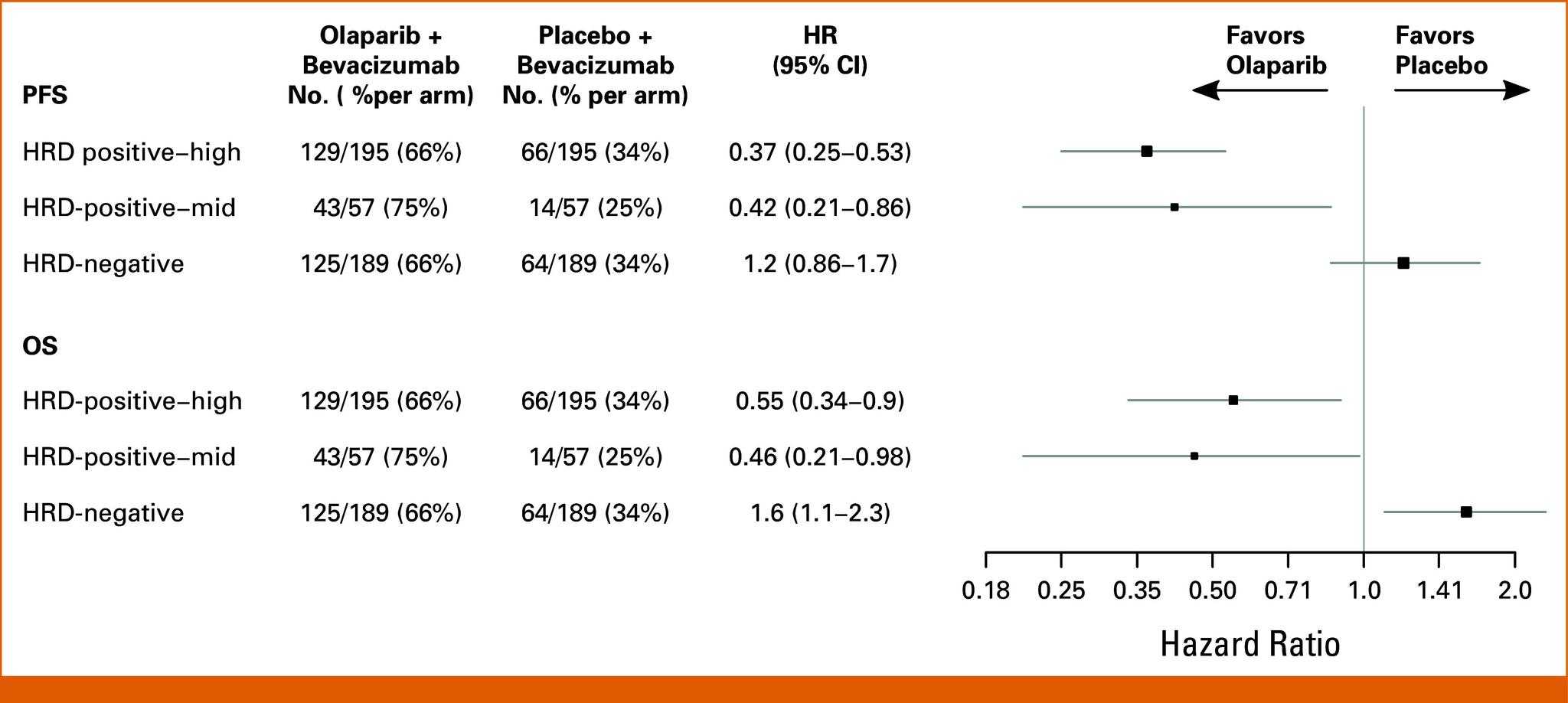
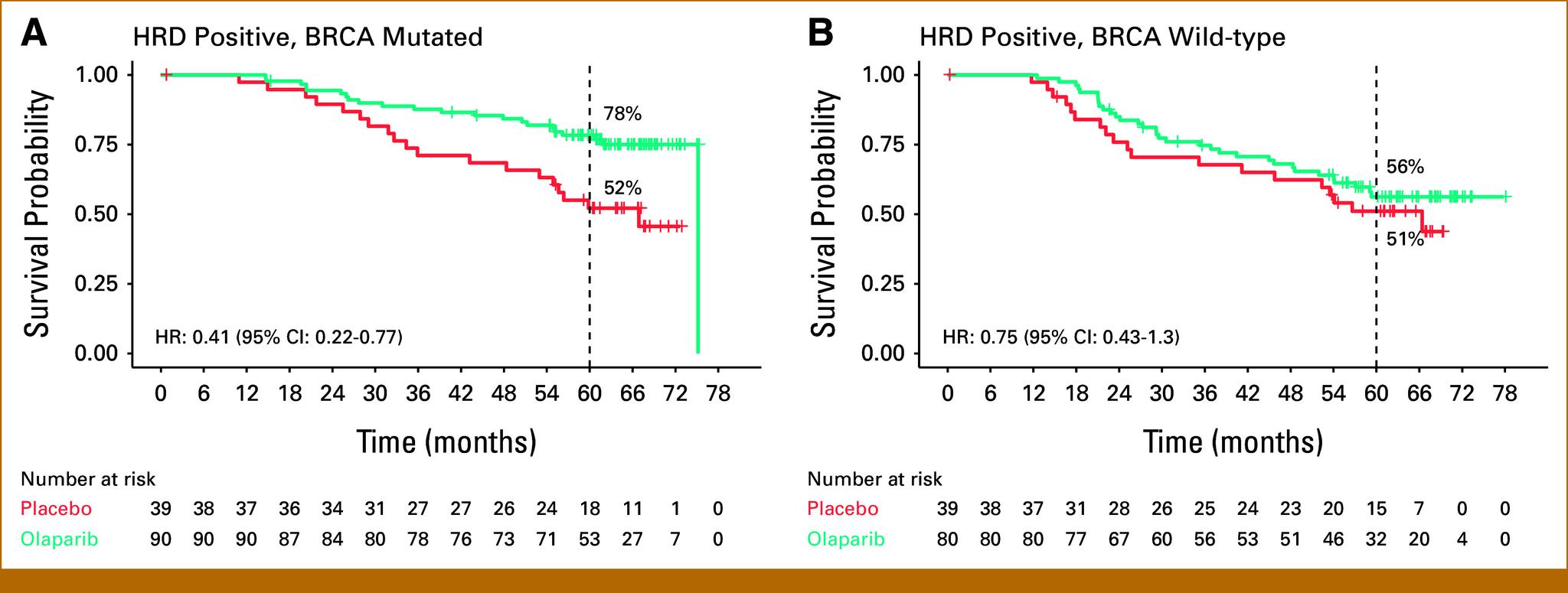
Final PFS was consistent with previously published data and confirmed the predictive value of the Geneva HRD test with a hazard ratio (HR) of 0.41 (95% CI, 0.30 to 0.57) for HRD-positive patients. The results for OS showed a HR of 0.56 (95% CI, 0.37 to 0.85) for HRD-positive patients and 1.6 (95% CI, 1.1 to 2.3) for HRD-negative patients. These results are consistent with those observed with the Myriad test, including the negative OS trend in the HRD-negative subgroup treated with olaparib + bevacizumab (HR, 1.2 [95% CI, 0.83 to 1.8]). A subgroup analysis of patients with intermediate HRD scores showed that the normalized large-scale state transition score used by the Geneva HRD test had both predictive and prognostic value.
CONCLUSION
The Geneva HRD test predicts PFS and OS benefit from olaparib + bevacizumab. The potential detrimental effect of olaparib + bevacizumab on OS in the HRD-negative population is hypothesis-generating and needs to be confirmed prospectively.
目的
已证实日内瓦同源重组缺陷(HRD)检测能够预测接受聚(ADP - 核糖)聚合酶抑制剂治疗的高级别卵巢癌患者的无进展生存期(PFS)。但其对总生存期(OS)的表现尚未得到评估。
方法
利用PAOLA - 1/ENGOT - ov25 III期临床试验的最终结果,该试验中位随访时间为5年,作为ENGOT HRD欧洲倡议的一部分,我们对468份样本进行了日内瓦HRD检测。根据奥拉帕利+贝伐单抗组和安慰剂+贝伐单抗组的最终PFS和OS对结果进行评估,并与Myriad MyChoice HRD检测进行比较。
结果
最终PFS与先前发表的数据一致,并证实了日内瓦HRD检测对HRD阳性患者的预测价值,风险比(HR)为0.41(95%CI,0.30至0.57)。OS结果显示,HRD阳性患者的HR为0.56(95%CI,0.37至0.85),HRD阴性患者的HR为1.6(95%CI,1.1至2.3)。这些结果与Myriad检测观察到的结果一致,包括在接受奥拉帕利+贝伐单抗治疗的HRD阴性亚组中OS呈阴性趋势(HR,1.2[95%CI,0.83至1.8])。对HRD评分中等的患者进行亚组分析表明,日内瓦HRD检测使用的标准化大规模状态转换评分具有预测和预后价值。
结论
日内瓦HRD检测可预测奥拉帕利+贝伐单抗带来的PFS和OS获益。奥拉帕利+贝伐单抗对HRD阴性人群OS的潜在有害影响仅为一种假设,需要前瞻性地予以证实。



 Zotero 插件