
β-微管蛋白4B基因突变导致一个多代家族出现常染色体显性遗传性视网膜色素变性并伴有感音神经性听力损失。
Mutation of beta-tubulin 4B gene ( causes autosomal dominant retinitis pigmentosa with sensorineural hearing loss in a multigenerational family.
作者信息
Gregory-Evans Cheryl Y, Joe Aaron W, Gregory-Evans Kevin
机构信息
Department of Ophthalmology and Visual Sciences, University of British Columbia, Vancouver, Canada.
Kelowna General Hospital, British Columbia, Canada.
出版信息
Mol Vis. 2025 May 16;31:175-188. eCollection 2025.
PURPOSE
Members of a multigenerational Canadian family presented to an inherited retinal degeneration (IRD) clinic with retinitis pigmentosa (RP) and sensorineural hearing loss, reminiscent of an Usher syndrome phenotype. Biallelic disease-causing variants in the known Usher syndrome genes were not identified. Therefore, we enrolled further family members in this study and examined whether other IRD gene variants could explain the phenotype in the family.
METHODS
Family members underwent a comprehensive ophthalmic examination, including best-corrected visual acuity, direct and indirect ophthalmoscopy, fundus photography, visual field testing, spectral-domain optical coherence tomography, audiological examination, and genetic testing. Some patients also had autofluorescence imaging. Loss-of-function testing was initiated by antisense morpholino knockdown of in zebrafish.
RESULTS
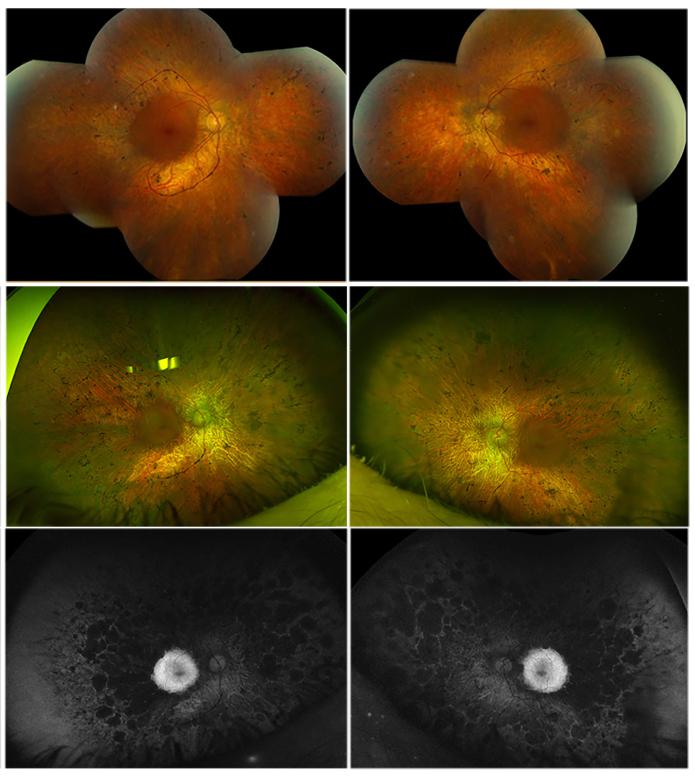
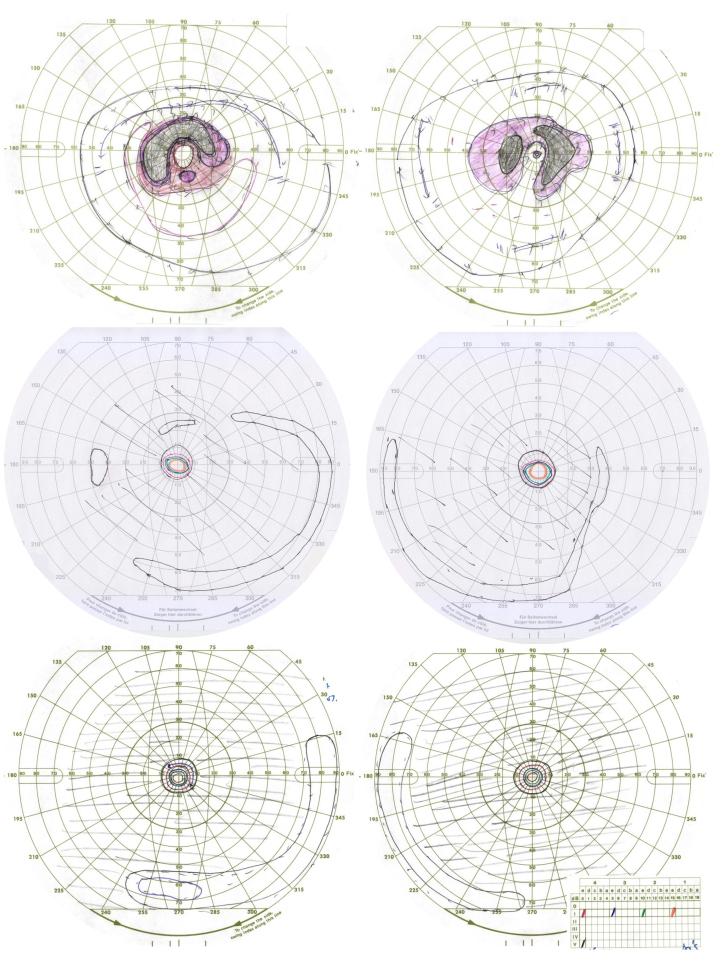
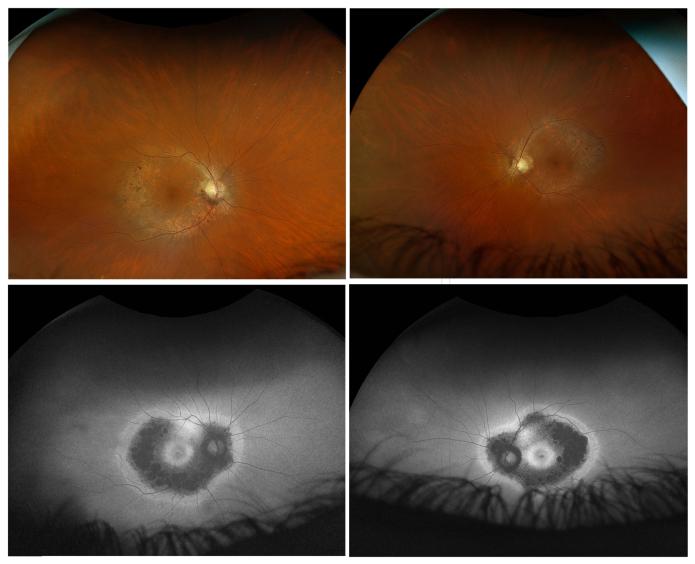
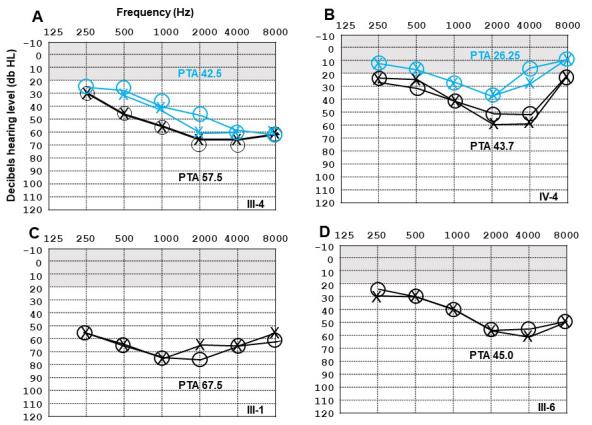
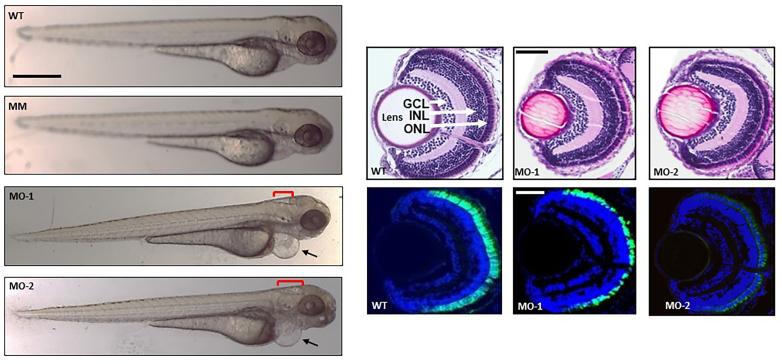
Multimodal clinical testing in affected patients revealed an autosomal dominant late-onset presentation of RP associated with progressive, bilateral sensorineural hearing loss that occurred in the second to third decades of life with no vestibular involvement. Panel-based genetic testing revealed a heterozygous c.1168C>T, p.Arg390Trp variant in the beta-tubulin 4B gene () only in affected family members. Based on analysis, segregation analysis through the family, and literature evaluation, this variant is likely to be the disease-causing variant inherited in an autosomal dominant manner. We searched our local database of ~1,000 patients with IRD, and no other variants were identified, confirming this is a rare disease variant. Knockdown of in zebrafish revealed cone and rod photoreceptor abnormalities in the retina and hydrocephalus in the developing brain, resulting in early larval lethality.
CONCLUSIONS
For the first time, we describe a multigenerational family with a gene variant p.(Arg390Trp) segregating with deaf-blindness, establishing autosomal dominant inheritance. This further confirms that the Arg390 codon is a mutation hotspot. We also expand the range of phenotypes seen with the p.(Arg390Trp) gene variant to include typical RP as well as a milder, pericentral RP. Furthermore, our studies suggest there is conservation of TUBB4B ciliary function between zebrafish and humans, making zebrafish a better model system for studying vision loss than the mouse model.
目的
一个加拿大多代家族的成员因患有色素性视网膜炎(RP)和感音神经性听力损失前往遗传性视网膜变性(IRD)诊所就诊,这让人联想到Usher综合征的表型。在已知的Usher综合征基因中未发现双等位基因致病变异。因此,我们让更多家族成员参与本研究,以检查其他IRD基因变异是否可以解释该家族的表型。
方法
家族成员接受了全面的眼科检查,包括最佳矫正视力、直接和间接检眼镜检查、眼底摄影、视野测试、光谱域光学相干断层扫描、听力检查和基因检测。一些患者还进行了自发荧光成像。通过斑马鱼中反义吗啉代敲低 启动功能丧失测试。
结果
对受影响患者的多模式临床测试显示,RP呈常染色体显性迟发性表现,伴有进行性双侧感音神经性听力损失,发生在生命的第二个至第三个十年,无前庭受累。基于面板的基因检测仅在受影响的家族成员中发现β微管蛋白4B基因( )存在杂合的c.1168C>T,p.Arg390Trp变异。基于 分析、家族分离分析和文献评估,该变异可能是以常染色体显性方式遗传的致病变异。我们在当地约1000名IRD患者的数据库中进行搜索,未发现其他 变异,证实这是一种罕见的疾病变异。在斑马鱼中敲低 显示视网膜中的视锥和视杆光感受器异常以及发育中的大脑出现脑积水,导致幼虫早期死亡。
结论
我们首次描述了一个携带 基因变异p.(Arg390Trp)且与失聪失明相关的多代家族,确立了常染色体显性遗传。这进一步证实Arg390密码子是一个突变热点。我们还将p.(Arg390Trp) 基因变异所见的表型范围扩大到包括典型RP以及较轻的中心周围性RP。此外,我们的研究表明斑马鱼和人类之间TUBB4B纤毛功能具有保守性,这使得斑马鱼成为比小鼠模型更好的研究视力丧失的模型系统。


 Zotero 插件