
中国上海儿科重症监护病房中耐碳青霉烯类肺炎克雷伯菌的肠道定植及后续感染
Carbapenem-resistant Klebsiella pneumoniae gut colonization and subsequent infection in pediatric intensive care units in shanghai, China.
作者信息
Guan Hongyan, Liu Jingxian, Yu Jiajia, Guo Kanglin, Chen Feng, Yu Jing, Liu Ying
机构信息
Department of Clinical Laboratory, Xin Hua Hospital, Shanghai Jiao Tong University School of Medicine, 1665 Kong Jiang Road, Shanghai, 200092, China.
出版信息
Ann Clin Microbiol Antimicrob. 2025 Jul 3;24(1):39. doi: 10.1186/s12941-025-00808-5.
BACKGROUND
It has been revealed that carbapenem-resistant Klebsiella pneumoniae (CRKP) colonization is closely associated with subsequent clinical infections. This study aimed to investigate the resistance and epidemiology of CRKP isolated from anal swabs and subsequent clinical infection specimens in two pediatric intensive care unit (ICU) departments. Clinical characteristics were analyzed to identify the risk factors of CRKP infection.
METHODS
A 3-year retrospective study was carried out in pediatric intensive care units (PICU) and neonatal intensive care units (NICU). CRKP isolates from colonization and infection samples were characterized by testing resistance genes and multilocus sequence typing (MLST). The results of MLST were analyzed to derive CCs by Bionumeric 8.0. Clinical variables such as gestational age, birth weight, mode of delivery, underlying diseases, exposure of antimicrobial agents, history of surgery, length of hospital stay, and prognosis were collected through the electronic medical record system and analyzed by SPSS 22.0.
RESULTS
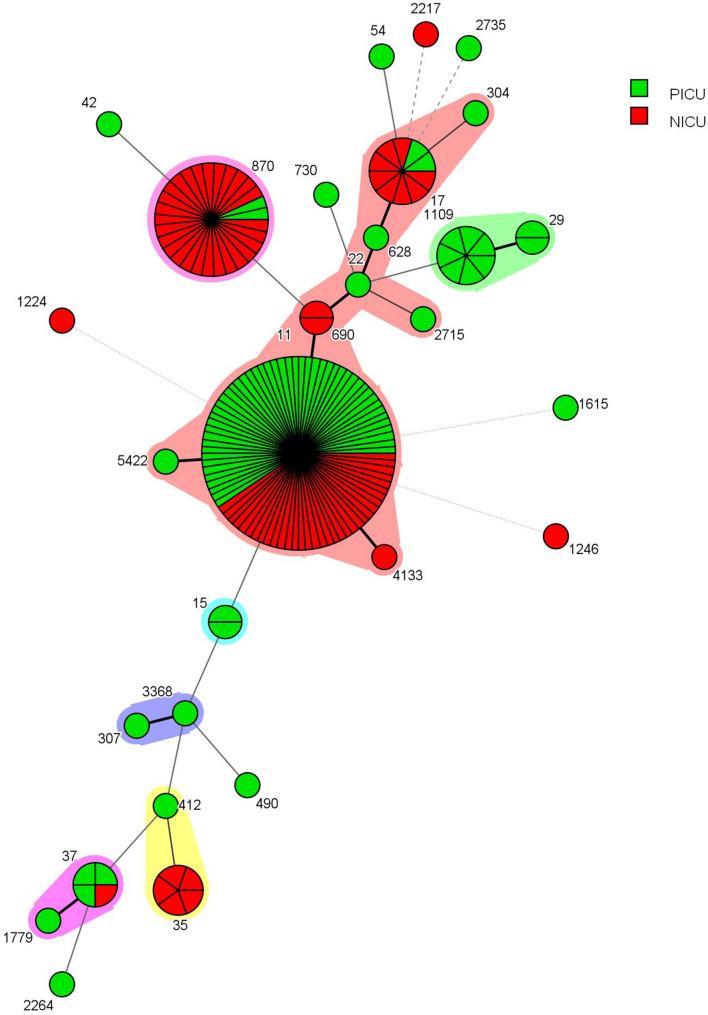
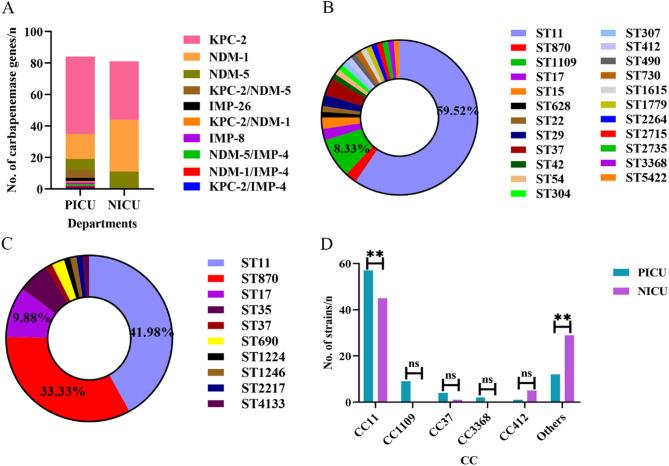
Of the 2225 patients who were screened for CRE colonization, 7.42% of patients were detected positive. The incidence of subsequent infection was 18.18%. Carbapenemase genes bla and bla were the most prevalent in the colonization and infection of CRKP. The majority of CRKP isolated from anal swabs and infection samples belonged to CC11/ST11. The distribution of CC11 in the PICU was significantly higher than in NICU. ST11/bla was significantly higher in infection CRKP isolates. Age older than one year and usage of carbapenems within 3 months prior to detection of CRKP colonization were independent risk factors for CRKP clinical infection.
CONCLUSION
The main prevalence of CRKP varies in different departments. Colonization of ST11/bla CRKP may increase the incidence of subsequent infections in pediatric ICU patients. Age and usage of carbapenems could increase the risk of CRKP infection in this study.
背景
已揭示耐碳青霉烯类肺炎克雷伯菌(CRKP)定植与随后的临床感染密切相关。本研究旨在调查从两个儿科重症监护病房(ICU)的肛拭子及随后的临床感染标本中分离出的CRKP的耐药性和流行病学情况。分析临床特征以确定CRKP感染的危险因素。
方法
在儿科重症监护病房(PICU)和新生儿重症监护病房(NICU)进行了一项为期3年的回顾性研究。通过检测耐药基因和多位点序列分型(MLST)对定植和感染样本中的CRKP分离株进行特征分析。利用Bionumeric 8.0分析MLST结果以推导克隆复合体(CCs)。通过电子病历系统收集胎龄、出生体重、分娩方式、基础疾病、抗菌药物暴露、手术史、住院时间和预后等临床变量,并使用SPSS 22.0进行分析。
结果
在2225例筛查产碳青霉烯酶肠杆菌(CRE)定植的患者中,7.42%的患者检测呈阳性。随后感染的发生率为18.18%。碳青霉烯酶基因bla和bla在CRKP的定植和感染中最为常见。从肛拭子和感染样本中分离出的大多数CRKP属于CC11/ST11。CC11在PICU中的分布显著高于NICU。感染的CRKP分离株中ST11/bla显著更高。年龄大于1岁以及在检测到CRKP定植前3个月内使用碳青霉烯类药物是CRKP临床感染的独立危险因素。
结论
CRKP的主要流行情况在不同科室有所不同。ST11/bla CRKP的定植可能会增加儿科ICU患者随后感染的发生率。在本研究中,年龄和碳青霉烯类药物的使用可能会增加CRKP感染风险。
 Zotero 插件