
预测晚期慢性肾脏病患者的住院情况及相关结局:一项系统评价、外部验证及开发研究。
Predicting Hospitalization and Related Outcomes in Advanced Chronic Kidney Disease: A Systematic Review, External Validation, and Development Study.
作者信息
Janse Roemer J, Milders Jet, Rotmans Joris I, Caskey Fergus J, Evans Marie, Torino Claudia, Szymczak Maciej, Drechsler Christiane, Wanner Christoph, Pippias Maria, Vilasi Antonio, Stel Vianda S, Chesnaye Nicholas C, Jager Kitty J, Dekker Friedo W, van Diepen Merel
机构信息
Department of Clinical Epidemiology, Leiden University Medical Center, Leiden, the Netherlands.
Department of Internal Medicine, Leiden University Medical Center, Leiden, the Netherlands.
出版信息
Kidney Med. 2025 Apr 25;7(7):101016. doi: 10.1016/j.xkme.2025.101016. eCollection 2025 Jul.
RATIONALE & OBJECTIVE: Hospitalization is common in patients with advanced chronic kidney disease (CKD). Predicting hospitalization and related outcomes would be beneficial for hospitals and patients. Therefore, we aimed to (1) give an overview of current prediction models for hospitalization, length of stay, and readmission in patients with advanced CKD; (2) externally validate these models; and (3) develop a new model if no valid models were identified.
STUDY DESIGN
Systematic review, development, and external validation study.
SETTING & PARTICIPANTS: We were interested in prediction models of hospitalization, length of stay, or readmission for patients with advanced CKD. Our available development and validation data consisted of hemodialysis, peritoneal dialysis, and advanced CKD patients not receiving dialysis from a Dutch dialysis and European advanced CKD cohort.
SELECTION CRITERIA FOR STUDIES
We systematically searched PubMed. Studies had to intentionally develop, validate, or update a prediction model in adults with CKD.
ANALYTICAL APPROACH
We used the PROBAST for risk of bias assessment. Identified models were externally validated on model discrimination (C-statistic) and calibration (calibration plot, slope, and calibration-in-the-large). We developed a Fine-Gray model for hospitalization within 1 year in patients initiating hemodialysis, accounting for the competing risk of death.
RESULTS
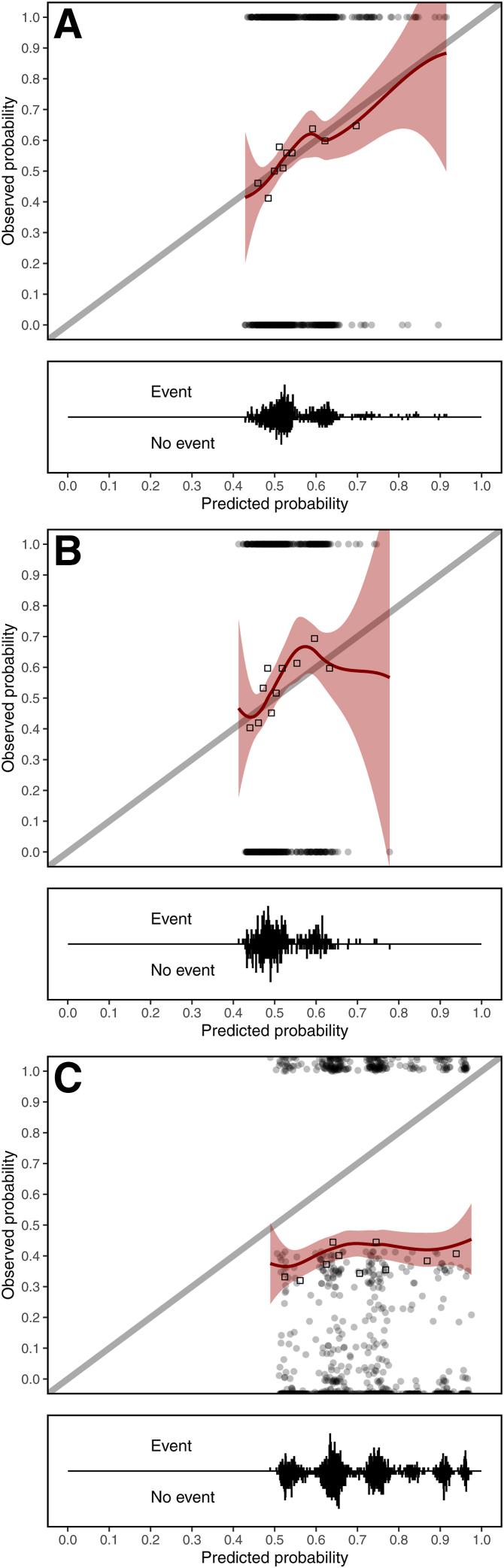
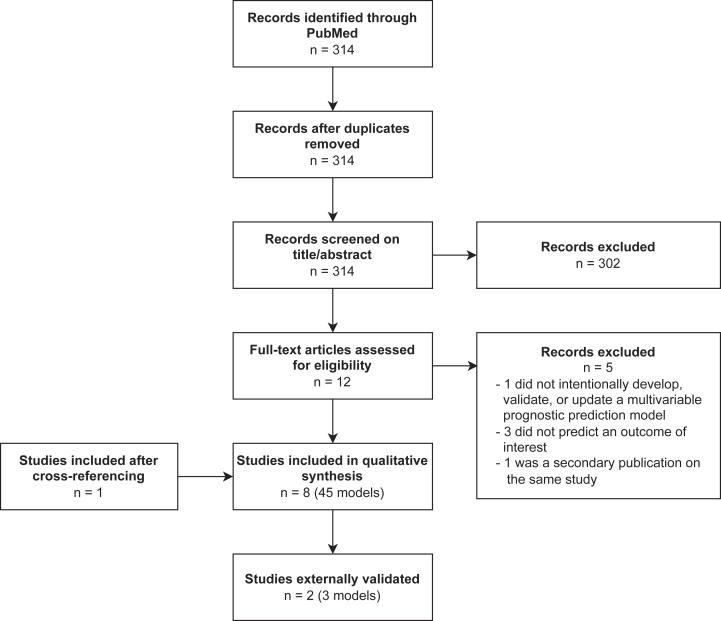
We identified 45 models in 8 studies. The majority were of low quality with a high risk of bias. Due to underreporting and population-specific predictors, we could only validate 3 models. These were poorly calibrated and had poor discrimination. Using multiple modeling strategies, an adequate new model could not be developed.
LIMITATIONS
The outcome hospitalization might be too heterogeneous, and we did not have all relevant predictors available.
CONCLUSIONS
Hospitalizations are important but difficult to predict for patients with advanced CKD. An improved prediction model should be developed, for example, using a more specific outcome (eg, cardiovascular hospitalizations) and more predictors (eg, patient-reported outcome measures).
原理与目的
晚期慢性肾脏病(CKD)患者住院情况较为常见。预测住院情况及相关结果对医院和患者均有益处。因此,我们旨在:(1)概述晚期CKD患者住院、住院时长及再入院的现有预测模型;(2)对这些模型进行外部验证;(3)若未识别出有效模型,则开发新模型。
研究设计
系统评价、开发及外部验证研究。
设置与参与者
我们关注晚期CKD患者住院、住院时长或再入院的预测模型。我们可用的开发和验证数据包括来自荷兰透析队列及欧洲晚期CKD队列的血液透析、腹膜透析患者以及未接受透析的晚期CKD患者。
研究的选择标准
我们系统检索了PubMed。研究必须是有意针对CKD成人患者开发、验证或更新预测模型。
分析方法
我们使用PROBAST进行偏倚风险评估。对识别出的模型在模型区分度(C统计量)和校准(校准图、斜率及大样本校准)方面进行外部验证。我们为开始血液透析的患者开发了一个用于预测1年内住院情况的Fine - Gray模型,同时考虑了死亡的竞争风险。
结果
我们在8项研究中识别出45个模型。大多数模型质量较低,存在较高的偏倚风险。由于报告不充分及特定人群预测因素的问题,我们仅能验证3个模型。这些模型校准不佳且区分度较差。使用多种建模策略,未能开发出合适的新模型。
局限性
住院结局可能过于异质性,且我们没有所有相关的预测因素。
结论
住院情况对晚期CKD患者很重要,但难以预测。应开发改进的预测模型,例如使用更具体的结局(如心血管住院)和更多的预测因素(如患者报告的结局指标)。
 Zotero 插件