
可变剪接和多聚腺苷酸化:健康与疾病中的关键调控机制。
Alternative cleavage and polyadenylation: key regulatory mechanisms in health and disease.
作者信息
Zhang Ying, Huang Zikun, Lu Weiqing, Liu Zhaoyong
机构信息
Department of Radiotherapy, Cancer Hospital of Shantou University Medical College, Shantou, Guangdong, China.
Clinical Research Center, Cancer Hospital of Shantou University Medical College, Shantou, Guangdong, China.
出版信息
RNA Biol. 2025 Dec;22(1):1-33. doi: 10.1080/15476286.2025.2529033. Epub 2025 Jul 9.
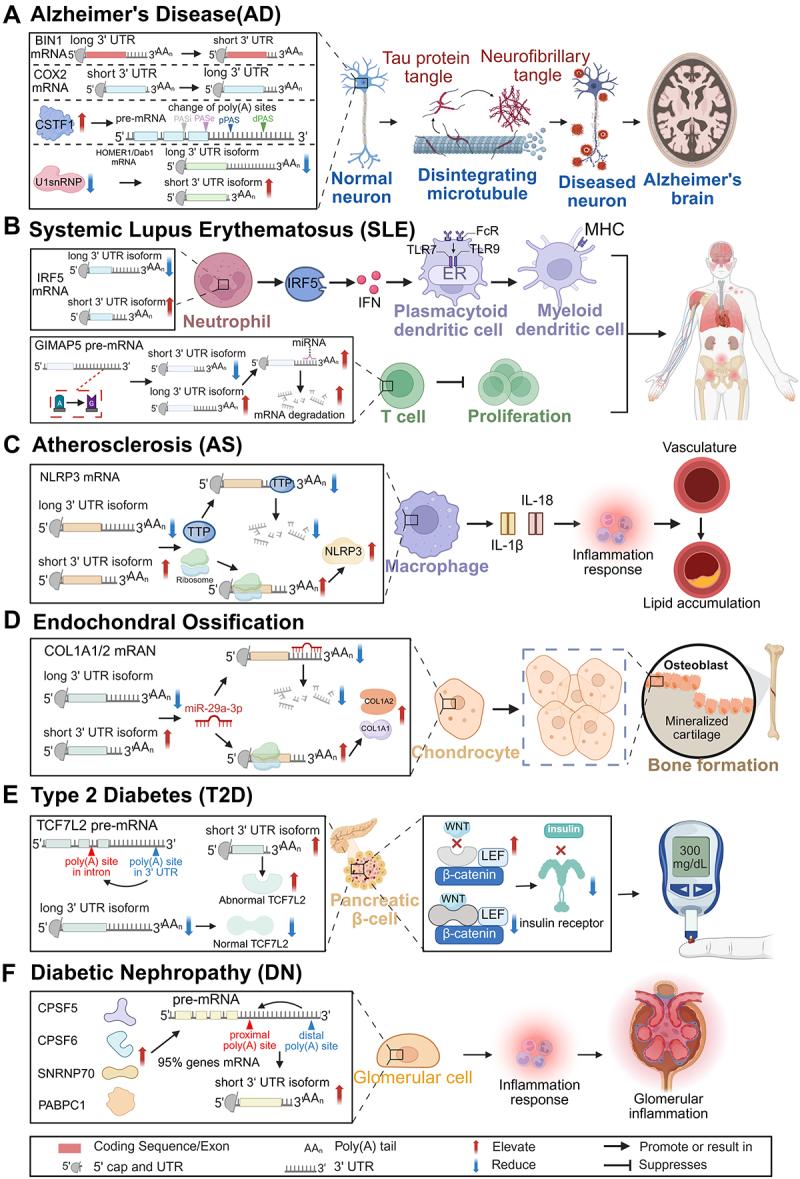
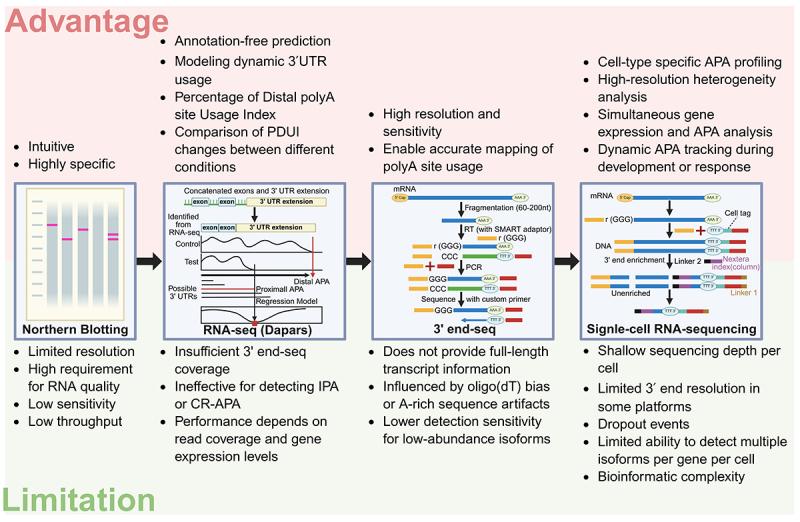
Alternative polyadenylation (APA) is a critical post-transcriptional regulatory mechanism that generates diverse mRNA isoforms by selecting different polyadenylation sites within pre-mRNAs, thereby modulating the length of the 3' untranslated region (3' UTR), thereby fine-tuning gene expression and protein synthesis. APA regulation involves conserved cis-acting elements, trans-acting factors, and key protein complexes such as CPSF and CSTF, influenced by the cellular context and various RNA-binding proteins. To address the complexity of APA, comprehensive methodologies and computational tools have been developed, leading to extensive APA databases with detailed biological annotations. Recent advancements in high-throughput sequencing and single-cell technologies have enhanced our understanding of APA's dynamic regulation across tissues and developmental stages, revealing its significant impact on cellular heterogeneity and disease progression. APA plays essential roles in numerous physiological processes, including neuronal homoeostasis, immune regulation, cardiovascular and vascular development, myogenesis, and metabolism. Dysregulation of APA is associated with a wide range of diseases, including neurodegenerative disorders, autoimmune conditions, cardiovascular diseases, metabolic syndromes, and genetic disorders. Clinically, targeting APA regulatory mechanisms offers promising opportunities for therapeutic interventions and the development of personalized medical strategies. This review highlights the pivotal role of APA in gene regulation and disease, emphasizing the need for continued research to unravel its complex mechanisms and leverage its potential in advancing precision medicine.
可变聚腺苷酸化(Alternative polyadenylation,APA)是一种关键的转录后调控机制,通过在信使核糖核酸前体(pre-mRNAs)内选择不同的聚腺苷酸化位点来产生多种信使核糖核酸(mRNA)异构体,从而调节3'非翻译区(3'UTR)的长度,进而微调基因表达和蛋白质合成。APA调控涉及保守的顺式作用元件、反式作用因子以及关键蛋白复合物,如切割与聚腺苷酸化特异性因子(CPSF)和切割刺激因子(CSTF),其受到细胞环境和各种RNA结合蛋白的影响。为了解决APA的复杂性,已经开发了全面的方法和计算工具,从而产生了具有详细生物学注释的大量APA数据库。高通量测序和单细胞技术的最新进展增强了我们对APA在不同组织和发育阶段的动态调控的理解,揭示了其对细胞异质性和疾病进展的重大影响。APA在众多生理过程中发挥着重要作用,包括神经元稳态、免疫调节、心血管和血管发育、肌生成以及新陈代谢。APA失调与多种疾病相关,包括神经退行性疾病、自身免疫性疾病、心血管疾病、代谢综合征和遗传性疾病。在临床上,靶向APA调控机制为治疗干预和个性化医疗策略的开发提供了有前景的机会。本综述强调了APA在基因调控和疾病中的关键作用,强调需要持续研究以阐明其复杂机制并利用其在推进精准医学方面的潜力。


 Zotero 插件