
使用具有延迟和运动校正功能的长轴向视野PET扫描仪对F-FDG摄取进行动态PET房室模型建模的模型选择。
Model selection for dynamic PET compartmental modelling of F-FDG uptake using a long axial field-of-view PET scanner with delay and motion correction.
作者信息
Moradi Hamed, Vashistha Rajat, O'Brien Kieran, Hammond Amanda, Rominger Axel, Sari Hasan, Shi Kuangyu, Vegh Viktor, Reutens David
机构信息
Centre for Advanced Imaging, Australian Institute for Bioengineering and Nanotechnology, The University of Queensland, Brisbane, Australia.
ARC Training Centre for Innovation in Biomedical Imaging Technology, The University of Queensland, Brisbane, Australia.
出版信息
EJNMMI Res. 2025 Jul 4;15(1):81. doi: 10.1186/s13550-025-01277-9.
BACKGROUND
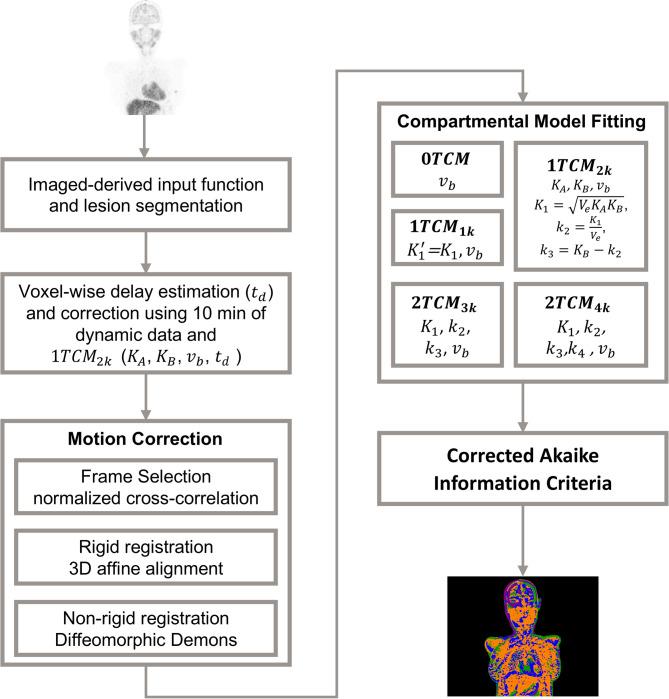
In dynamic PET with tracer kinetic modeling, model complexity is an important but often under-recognised challenge affecting robust parameter estimation, particularly for noisy data. Traditional methods often neglect tissue heterogeneity and apply a single model universally. We applied a model selection approach alongside delay and motion correction, enabling the selection of models with varying complexity to better account for tissue heterogeneity.
RESULTS
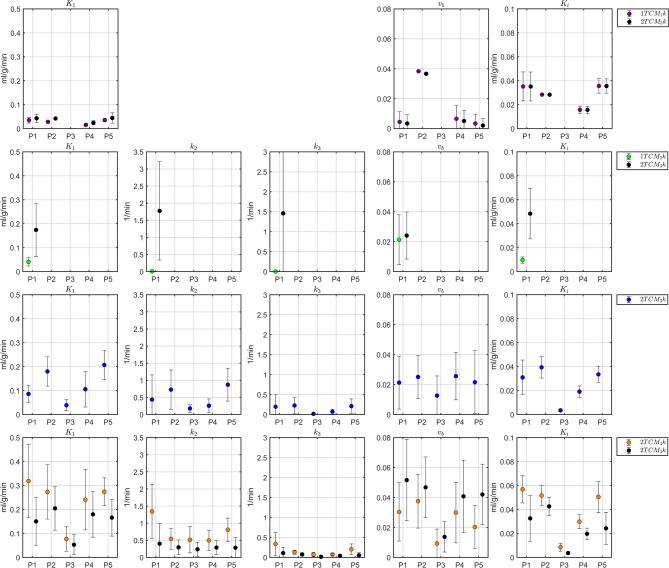
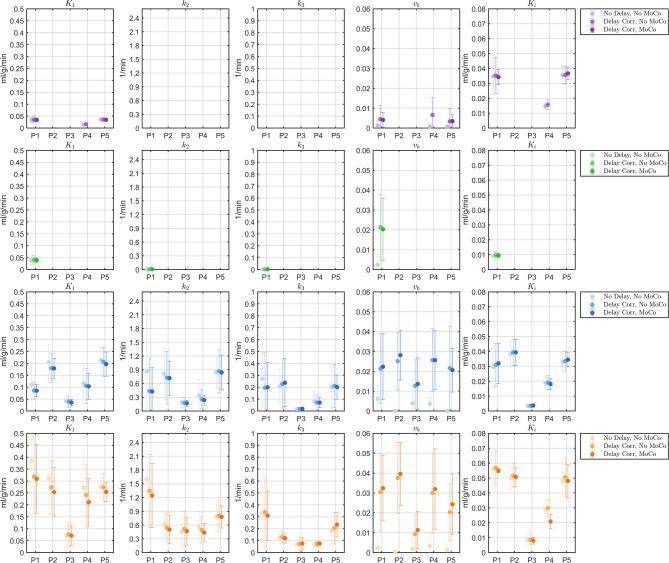
The study included five subjects with breast cancer undergoing dynamic F-FDG PET imaging using a long axial field of view scanner. Voxel-wise kinetic model parameter estimation utilized five compartmental models, with the best model chosen using the Akaike Information Criterion. The model selection revealed diverse kinetic models within breast cancer lesions voxel-wise, with reduced parameter estimation variability attributed to the choice of simpler models. Applying delay and motion correction reduced the mean coefficient of variation in estimated kinetic parameters by 25%.
CONCLUSIONS
We applied a standard model selection approach to identify the optimal compartmental model for voxel-wise parameter estimation in long field-of-view dynamic PET imaging. Our results demonstrate that accounting for tissue heterogeneity in breast lesions is critical for accurate quantification. Additionally, delay and motion correction were shown to improve image quality, enhance quantification accuracy, and support more reliable model selection.
CLINICAL TRIAL REGISTRATION
Clinical trial number: not applicable.
背景
在采用示踪剂动力学建模的动态PET中,模型复杂性是一个重要但常被忽视的挑战,影响着稳健的参数估计,尤其是对于噪声数据。传统方法往往忽略组织异质性并普遍应用单一模型。我们在进行延迟和运动校正的同时应用了一种模型选择方法,能够选择具有不同复杂性的模型,以更好地考虑组织异质性。
结果
该研究纳入了5名患有乳腺癌的受试者,他们使用长轴视野扫描仪进行了动态F-FDG PET成像。体素级动力学模型参数估计采用了五种房室模型,并使用赤池信息准则选择最佳模型。模型选择显示,乳腺癌病灶内体素级的动力学模型各不相同,由于选择了更简单的模型,参数估计的变异性降低。应用延迟和运动校正使估计的动力学参数的平均变异系数降低了25%。
结论
我们应用了一种标准的模型选择方法,以确定长视野动态PET成像中体素级参数估计的最佳房室模型。我们的结果表明,考虑乳腺病变中的组织异质性对于准确量化至关重要。此外,延迟和运动校正被证明可改善图像质量、提高量化准确性并支持更可靠的模型选择。
临床试验注册
临床试验编号:不适用。




 Zotero 插件