
皮肤自发荧光与2型糖尿病患者的血糖变异性相关。
Skin autofluorescence is associated with glycemic variability in type 2 diabetes patients.
作者信息
Shin Eui Seok, Jung Hyun Joo, Kim Jindong, Cho Minhyun, Kim Tae Seon
机构信息
Health Solution Lab, Samsung Research, Samsung Electronics, Seoul, Korea.
出版信息
Sci Rep. 2025 Jul 6;15(1):24105. doi: 10.1038/s41598-025-09517-7.
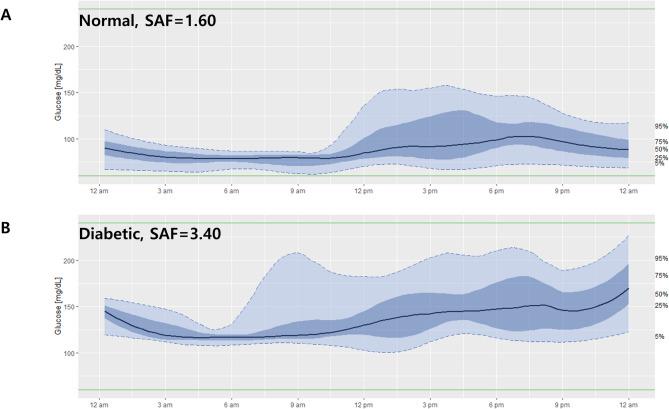
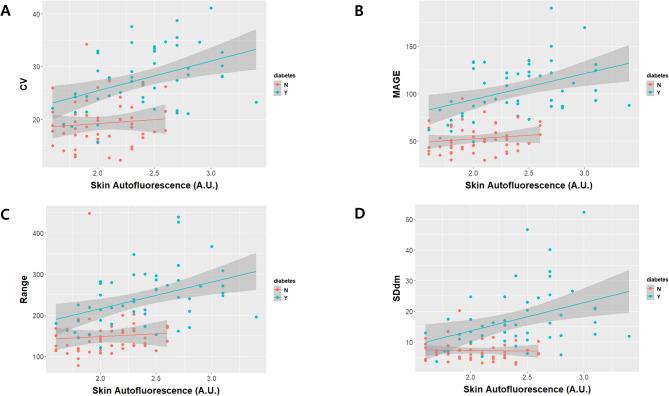
Type 2 diabetes mellitus (T2DM) is a chronic disorder characterized by insulin resistance and hyperglycemia. To prevent diabetic complications, blood glucose levels should be maintained within a target range. While glycated hemoglobin (HbA1c) is widely used to assess long-term glycemic control, it does not provide information on glycemic variability (GV), which contributes to diabetes-related complications. Measuring skin autofluorescence (SAF) is a non-invasive method for measuring advanced glycation end-products (AGEs) in skin tissue and the accumulation of AGE is accelerated under hyperglycemic conditions. However, the relationship between SAF and GV in T2DM is not explored. This study examines the correlation between SAF and GV in T2DM patients and address the potential of SAF as a biomarker to alleviate the risk of diabetic complications. Fifty T2DM patients and fifty non-diabetic controls were recruited. SAF was measured using an AGE reader, and GV was assessed through continuous glucose monitoring (CGM) for 14 days. CGM metrics, including Mean Amplitude of Glycemic Excursions (MAGE) and Coefficient of Variation (CV), were analyzed. Serum AGE levels were measured via ELISA. Bivariate and multivariate associations between SAF and GV were examined using Pearson correlation analysis and multiple linear regression. T2DM patients exhibited higher SAF and GV compared to controls. SAF was positively correlated with GV metrics, including CV and MAGE, in diabetic patients, even after adjusting for confounding factors. No significant correlation was found between GV and serum AGE levels both in normal and T2DM subjects. SAF correlates with GV in T2DM, suggesting its potential as a non-invasive biomarker for glycemic fluctuations and associated risk. Unlike serum AGEs, SAF reflects localized AGE accumulation, which may be a complementary biomarker to HbA1c in assessing glycemic variability related with diabetes complication. Further research, such as longitudinal study, is needed to confirm its clinical utility in predicting long-term outcomes.
2型糖尿病(T2DM)是一种以胰岛素抵抗和高血糖为特征的慢性疾病。为预防糖尿病并发症,血糖水平应维持在目标范围内。虽然糖化血红蛋白(HbA1c)被广泛用于评估长期血糖控制情况,但它并未提供有关血糖变异性(GV)的信息,而血糖变异性会导致糖尿病相关并发症。测量皮肤自发荧光(SAF)是一种用于测量皮肤组织中晚期糖基化终产物(AGEs)的非侵入性方法,且在高血糖条件下AGE的积累会加速。然而,T2DM中SAF与GV之间的关系尚未得到探究。本研究考察了T2DM患者中SAF与GV之间的相关性,并探讨了SAF作为一种生物标志物以降低糖尿病并发症风险的潜力。招募了50名T2DM患者和50名非糖尿病对照者。使用AGE阅读器测量SAF,并通过连续血糖监测(CGM)14天来评估GV。分析了包括血糖波动平均幅度(MAGE)和变异系数(CV)在内的CGM指标。通过酶联免疫吸附测定法测量血清AGE水平。使用Pearson相关分析和多元线性回归研究SAF与GV之间的双变量和多变量关联。与对照组相比,T2DM患者表现出更高的SAF和GV。在糖尿病患者中,即使在调整混杂因素后,SAF仍与包括CV和MAGE在内的GV指标呈正相关。在正常人和T2DM受试者中,均未发现GV与血清AGE水平之间存在显著相关性。T2DM中SAF与GV相关,表明其作为血糖波动及相关风险的非侵入性生物标志物的潜力。与血清AGE不同,SAF反映局部AGE积累,在评估与糖尿病并发症相关的血糖变异性方面,它可能是HbA1c的补充生物标志物。需要进一步的研究,如纵向研究,以确认其在预测长期预后方面的临床效用。
 Zotero 插件