
免疫检查点和BRAF/MEK抑制剂治疗失败后晚期黑色素瘤患者的化疗疗效
Chemotherapy efficacy in advanced melanoma patients after failure of immune checkpoint and BRAF/MEK inhibitors.
作者信息
Galus Łukasz, Małecka Daria Tusień, Michalak Michał, Kopeć Sylwia, Kozak Katarzyna, Piejko Karolina, Ziętek Marcin, Chowaniec Zbyszko, Stopa Bożena Cybulska, Dziura Robert, Żubrowska Justyna, Winciorek Grażyna Kamińska, Bal Wiesław, Rutkowski Piotr, Mackiewicz Jacek
机构信息
Department of Medical and Experimental Oncology, Institute of Oncology, Poznan University of Medical Sciences, Poznań, Poland.
Department of Computer Science and Statistics, Poznan University of Medical Sciences, Poznań, Poland.
出版信息
Contemp Oncol (Pozn). 2025;29(2):165-170. doi: 10.5114/wo.2025.150451. Epub 2025 May 9.
INTRODUCTION
Despite the introduction of new therapies for the treatment of advanced melanoma, treatment is ineffective for a certain number of patients. The efficacy of chemotherapy after failure of anti-programmed death receptor (PD-1) immunotherapy alone or combined with anti-cytotoxic T-lymphocyte-associated antigen (CTLA) is not fully understood. It is believed that due to the immunomodulatory effect of cytostatic agents, its efficacy may be greater when applied after the failure of immunotherapy. The aim of this study was to evaluate the efficacy of different chemotherapy regimens after failure of immunotherapy.
MATERIAL AND METHODS
Patients with advanced melanoma after failure of immunotherapy (anti-PD1+/- anti-CTLA-4) and BRAF mutation-targeted therapy with a BRAF/MEK inhibitor were included in a multicenter, retrospective analysis. Patients were treated with one of four chemotherapy regimens: dacarbazine (DTIC); paclitaxel with carboplatin; cisplatin, vinblastine and dacarbazine (CVD) or bleomycin, DTIC, lomustine, vincristine. The objective response rate (ORR), disease control rate (DCR), median progression-free survival (PFS) and overall survival (OS) were compared in study patients.
RESULTS
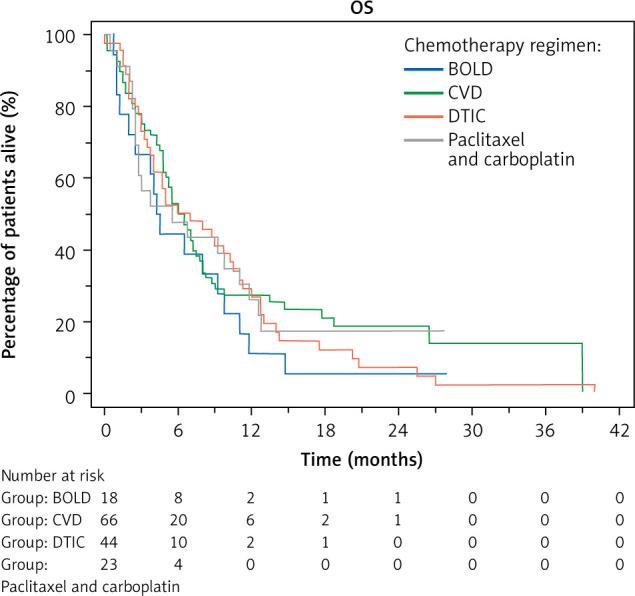
One hundred twenty-four patients were included in the study. Objective response rate was 16.88%, DCR was 38.96%, while median PFS and OS were 2.75 [95% CI: 2.25-3.5] and 6 months [95% CI: 4.75-40], respectively. There were no statistically significant differences in ORR, DCR, median PFS, and OS rates between the patients receiving different chemotherapy regimens.
CONCLUSIONS
In advanced melanoma patients after failure of immune-checkpoint inhibitors with or without BRAF/MEK inhibitors, the choice of chemotherapy regimen remains dependent on the patient's general condition, comorbidities, the need for rapid reduction of tumor masses, and physician and patient preference.
引言
尽管已推出用于治疗晚期黑色素瘤的新疗法,但仍有一定数量的患者治疗无效。抗程序性死亡受体(PD-1)免疫疗法单独或联合抗细胞毒性T淋巴细胞相关抗原(CTLA)治疗失败后化疗的疗效尚未完全明确。据信,由于细胞生长抑制剂的免疫调节作用,在免疫疗法失败后应用时其疗效可能更佳。本研究的目的是评估免疫疗法失败后不同化疗方案的疗效。
材料与方法
免疫疗法(抗PD1±抗CTLA-4)及BRAF/MEK抑制剂靶向BRAF突变治疗失败后的晚期黑色素瘤患者纳入一项多中心回顾性分析。患者接受四种化疗方案之一治疗:达卡巴嗪(DTIC);紫杉醇联合卡铂;顺铂、长春碱和达卡巴嗪(CVD)或博来霉素、DTIC、洛莫司汀、长春新碱。比较研究患者的客观缓解率(ORR)、疾病控制率(DCR)、中位无进展生存期(PFS)和总生存期(OS)。
结果
124例患者纳入研究。客观缓解率为16.88%,疾病控制率为38.96%,而中位无进展生存期和总生存期分别为2.75[95%CI:2.25 - 3.5]和6个月[95%CI:4.75 - 40]。接受不同化疗方案的患者之间,客观缓解率、疾病控制率、中位无进展生存期和总生存期率无统计学显著差异。
结论
在接受或未接受BRAF/MEK抑制剂的免疫检查点抑制剂治疗失败后的晚期黑色素瘤患者中,化疗方案的选择仍取决于患者的一般状况、合并症、迅速缩小肿瘤肿块的需求以及医生和患者的偏好。

 Zotero 插件