
低收入和中等收入国家将计划生育服务与其他生殖健康服务相结合的过程:一项范围综述
The Process of Integrating Family Planning Services with Other Reproductive Health Services in Low and Middle-Income Countries: A Scoping Review.
作者信息
Gul Farina, Lassi Zohra S, Tessema Gizachew A, Ahmed Jawaria Mukhtar, Mahmood Mohammad Afzal
机构信息
School of Public Health, University of Adelaide, Adelaide, Australia.
Robinson Research Institute, University of Adelaide, South Australia, Australia.
出版信息
Int J Integr Care. 2025 Jul 1;25(3):2. doi: 10.5334/ijic.8912. eCollection 2025 Jul-Sep.
INTRODUCTION
In low-resource settings, fragmented family planning (FP) services limit contraceptive access, contributing to high unmet needs and unintended pregnancies. Integrating FP with existing reproductive health services can improve access and continuity of care. This review examines the integration strategies in low and middle-income countries (LMICs).
THEORY AND METHODS
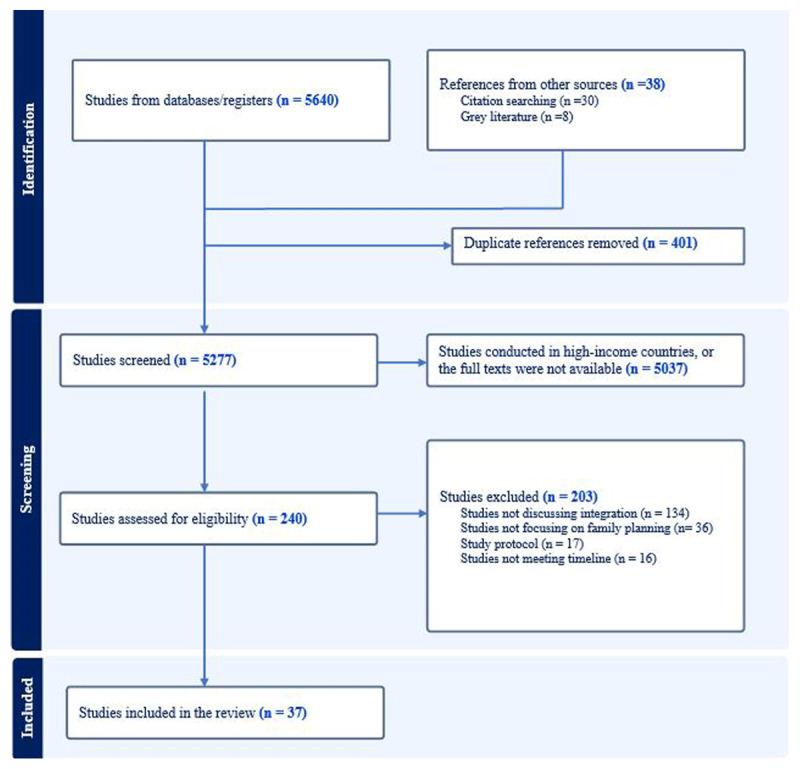
We conduct a scoping review across five databases for peer-reviewed literature and Google Scholar for grey literature, guided by Joanna Briggs Institute (JBI) and Arksey & O'Malley's frameworks. Data were charted study characteristics and details of integration process. Results were reported following PRISMA-ScR guidelines.
RESULTS
The total of 37 studies from LMICs were included. Only five studies provided explicit definitions of integration. Key strategies involved aligning FP with other services, promoting dual-method use in HIV care, and incorporating long-acting reversible contraception with post-abortion and postpartum care. Training was provided to various health workers to support services integration. Most Models used co-location of services within the same facility. Innovative approaches, such as; the Happy Client Model and private counselling spaces. Integration was influenced by provider skills, workload, communication dynamics, training gaps, and supply constraints.
CONCLUSION
A review identified diverse methods and factors for integrating family planning services. Clear operational definitions and innovative services delivery models are critical for effective integration. Further research should inform context-adaptable frameworks for implementation in resource-constrained settings. These findings can inform integrated care policy by highlighting the need for coordinated service models, provider training, and context-sensitive strategies to optimise FP access in LMICs.
引言
在资源匮乏地区,计划生育(FP)服务分散,限制了避孕药具的获取,导致未满足的需求和意外怀孕率居高不下。将计划生育与现有的生殖健康服务相结合,可以改善服务的可及性和连续性。本综述考察了低收入和中等收入国家(LMICs)的整合策略。
理论与方法
我们按照乔安娜·布里格斯研究所(JBI)以及阿克西和奥马利的框架,在五个数据库中检索同行评议文献,并在谷歌学术中检索灰色文献,进行了一项范围综述。对数据进行了图表化处理,涵盖研究特征和整合过程的细节。结果按照PRISMA-ScR指南进行报告。
结果
纳入了来自低收入和中等收入国家的37项研究。只有五项研究对整合给出了明确的定义。关键策略包括使计划生育与其他服务相结合、在艾滋病护理中推广双重方法的使用,以及将长效可逆避孕措施纳入堕胎后和产后护理。为各类卫生工作者提供了培训,以支持服务整合。大多数模式采用在同一机构内将服务同地安置。创新方法,如快乐客户模式和私人咨询空间。整合受到提供者技能、工作量、沟通动态、培训差距和供应限制的影响。
结论
一项综述确定了整合计划生育服务的多种方法和因素。明确的操作定义和创新的服务提供模式对于有效整合至关重要。进一步的研究应为在资源受限环境中实施的因地制宜的框架提供信息。这些发现可通过强调协调服务模式、提供者培训和因地制宜的策略的必要性,为综合护理政策提供参考,以优化低收入和中等收入国家的计划生育服务可及性。
 Zotero 插件