
[新诊断的伴过多原始细胞的骨髓增生异常综合征患者接受去甲基化药物治疗前后基因突变状态与治疗疗效及生存的相关性分析]
[Analysis of the association between pre- and post-treatment genetic mutation status and treatment efficacy and survival in patients with newly diagnosed myelodysplastic syndromes with excess blasts receiving hypomethylating agent therapy].
作者信息
Zhong T, Qin T J, Xu Z F, Pan L J, Qu S Q, Jiao M, Gao Q Y, Xiao Z J, Li B
机构信息
State Key Laboratory of Experimental Hematology, National Clinical Research Center for Blood Diseases, Haihe Laboratory of Cell Ecosystem, Institute of Hematology & Blood Diseases Hospital, Chinese Academy of Medical Sciences & Peking Union Medical College, Tianjin 300020, China Tianjin Institutes of Health Science, Tianjin 301600, China.
出版信息
Zhonghua Xue Ye Xue Za Zhi. 2025 May 14;46(5):417-424. doi: 10.3760/cma.j.cn121090-20241210-00553.
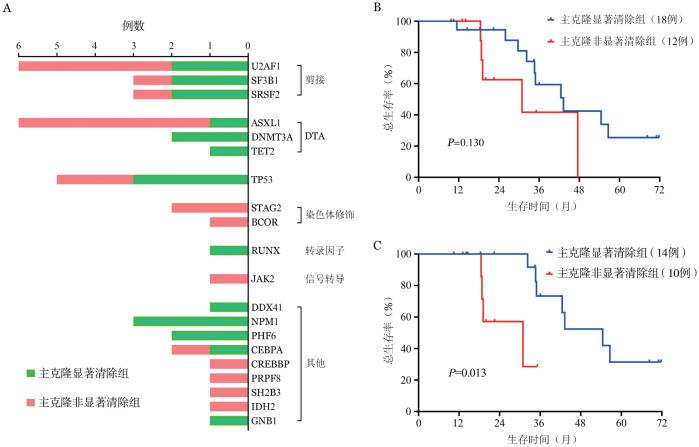
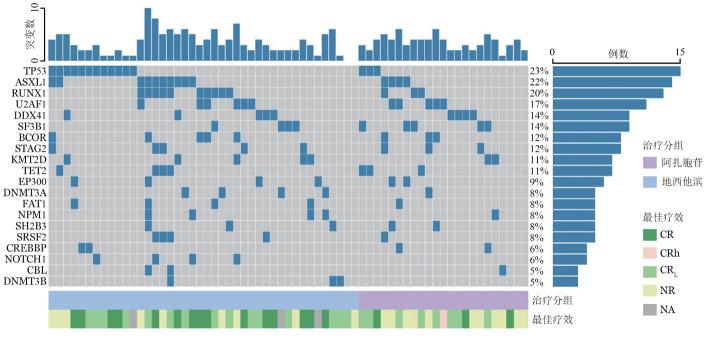
To investigate the association between pre- and post-treatment gene mutation profiles and clinical outcomes (treatment response and prognosis) in patients with myelodysplastic syndromes with excess blasts (MDS-EB) receiving hypomethylating agent (HMA) monotherapy. The clinical characteristics, treatment efficacy, and survival outcomes of 69 treatment-naive patients with MDS-EB who underwent next-generation sequencing (NGS) before treatment and completed at least 4 cycles of HMA monotherapy at the Institute of Hematology & Blood Diseases Hospital, CAMS & PUMC, between June 2016 and September 2023, were retrospectively analyzed. ① The cohort comprised 47 males and 22 females with a median age of 62 years (range: 41-80). Thirty-nine patients were classified as MDS-EB1 and 30 as MDS-EB2. The median number of treatment cycles was 6 (range: 4-35). The median follow-up duration was 22 months (range: 5-72), and the median overall survival (OS) was 32 months (95% : 27-43). ② The presence of DTA (DNMT3A, TET2, or ASXL1) mutations, signaling pathway mutations, transcription factor mutations, or splicing factor mutations before HMA treatment showed no significant association with the best response within 4 treatment cycles, duration of response (DOR), or OS. TP53 mutation status was significantly associated with DOR and shorter OS. The median DOR was 3 months (95% : 1-10) for patients with biallelic TP53 mutations, 10 months (95% : 3-34) for those with monoallelic TP53 mutations, and 16 months (95% : 8-27) in patients without TP53 mutations (=0.032). The median OS was 16 months (95% : 7-38), 15 months (95% : 6-40), and 35 months (95% : 14-91), respectively (<0.001). ③ Neither the Revised International Prognostic Scoring System (IPSS-R) nor the Molecular International Prognostic Scoring System (IPSS-M) could predict the best response within 4 treatment cycles or DOR in patients receiving HMA therapy. ④ Among patients without TP53 mutations, the median OS was 55 months (95% : 9-106) for the major clone significant clearance group (=14) and 31 months (95% : 16-184) for the major clone non-significant clearance group (=10) (=0.013). For patients who responded to HMA treatment and had significant major clone clearance, the 3-year OS rate reached (77.8±13.9) %. For MDS-EB patients receiving HMA monotherapy, single gene mutations, IPSS-R, and IPSS-M could not effectively predict treatment outcomes before therapy. However, for patients without TP53 mutations, monitoring the degree of major clone clearance by NGS during treatment may predict the long-term efficacy in MDS patients receiving HMA therapy.
旨在研究接受去甲基化药物(HMA)单药治疗的伴过多原始细胞的骨髓增生异常综合征(MDS-EB)患者治疗前后基因突变谱与临床结局(治疗反应和预后)之间的关联。对2016年6月至2023年9月期间在中国医学科学院血液病医院接受下一代测序(NGS)且至少完成4个周期HMA单药治疗的69例初治MDS-EB患者的临床特征、治疗疗效和生存结局进行回顾性分析。①该队列包括47例男性和22例女性,中位年龄62岁(范围:41-80岁)。39例患者被分类为MDS-EB1,30例为MDS-EB2。治疗周期的中位数为6(范围:4-35)。中位随访时间为22个月(范围:5-72),中位总生存期(OS)为32个月(95%置信区间:27-43)。②HMA治疗前存在DTA(DNMT3A、TET2或ASXL1)突变、信号通路突变、转录因子突变或剪接因子突变与4个治疗周期内的最佳反应、反应持续时间(DOR)或OS均无显著关联。TP53突变状态与DOR和较短的OS显著相关。双等位基因TP53突变患者的中位DOR为3个月(95%置信区间:1-10),单等位基因TP53突变患者为10个月(95%置信区间:3-34),无TP53突变患者为16个月(95%置信区间:8-27)(P=0.032)。中位OS分别为16个月(95%置信区间:7-38)、15个月(95%置信区间:6-40)和35个月(95%置信区间:14-91)(P<0.001)。③修订后的国际预后评分系统(IPSS-R)和分子国际预后评分系统(IPSS-M)均无法预测接受HMA治疗患者4个治疗周期内的最佳反应或DOR。④在无TP53突变的患者中,主要克隆显著清除组(n=14)的中位OS为55个月(95%置信区间:9-106),主要克隆非显著清除组(n=10)为31个月(95%置信区间:16-184)(P=0.013)。对于对HMA治疗有反应且主要克隆有显著清除的患者,3年OS率达到(77.8±13.9)%。对于接受HMA单药治疗的MDS-EB患者,单基因突变、IPSS-R和IPSS-M在治疗前均无法有效预测治疗结局。然而,对于无TP53突变的患者,治疗期间通过NGS监测主要克隆清除程度可能预测接受HMA治疗的MDS患者的长期疗效。
 Zotero 插件