
揭示拉丁裔混血人群中与酒精有害使用相关的遗传机制。
Uncovering genetic mechanisms associated with harmful use of alcohol in admixed Latin Americans.
作者信息
Amaral Edson H B, Britto Gabriela de S G, de São Pedro Raquel B, Moreira Alberto O, Scliar Marília O, Lyra Ricardo, Lima Natália P, Feitosa Caroline A, Figueiredo Camila A V, Pitangueira Helena M, da Silva Thiago Magalhães, Vasconcelos Luydson R S, Carmo Rodrigo F, Barreto Maurício L, Tarazona-Santos Eduardo, Horta Bernardo L, Brunialti-Godard Ana L, Oliveira Pablo R S
机构信息
Instituto de Biologia, Universidade Federal da Bahia, R. Barão de Jeremoabo, 668 - Ondina, Salvador, 1154, BA, Brazil.
Centro de Pesquisa em Genoma Humano e Células-Tronco, Universidade de São Paulo, São Paulo, Brazil.
出版信息
BMC Genomics. 2025 Jul 7;26(1):639. doi: 10.1186/s12864-025-11691-x.
BACKGROUND
Harmful use of alcohol (HUA) refers to drinking patterns that are associated with increased risk of medical complications and adverse social impacts. HUA is a multifactorial condition, involving neurotransmission system alterations, environmental factors, and genetic predisposition. Previous studies have identified numerous genetic variants associated with alcohol-related phenotypes. However, the generalizability of these findings remains limited, as most studies have primarily focused on European and Asian populations, leaving other ethnic groups, such as Latino Americans, underrepresented. Here, we explored the genetic mechanisms underlying HUA in admixed Brazilians. HUA was evaluated in 2,840 individuals using the Alcohol Use Disorder Identification Test (AUDIT). Genetic variations were assessed using a genome-wide genotyping array, followed by genotype imputation. Ancestry patterns were estimated by comparing individual variants with those of reference populations. Association analysis was performed using multivariate logistic regression, and the functional impacts of variants were investigated through in silico analysis. Pathway enrichment and network analyses were conducted to identify potential genetic mechanisms underlying HUA.
RESULTS
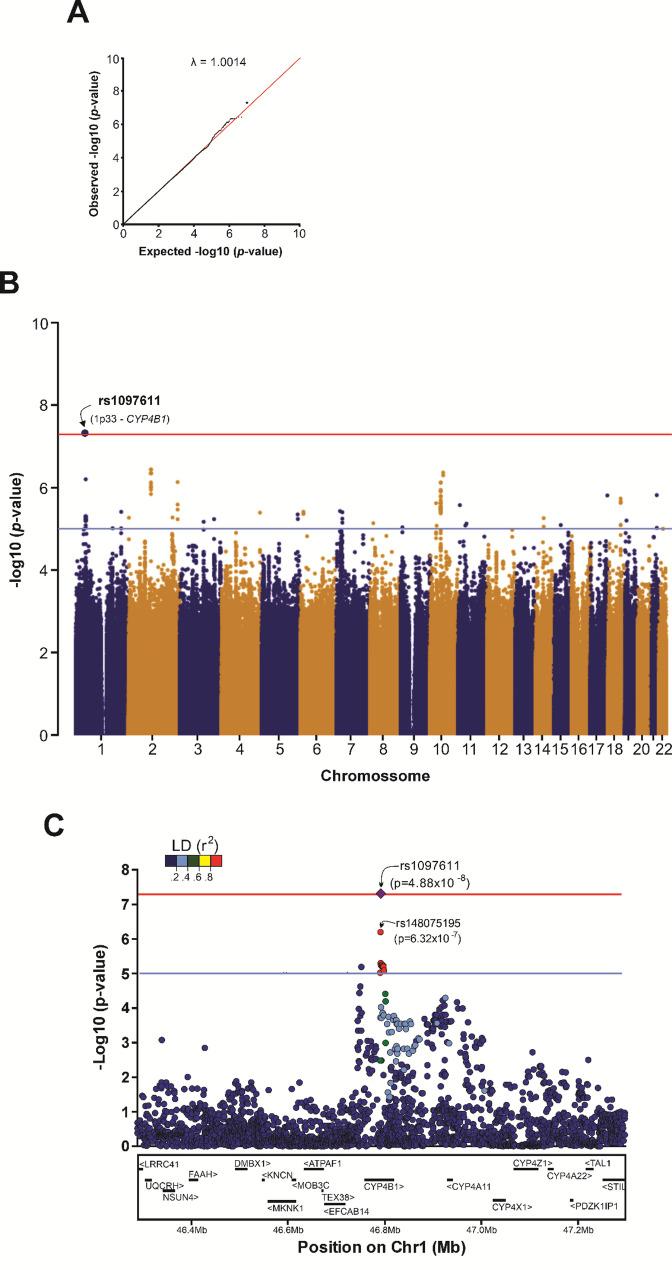
Ancestry analysis confirmed the admixed nature of the study population, with lower levels of European ancestry significantly associated (p < 0.05, Mann-Whitney U test) with increased risk of HUA, suggesting potential ancestry-related genetic or socio-environmental factors contributing to alcohol-related behaviors. The genome-wide association study identified a significant association between the variant rs1097611 at 1p33 and HUA p = 4.88 × 10, odds ratio [OR] = 1.8, confidence interval [CI] = 1.46-2.23), based on a multivariate logistic regression model assuming additive genetic effects and adjusted for sex and European ancestry. The rs1097611 and other variants at this locus are located in regulatory regions and have been previously associated with differential CYP4B1 expression across multiple tissues. Other suggestive association signals (5 × 10 < p < 10) were identified at loci previously implicated in addictive substance use behaviors, including alcohol and/or tobacco consumption, such as 10q21.2 (ARID5B), 5q34-q35.1 (SLIT3), and 10q11.23 (SGMS1). Genome-based pathway enrichment analysis revealed several mechanisms potentially involved in HUA, primarily related to neurobiological processes and neuronal signaling. Finally, network analysis revealed a highly interconnected cluster of nervous system-related pathways, pointing to their potential functional interplay.
CONCLUSIONS
This study identifies novel loci, particularly at 1p33 (CYP4B1), and genetic mechanisms potentially involved in HUA in an admixed Latin American population. Studies in diverse ethnic groups are crucial to uncover novel genetic risk variants for HUA and improve its management.
背景
有害饮酒(HUA)是指与医学并发症风险增加及不良社会影响相关的饮酒模式。HUA是一种多因素疾病,涉及神经传递系统改变、环境因素和遗传易感性。既往研究已鉴定出众多与酒精相关表型相关的基因变异。然而,这些研究结果的普遍性仍然有限,因为大多数研究主要集中在欧洲和亚洲人群,拉丁裔美国人等其他种族群体的代表性不足。在此,我们探讨了混血巴西人中HUA的遗传机制。使用酒精使用障碍识别测试(AUDIT)对2840名个体进行了HUA评估。使用全基因组基因分型阵列评估基因变异,随后进行基因型推算。通过将个体变异与参考人群的变异进行比较来估计祖先模式。使用多变量逻辑回归进行关联分析,并通过计算机分析研究变异的功能影响。进行通路富集和网络分析以识别HUA潜在的遗传机制。
结果
祖先分析证实了研究人群的混血性质,欧洲血统水平较低与HUA风险增加显著相关(p < 0.05,曼-惠特尼U检验),这表明可能存在与祖先相关的遗传或社会环境因素导致与酒精相关的行为。全基因组关联研究确定,基于假设加性遗传效应并根据性别和欧洲血统进行调整的多变量逻辑回归模型,位于1p33的变异rs1097611与HUA显著相关(p = 4.88 × 10,优势比[OR] = 1.8,置信区间[CI] = 1.46 - 2.23)。rs1097611及该位点的其他变异位于调控区域,此前已与多个组织中CYP4B1的差异表达相关。在先前与成瘾性物质使用行为(包括酒精和/或烟草消费)相关的位点,如10q21.2(ARID5B)、5q34 - q35.1(SLIT3)和10q11.23(SGMS1),鉴定出了其他提示性关联信号(5 × 10 < p < 10)。基于基因组的通路富集分析揭示了几种可能参与HUA的机制,主要与神经生物学过程和神经元信号传导有关。最后,网络分析揭示了一个高度互联的神经系统相关通路簇,表明它们可能存在功能相互作用。
结论
本研究在一个混血拉丁裔人群中鉴定出了新的位点,特别是1p33(CYP4B1),以及可能参与HUA的遗传机制。对不同种族群体的研究对于发现HUA新的遗传风险变异并改善其管理至关重要。




 Zotero 插件