
Set1是白色念珠菌中响应外部信号的关键转录调节因子。
Set1 is a critical transcriptional regulator in response to external signals in Candida albicans.
作者信息
Kim Jueun, Park Jiyeon, Lee Eun-Jin, Cho Yong-Joon, Lee Jung-Shin
机构信息
Department of Molecular Bioscience, College of Biomedical Science, Kangwon National University, Chuncheon 24341, Republic of Korea.
Institute of Life Sciences, Kangwon National University, Chuncheon 24341, Republic of Korea.
出版信息
Nucleic Acids Res. 2025 Jul 8;53(13). doi: 10.1093/nar/gkaf632.
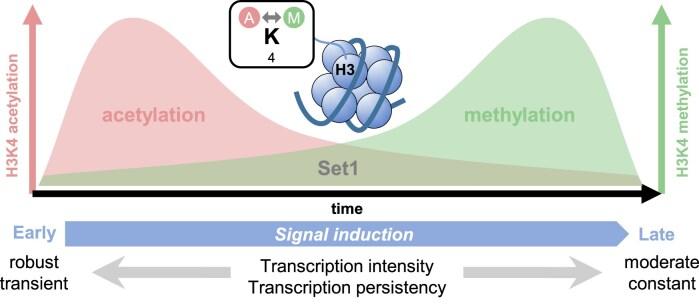
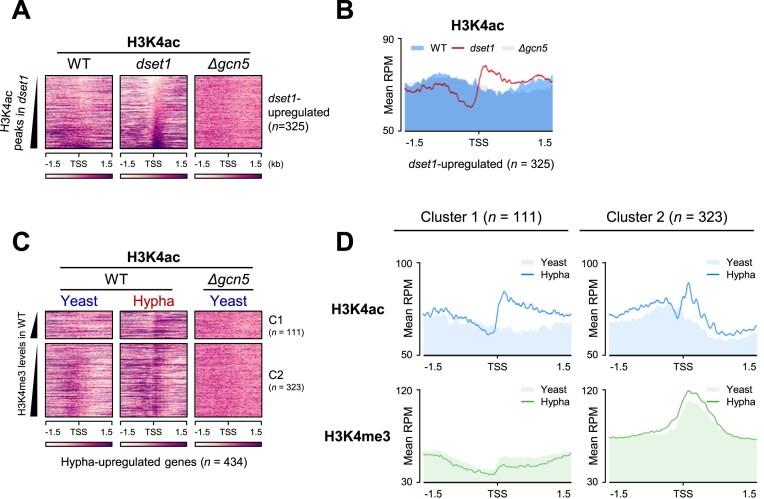
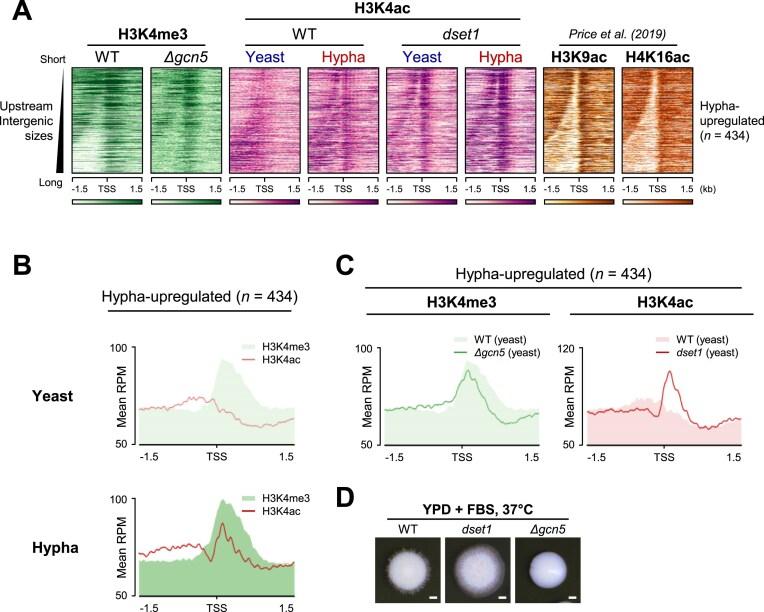
Precise gene regulation is vital for maintaining cellular homeostasis and enabling environmental adaptation in living organisms. Eukaryotic organisms display intricate transcriptional regulation influenced by chromatin structures and histone modifications. Set1-mediated methylation of histone H3 at lysine 4 (H3K4) is a well-established marker of active transcription in eukaryotes. However, the deletion of Set1 in the dimorphic pathogenic fungus, Candida albicans, led to the activation of signal-responsive genes even in the absence of external signals. The present study aimed to elucidate Set1's role in the transcription of genes that respond to external signals. These inducible genes displayed atypical H3K4 modification patterns. During the initial induction stages, H3K4 methylation was not involved in the rapid and robust expression of these genes; instead, acetylation of the same residue was involved. H3K4 acetylation significantly increased in the absence of H3K4 methylation, allowing genes that did not receive external transcriptional signals to initiate mRNA expression, leading to morphological changes. With continued exposure to induction signals, the heightened H3K4 acetylation decreased while H3K4 methylation increased in these genes. Thus, inducible genes receive positive feedback for stable and sustainable expression. In conclusion, Set1 precisely modulates H3K4 methylation and acetylation levels to regulate the transcription of inducible genes at specific times and levels.
精确的基因调控对于维持细胞内稳态以及使生物体能够适应环境至关重要。真核生物表现出受染色质结构和组蛋白修饰影响的复杂转录调控。Set1介导的组蛋白H3赖氨酸4位点(H3K4)甲基化是真核生物中活跃转录的一个公认标志。然而,在二态致病真菌白色念珠菌中删除Set1会导致即使在没有外部信号的情况下信号响应基因也被激活。本研究旨在阐明Set1在对外部信号作出反应的基因转录中的作用。这些可诱导基因表现出非典型的H3K4修饰模式。在初始诱导阶段,H3K4甲基化不参与这些基因的快速和强劲表达;相反,相同残基的乙酰化参与其中。在没有H3K4甲基化的情况下,H3K4乙酰化显著增加,使得未接收到外部转录信号的基因启动mRNA表达,从而导致形态变化。随着持续暴露于诱导信号,这些基因中升高的H3K4乙酰化水平下降,而H3K4甲基化水平增加。因此,可诱导基因获得正反馈以实现稳定和可持续的表达。总之,Set1精确调节H3K4甲基化和乙酰化水平,以在特定时间和水平调节可诱导基因的转录。



 Zotero 插件