
胸骨旁肋间浅平面阻滞与全胸骨切开术:一项随机试验。
Superficial Parasternal Intercostal Plane Block and Full Sternotomy; A Randomized Trial.
作者信息
Kalli Antti, Vistbacka Julia, Moilanen Eeva, Järvelä Kati, Mennander Ari
机构信息
Faculty of Medicine and Health Technology, Tampere University, Tampere 33520, Finland.
Tampere University Hospital, Heart Hospital, Tampere 33520, Finland.
出版信息
Eur J Cardiothorac Surg. 2025 Jul 1;67(7). doi: 10.1093/ejcts/ezaf226.
OBJECTIVES
Cardiac surgery via full sternotomy impacts postoperative lung function. We studied whether ultrasound-guided superficial parasternal intercostal plane block (SPIP) before surgical aortic valve replacement via full sternotomy would ameliorate postoperative lung function and filtration capacity.
METHODS
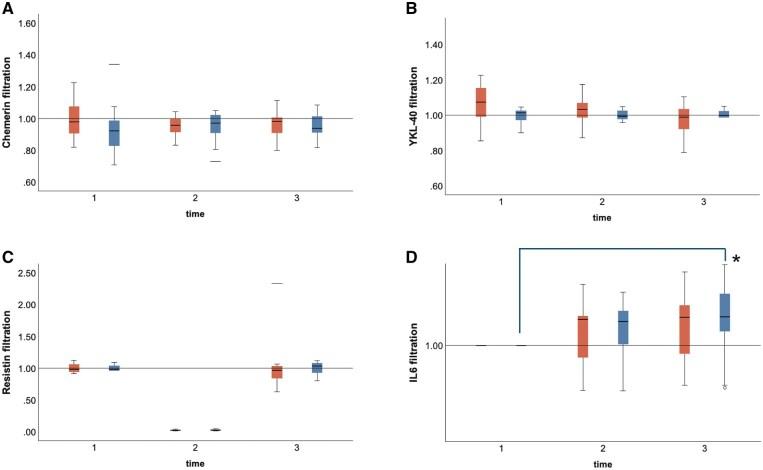
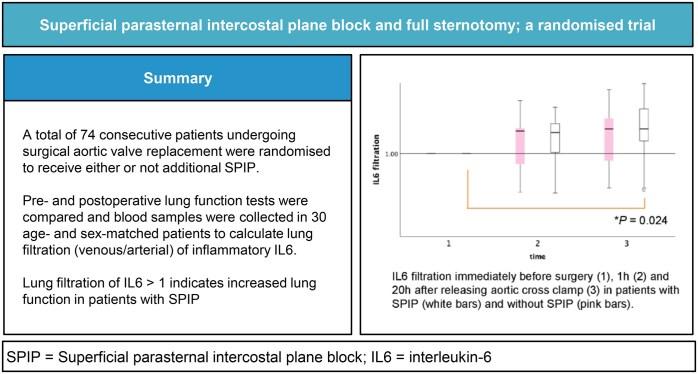
A total of 74 consecutive patients undergoing surgical aortic valve replacement were randomized to receive either or not additional SPIP. Pre- and postoperative lung function tests were compared among the patients. Venous and arterial blood samples were collected to calculate lung filtration (venous/arterial) of the inflammatory factors chemerin, chitinase-3-like protein 1 (YKL-40), resistin, and interleukin-6 (IL6) immediately before (T1), 1 hour after releasing aortic cross-clamp (T2), and on the following morning (T3) after surgery in 30 age- and sex-adjusted patients.
RESULTS
Patients with SPIP were older as compared to those without (66.7 [10.7] vs 60.2 [13.4], years, respectively, P < 0.04). Neither other patient characteristics nor preoperative lung functions differed between the patient groups. Forced expiratory volume in 1 second (FEV), forced volume capacity (FVC), and relative FVC changes decreased less in patients treated with wound analgesia as compared to those without (P = 0.024, P = 0.042, and P = 0.042). Total oxycodone consumption (P = 0.634), YKL-40, and resistin did not differ between the groups. Arterial chemerin decreased and venous/arterial IL6 ratio increased in patients with SPIP as compared to those without (P = 0.024 versus P = 0.332, respectfully).
CONCLUSIONS
SPIP before aortic valve surgery via full sternotomy impacts postoperative respiratory function and venous/arterial IL6 ratio.
CLINICAL REGISTRATION NUMBER
The study was approved by the institutional review board (Ethical Committee of the Tampere University Hospital, Tampere, Finland, registration number R18011M) on March 8, 2018, and the study conforms to the ethical guidelines of the Declaration of Helsinki. The trial was registered as ClinicalTrials.gov ID NCT03704753 (EudraCT = 2017-004744-38).
目的
经全胸骨切开术进行心脏手术会影响术后肺功能。我们研究了在经全胸骨切开术进行主动脉瓣置换术前,超声引导下的胸骨旁浅表肋间平面阻滞(SPIP)是否能改善术后肺功能和滤过能力。
方法
共有74例连续接受主动脉瓣置换手术的患者被随机分组,分别接受或不接受额外的SPIP。比较患者术前和术后的肺功能测试结果。在30例年龄和性别匹配的患者中,于手术前即刻(T1)、松开主动脉阻断钳后1小时(T2)以及术后次日早晨(T3)采集静脉和动脉血样,以计算炎症因子chemerin、几丁质酶-3样蛋白1(YKL-40)、抵抗素和白细胞介素-6(IL6)的肺滤过率(静脉血/动脉血)。
结果
接受SPIP的患者比未接受的患者年龄更大(分别为66.7 [10.7]岁和60.2 [13.4]岁,P < 0.04)。患者组之间的其他患者特征和术前肺功能均无差异。与未接受伤口镇痛的患者相比,接受伤口镇痛治疗的患者1秒用力呼气量(FEV)、用力肺活量(FVC)和FVC相对变化的下降幅度较小(P = 0.024、P = 0.042和P = 0.042)。两组之间的羟考酮总消耗量(P = 0.634)、YKL-40和抵抗素无差异。与未接受SPIP的患者相比,接受SPIP的患者动脉血chemerin水平降低,静脉血/动脉血IL6比值升高(分别为P = 0.024和P = 0.332)。
结论
经全胸骨切开术进行主动脉瓣手术前的SPIP会影响术后呼吸功能和静脉血/动脉血IL6比值。
临床注册号
该研究于2018年3月8日获得机构审查委员会(芬兰坦佩雷大学医院伦理委员会,注册号R18011M)批准,且该研究符合《赫尔辛基宣言》的伦理准则。该试验已在ClinicalTrials.gov注册,编号为NCT03704753(EudraCT = 2017-004744-38)。
 Zotero 插件