
孕妇和产后妇女关于压力性尿失禁的知识、态度及行为
Knowledge, attitudes, and practices of pregnant and postpartum women regarding stress urinary incontinence.
作者信息
Dong Qin, Wan Shenxian, Wang Ruihua, Guo Sanshan, Shen Hong, Wang Ningjuan, Cai Wenting, Cai Luxi, Zhao Wei
机构信息
Department of Obstetrics and Gynecology, Suzhou Research Center of Medical School, Suzhou Hospital, Affiliated Hospital of Medical School, Nanjing University, Suzhou, 215000, Jiangsu, China.
Department of obstetrics, First Affiliated Hospital of Soochow University, Suzhou, 215000, Jiangsu, China.
出版信息
Sci Rep. 2025 Jul 8;15(1):24535. doi: 10.1038/s41598-025-09798-y.
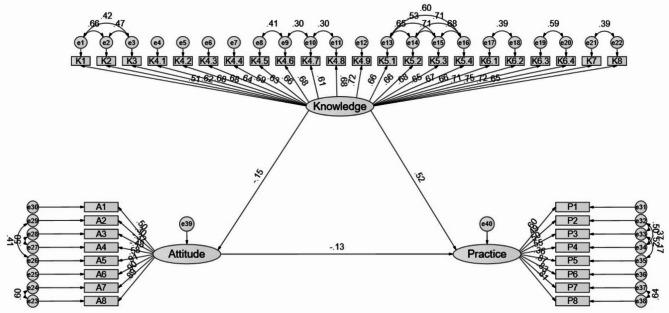
This study aimed to assess the knowledge, attitudes, and practices (KAP) of pregnant and postpartum women regarding stress urinary incontinence. Conducted in Suzhou from January to March 2024, the cross-sectional study involved 476 participants, predominantly pregnant women (81.3%). Data were collected through self-administered questionnaires, covering demographic characteristics and KAP scores. Findings revealed median scores: knowledge 20.00 [12.00, 28.00] (range: 0-44), attitudes 21.00 [19.75, 24.00] (range: 8-40), and practices 26.00 [22.00, 31.00] (range: 8-40). Structural equation modeling (SEM) showed knowledge directly influenced attitudes (β = -0.153, p < 0.001), while both knowledge (β = 0.522, p < 0.001) and attitudes (β = -0.128, p = 0.004) significantly impacted practices. Moreover, knowledge indirectly affected practices via attitudes (β = 0.020, p = 0.031). Multivariate logistic regression indicated that higher knowledge scores (OR = 1.101, p < 0.001) and higher education levels were associated with proactive practices. The results highlighted inadequate knowledge and negative attitudes among participants. Consequently, it is vital to implement targeted educational programs aimed at improving understanding and attitudes towards stress urinary incontinence in pregnant and postpartum women, enhancing their self-management behaviors.
本研究旨在评估孕妇和产后妇女关于压力性尿失禁的知识、态度和行为。该横断面研究于2024年1月至3月在苏州进行,涉及476名参与者,其中主要是孕妇(81.3%)。通过自填问卷收集数据,涵盖人口统计学特征和知识、态度、行为得分。研究结果显示,知识得分中位数为20.00[12.00, 28.00](范围:0 - 44),态度得分中位数为21.00[19.75, 24.00](范围:8 - 40),行为得分中位数为26.00[22.00, 31.00](范围:8 - 40)。结构方程模型(SEM)显示,知识直接影响态度(β = -0.153,p < 0.001),而知识(β = 0.522,p < 0.001)和态度(β = -0.128,p = 0.004)均显著影响行为。此外,知识通过态度间接影响行为(β = 0.020,p = 0.031)。多因素逻辑回归表明,较高的知识得分(OR = 1.101,p < 0.001)和较高的教育水平与积极的行为相关。结果突出了参与者知识不足和态度消极的问题。因此,实施有针对性的教育项目以提高孕妇和产后妇女对压力性尿失禁的认识和态度,增强她们的自我管理行为至关重要。
 Zotero 插件