
高通量激光解吸电离质谱技术在大规模队列中解析前列腺癌独特的代谢图谱。
High-throughput LDI MS technology decodes the distinct metabolic landscape of prostate cancer in a large-scale cohort.
作者信息
Jiang Xinrong, Zhang Chen, Le Jing, Zhang Jie, Cao Shuo, Xu Xinran, Chen Xiaoming, Cheng Sheng, Yu Haitao, Jiang Haofei, Zang Ruichen, Wang Kunyu, Chen Weiwu, Fan Haobo, Wu Jianmin, Yu Yanlan, Ding Guoqing
机构信息
Department of Urology, School of Medicine, Sir Run Run Shaw Hospital, Zhejiang University, Hangzhou, 310016, P. R. China.
Institute of Analytical Chemistry, Department of Chemistry, Zhejiang University, Hangzhou, 310058, P. R. China.
出版信息
Biomark Res. 2025 Jul 9;13(1):94. doi: 10.1186/s40364-025-00804-z.
BACKGROUND
Prostate cancer (PCa) remains a leading global malignancy, yet current diagnostic reliance on prostate-specific antigen (PSA) testing is limited by suboptimal sensitivity and specificity for early-stage detection. The present study aims to establish an effective high-throughput screening technique for accurate PCa diagnosis.
METHODS
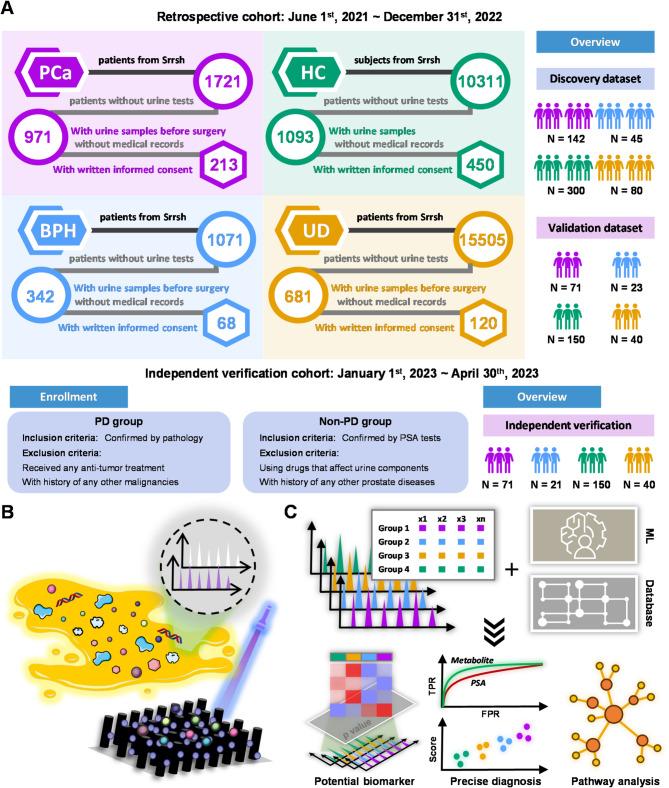
A large-scale cohort of 28,892 subjects was considered for inclusion in this study, and 1133 volunteers were finally selected, including 600 healthy controls, 160 patients diagnosed with other diseases of urinary system, 89 patients diagnosed with benign prostate hyperplasia (BPH), and 284 PCa patients. Discovery and internal validation phases of diagnostic models were conducted through machine learning of urine metabolic fingerprints obtained by laser desorption/ionization mass spectrometry (LDI-MS). Furthermore, the developed diagnostic model was verified in an external validation cohort.
RESULTS
In retrospective cohort, the stepwise binary classification model achieved satisfactory diagnostic performance with areas under curves (AUCs) of 0.9599–0.9957 in the discovery ( = 567) and internal validation dataset ( = 284). In the external validation cohort ( = 282), AUC values from the ROC curves that differentiate Non-PD from PD, BPH from PCa, and HC from UD were 0.9815, 0.9705, and 0.9980, respectively. More than 95% significant PCa patients in the gray area (3 < tPSA < 10 ng/mL) were successfully identified from BPH subjects. Notably, four metabolite-related candidate genes were identified in this work, including , , and .
CONCLUSIONS
This study demonstrated the clinical potential of an LDI-MS-based non-invasive urine biopsy for early prostate cancer detection, particularly in improving diagnostic accuracy for patients with tPSA levels in the gray zone (3–10 ng/mL).
SUPPLEMENTARY INFORMATION
The online version contains supplementary material available at 10.1186/s40364-025-00804-z.
背景
前列腺癌(PCa)仍是全球主要的恶性肿瘤,但目前对前列腺特异性抗原(PSA)检测的诊断依赖在早期检测的敏感性和特异性方面存在局限。本研究旨在建立一种有效的高通量筛查技术以准确诊断PCa。
方法
本研究考虑纳入一个28892名受试者的大规模队列,最终选取了1133名志愿者,包括600名健康对照、160名被诊断患有其他泌尿系统疾病的患者、89名被诊断患有良性前列腺增生(BPH)的患者以及284名PCa患者。通过对激光解吸/电离质谱(LDI-MS)获得的尿液代谢指纹进行机器学习,开展诊断模型的发现和内部验证阶段。此外,在外部验证队列中对所开发的诊断模型进行验证。
结果
在回顾性队列中,逐步二元分类模型在发现数据集(n = 567)和内部验证数据集(n = 284)中取得了令人满意的诊断性能,曲线下面积(AUC)为0.9599 - 0.9957。在外部验证队列(n = 282)中,区分非PCa与PCa、BPH与PCa以及健康对照与泌尿系统疾病患者的ROC曲线的AUC值分别为0.9815、0.9705和0.9980。从BPH受试者中成功识别出超过95%处于灰色区域(3 < tPSA < 10 ng/mL)的显著PCa患者。值得注意的是,本研究确定了四个与代谢物相关的候选基因,包括 、 、 和 。
结论
本研究证明了基于LDI-MS的非侵入性尿液活检在早期前列腺癌检测中的临床潜力,特别是在提高tPSA水平处于灰色区域(3 - 10 ng/mL)患者的诊断准确性方面。
补充信息
在线版本包含可在10.1186/s40364 - 025 - 00804 - z获取的补充材料。



 Zotero 插件