
mLIFE随机试验考察了将社交支持提供游戏化对减肥的影响。
The mLIFE randomized trial examining the impact of gamifying social support provision for weight loss.
作者信息
Turner-McGrievy Gabrielle M, Delgado-Díaz Diana Carolina, DuBois Kelli E, Aydin Halide Zeynep, Monroe Courtney M, Kim Yesil, Hardin James, Wilcox Sara, Valafar Homayoun
机构信息
Prevention Research Center, Arnold School of Public Health, University of South Carolina, Columbia, South Carolina, USA.
Department of Health Promotion, Education, and Behavior, Arnold School of Public Health, University of South Carolina, Columbia, South Carolina, USA.
出版信息
Obesity (Silver Spring). 2025 Aug;33(8):1447-1456. doi: 10.1002/oby.24330. Epub 2025 Jul 8.
OBJECTIVE
The Mobile Lifestyle Intervention for Food and Exercise (mLIFE) study was a 12-month mobile weight loss intervention examining social gaming to promote social support.
METHODS
Adults with overweight or obesity (n = 243) were randomized to the mLIFE + points (received points for social support activities) or mLIFE group (blinded to points). Weight was measured via Fitbit scales. Repeated-measures mixed models were used to conduct both an intent-to-treat analysis and an analysis among adherent participants (logged on to the mLIFE app ≥25% of study days).
RESULTS
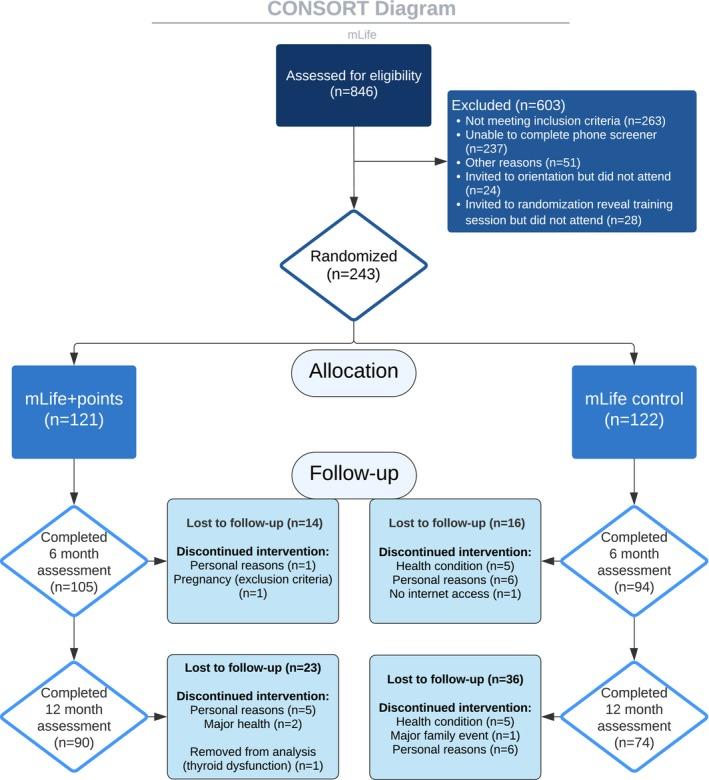
Attrition was lower in the mLIFE + points group (22% vs. 41% in mLIFE; χ = 9.8, p < 0.01), and adherence was higher (61% vs. 42% in mLIFE; χ = 7.6, p < 0.01). None of the group × time interactions was significant for the intent-to-treat analysis except for total number of points earned at 12 months (mLIFE + points mean 605.9 [SE 203.2] vs. mLIFE mean 350.0 [SE 200.0]; p < 0.01). The mLIFE + points participants lost a mean of 5.3 [SE 0.6] kg at 12 months (vs. mean 3.5 [SE 0.7] kg in mLIFE; p = 0.09). Among adherent participants (n = 127), mLIFE + points participants lost more weight (mean 7.3 [SE 0.8] kg) than mLIFE (mean 3.8 [SE 0.9] kg; p < 0.01).
CONCLUSIONS
The use of points led to greater weight loss at 12 months, but only among adherent participants. Providing points for completing social support activities is a way to retain participants and increase engagement in a mobile intervention.
目的
“食物与运动的移动生活方式干预(mLIFE)”研究是一项为期12个月的移动减肥干预研究,旨在探讨社交游戏对促进社会支持的作用。
方法
将超重或肥胖的成年人(n = 243)随机分为mLIFE +积分组(参与社会支持活动可获得积分)或mLIFE组(对积分情况不知情)。通过Fitbit体重秤测量体重。采用重复测量混合模型进行意向性分析以及对依从性参与者(登录mLIFE应用程序的天数≥研究天数的25%)进行分析。
结果
mLIFE +积分组的失访率较低(mLIFE +积分组为22%,mLIFE组为41%;χ = 9.8,p < 0.01),依从性较高(mLIFE +积分组为61%,mLIFE组为42%;χ = 7.6,p < 0.01)。除了12个月时获得的总积分外,意向性分析中所有组×时间的交互作用均无统计学意义(mLIFE +积分组平均为605.9 [标准误203.2],mLIFE组平均为350.0 [标准误200.0];p < 0.01)。mLIFE +积分组的参与者在12个月时平均减重5.3 [标准误0.6] kg(mLIFE组平均为3.5 [标准误0.7] kg;p = 0.09)。在依从性参与者(n = 127)中,mLIFE +积分组的参与者比mLIFE组减重更多(平均7.3 [标准误0.8] kg比3.8 [标准误0.9] kg;p < 0.01)。
结论
在12个月时,积分的使用导致了更多的体重减轻,但仅在依从性参与者中如此。为完成社会支持活动提供积分是留住参与者并提高移动干预参与度的一种方式。
 Zotero 插件