
前列腺癌的多基因风险评分:英国和澳大利亚队列的比较评估。
Polygenic risk scores for prostate cancer: Comparative evaluations in UK and Australian cohorts.
作者信息
Tanha Hamzeh M, Law Matthew H, Ingold Nathan, Ly Philip, Olsen Catherine M, Pandeya Nirmala, Smith David P, MacInnis Robert J, Whiteman David C, Cust Anne E, Steinberg Julia
机构信息
The Daffodil Centre, The University of Sydney, a Joint Venture with Cancer Council NSW, Sydney, NSW, Australia; Department of Population Health, QIMR Berghofer Medical Research Institute, Brisbane, QLD, Australia.
Statistical Genetics, Population Health, QIMR Berghofer Medical Research Institute, Herston Rd, Brisbane, QLD 4006, Australia; School of Biomedical Sciences, Faculty of Health, Queensland University of Technology, Brisbane, QLD 4001, Australia; School of Biomedical Sciences, Faculty of Medicine, University of Queensland, Brisbane, QLD 4072, Australia.
出版信息
HGG Adv. 2025 Jul 7;6(4):100477. doi: 10.1016/j.xhgg.2025.100477.
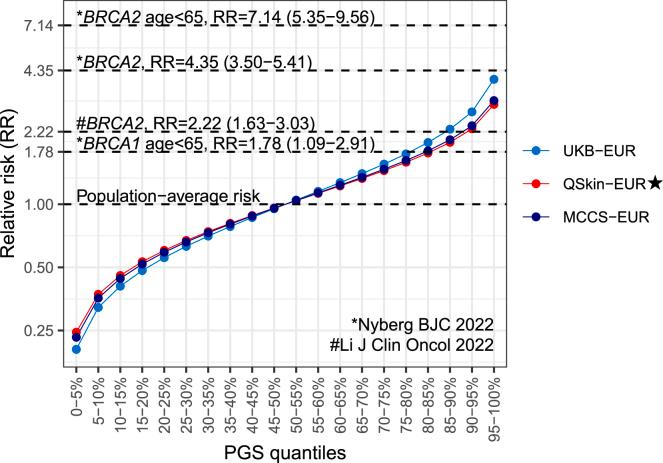
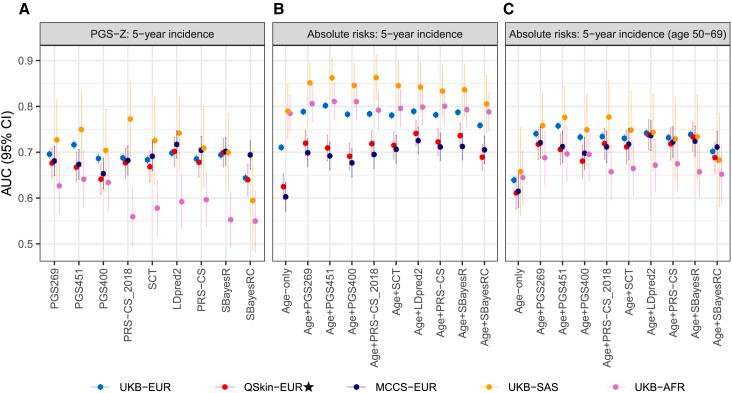
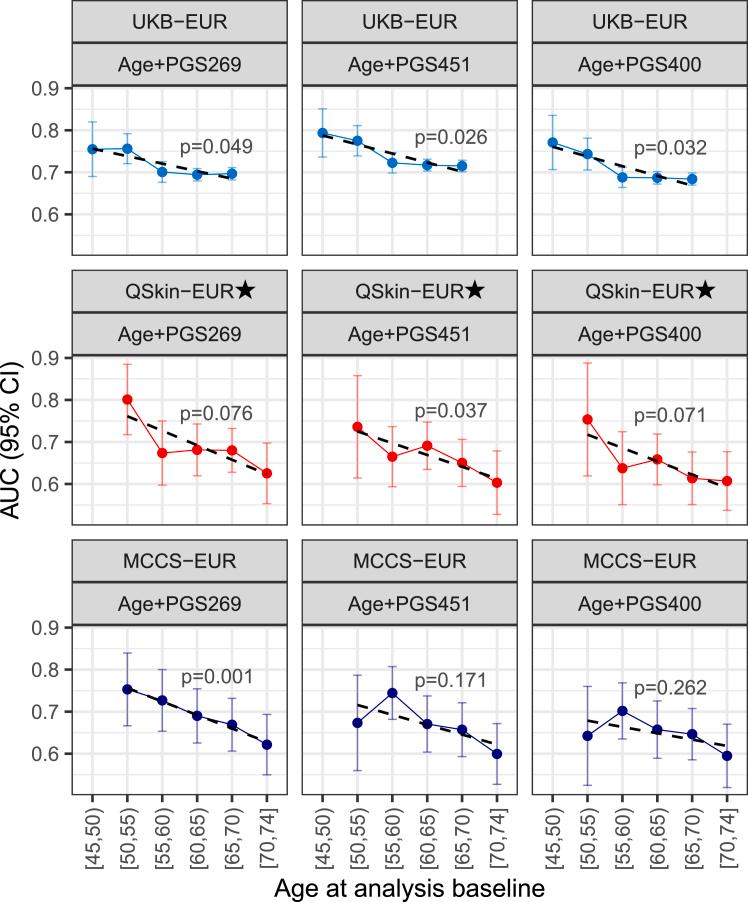
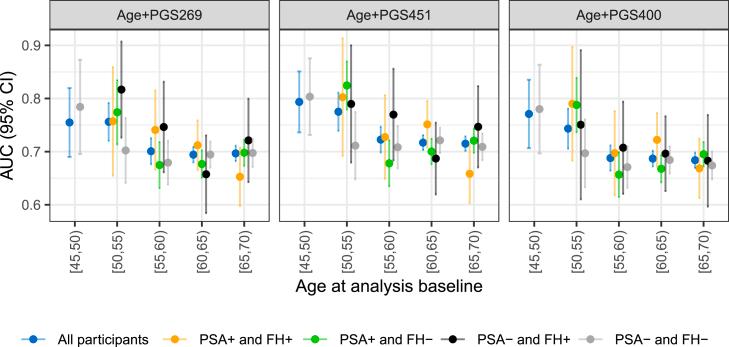
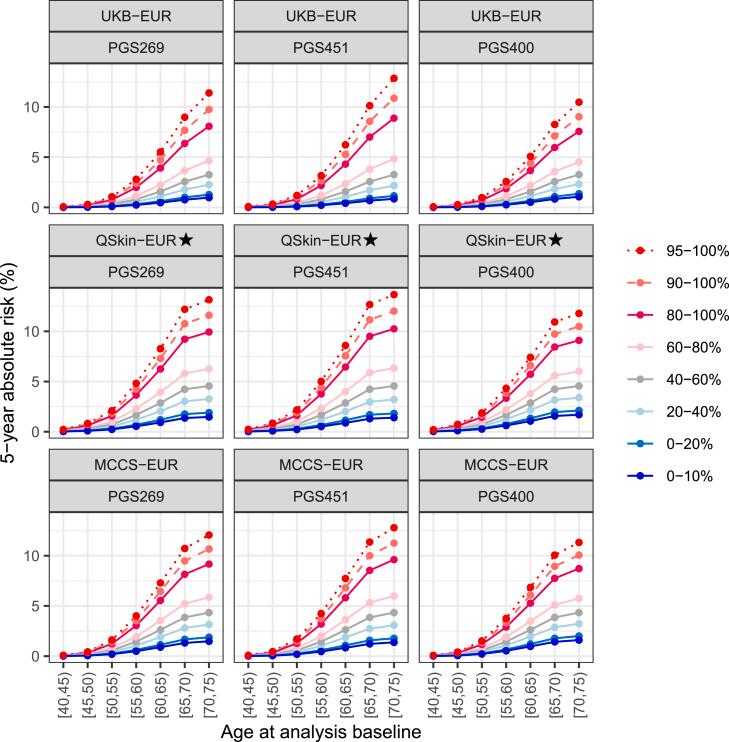
Risk-based approaches offer promise for enhancing early detection of prostate cancer. Polygenic risk scores (PGSs) have emerged as a potential approach for risk stratification, though their performance varies by population. We evaluated nine PGSs (four existing, five new) for predicting 5-year prostate cancer risk across three international population-based prospective cohorts: UK Biobank (UKB), the Australian QSkin Sun and Health Study (QSkin), and Melbourne Collaborative Cohort Study (MCCS). We analyzed UKB European-ancestry (n = 184,010), South-Asian-ancestry (n = 5,097), and African-ancestry (n = 3,193), QSkin European-ancestry (n = 6,791), and MCCS European-ancestry (n = 1,809) male participants. We estimated age-specific 5-year prostate cancer risks (from population data) and PGS-adjusted risks (age-specific risks multiplied by PGS-based relative risks). Predictive performance was assessed using discrimination (AUC) and calibration. PGS significantly enhanced 5-year risk prediction over age alone, particularly for European ancestry (AUC increase 0.05-0.12, p < 10). PGS performance was consistent across European-ancestry men in Australian and UK cohorts, and by pre-baseline prostate-specific antigen tests and family history in UKB. No single PGS outperformed others across all cohorts and ancestry groups. As an illustrative example for potential risk stratification, for a leading PGS in both Australian cohorts, we estimated the population-average 5-year risk at age 50 was reached 5 years earlier by individuals with 20% highest PGS451 and 5 years later by those with 20% lowest PGS451. In conclusion, rigorous analyses with consistent results from international cohorts support the potential of PGS to improve 5-year prostate cancer risk prediction. In the future, PGS may be improved further to enhance performance in diverse populations.
基于风险的方法有望提高前列腺癌的早期检测率。多基因风险评分(PGS)已成为一种潜在的风险分层方法,但其性能因人群而异。我们评估了九种PGS(四种现有,五种新的)在三个基于国际人群的前瞻性队列中预测5年前列腺癌风险的能力:英国生物银行(UKB)、澳大利亚QSkin阳光与健康研究(QSkin)和墨尔本协作队列研究(MCCS)。我们分析了UKB中欧洲血统(n = 184,010)、南亚血统(n = 5,097)和非洲血统(n = 3,193)的男性参与者,QSkin中欧洲血统(n = 6,791)的男性参与者,以及MCCS中欧洲血统(n = 1,809)的男性参与者。我们估计了特定年龄的5年前列腺癌风险(来自人群数据)和PGS调整后的风险(特定年龄风险乘以基于PGS的相对风险)。使用鉴别力(AUC)和校准来评估预测性能。PGS显著提高了仅基于年龄的5年风险预测能力,特别是对于欧洲血统人群(AUC增加0.05 - 0.12,p < 10)。在澳大利亚和英国队列中,欧洲血统男性的PGS性能一致,并且在UKB中通过基线前前列腺特异性抗原检测和家族史也表现一致。在所有队列和血统组中,没有单一的PGS优于其他PGS。作为潜在风险分层的一个示例,对于澳大利亚两个队列中领先的一种PGS,我们估计,对于PGS451最高的20%个体,在50岁时达到人群平均5年风险的时间比平均水平早5年,而PGS451最低的20%个体则晚5年。总之,来自国际队列的严格分析且结果一致,支持了PGS在改善5年前列腺癌风险预测方面的潜力。未来,PGS可能会进一步改进,以提高在不同人群中的性能。
 Zotero 插件