
一线使用组蛋白去乙酰化酶抑制剂(HDACis)加替雷利珠单抗联合化疗治疗晚期非小细胞肺癌:一项单臂II期研究。
First-line treatment with HDACis plus tislelizumab combined with chemotherapy in advanced NSCLC: a single-arm phase II study.
作者信息
Wang Lijie, Gao Ming, Wang Ting, Cui Pengfei, Chen Guangying, Han Xiao, Ma Zhiqiang, Yang Wenyu, Jing Fangfang, Ma Junxun, Zhang Fan, Tao Haitao, Hu Yi
机构信息
Department of Medical Oncology, Senior Department of Oncology, 5th Medical Centre of PLA General Hospital, Beijing 100071, China.
Medical College of Nankai University, Department of Oncology, Tianjin 300071, China.
出版信息
Oncologist. 2025 Jul 4;30(7). doi: 10.1093/oncolo/oyaf155.
BACKGROUND
Immune checkpoint inhibitors in combination with chemotherapy have been a common first-line treatment for non-small cell lung cancer (NSCLC), but they do not work for all patients. HDAC inhibitors (HDACis) may synergize with progressive disease (PD)-1 antibodies by inducing and activating cellular immunity. In this phase II study, we assessed the efficacy and tolerability of chidamide and tislelizumab in combination with chemotherapy in NSCLC patients.
METHODS
This was a single-arm, prospective study. Driver-gene negative locally advanced and metastatic NSCLC patients without prior systemic treatment were enrolled. Patients received chidamide, tislelizumab, and chemotherapy for 4-6 cycles and were then maintained by tislelizumab and chidamide. The primary endpoint was objective response rate (ORR), and secondary endpoints included disease control rate (DCR), progression-free survival (PFS), duration of response, overall survival (OS) and safety.
RESULTS
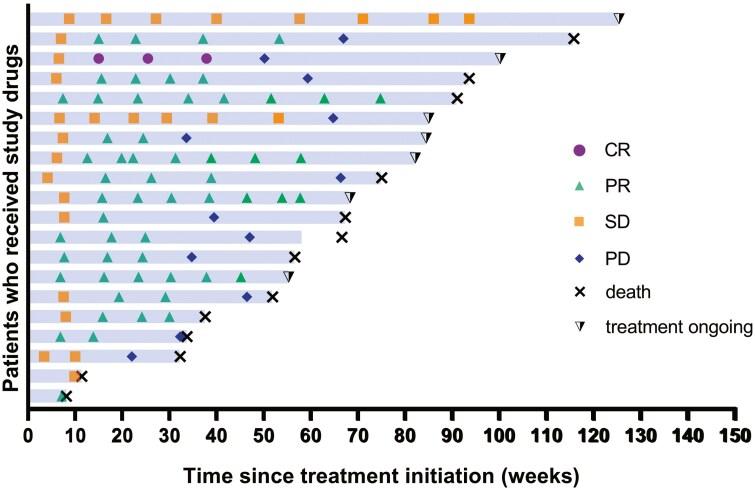
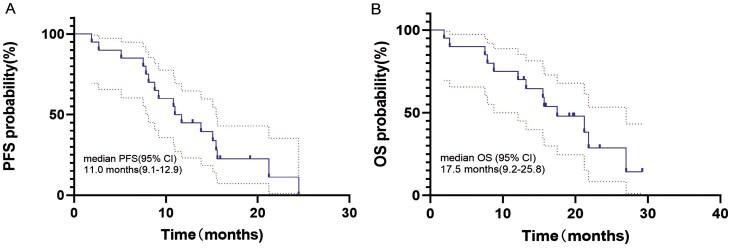
Twenty patients were enrolled in the study and most of them were PD-L1 1%-49% and PD-L1 < 1%. At the data cutoff, ORR was 80% (95% CI, 56.3-94.3), and DCR was 100%. The median follow-up was 23.4 months, the median PFS was 11.0 months (95% CI, 9.1-12.9m), and the median OS was 17.5 months (95% CI, 9.2-25.8m). Eleven patients (55.0%) had ≥ Grade 3 treatment-related adverse events (TRAEs). The most common ≥ Grade 3 TRAEs were leukopenia (25.0%) and neutropenia (20.0%). No patients died from treatment-related adverse events.
CONCLUSIONS
The combination of HDACi and tislelizumab with chemotherapy showed promising antitumor effects and manageable toxicity. More studies are needed to further confirm these results.
CLINICALTRIALS.GOV IDENTIFIER: ChiCTR2000041542.
背景
免疫检查点抑制剂联合化疗一直是非小细胞肺癌(NSCLC)常见的一线治疗方法,但并非对所有患者都有效。组蛋白去乙酰化酶抑制剂(HDACis)可能通过诱导和激活细胞免疫与程序性死亡蛋白1(PD)-1抗体产生协同作用。在这项II期研究中,我们评估了西达本胺和替雷利珠单抗联合化疗在NSCLC患者中的疗效和耐受性。
方法
这是一项单臂前瞻性研究。纳入未接受过全身治疗的驱动基因阴性的局部晚期和转移性NSCLC患者。患者接受西达本胺、替雷利珠单抗和化疗4 - 6个周期,然后接受替雷利珠单抗和西达本胺维持治疗。主要终点为客观缓解率(ORR),次要终点包括疾病控制率(DCR)、无进展生存期(PFS)、缓解持续时间、总生存期(OS)和安全性。
结果
20例患者入组研究,其中大多数患者的程序性死亡配体1(PD-L1)表达为1%-49%和PD-L1<1%。在数据截止时,ORR为80%(95%置信区间,56.3 - 94.3),DCR为100%。中位随访时间为23.4个月,中位PFS为11.0个月(95%置信区间,9.1 - 12.9个月),中位OS为17.5个月(95%置信区间,9.2 - 25.8个月)。11例患者(55.0%)发生≥3级治疗相关不良事件(TRAEs)。最常见的≥3级TRAEs为白细胞减少(25.0%)和中性粒细胞减少(20.0%)。无患者死于治疗相关不良事件。
结论
HDACi与替雷利珠单抗联合化疗显示出有前景的抗肿瘤效果和可管理的毒性。需要更多研究来进一步证实这些结果。
临床试验注册号
ChiCTR2000041542。


 Zotero 插件