
用于罕见妇科肿瘤精准医疗的基于大语言模型的数字孪生体
Large language models-enabled digital twins for precision medicine in rare gynecological tumors.
作者信息
Lammert Jacqueline, Pfarr Nicole, Kuligin Leonid, Mathes Sonja, Dreyer Tobias, Modersohn Luise, Metzger Patrick, Ferber Dyke, Kather Jakob Nikolas, Truhn Daniel, Adams Lisa Christine, Bressem Keno Kyrill, Lange Sebastian, Schwamborn Kristina, Boeker Martin, Kiechle Marion, Schatz Ulrich A, Bronger Holger, Tschochohei Maximilian
机构信息
Department of Gynecology and Center for Hereditary Breast and Ovarian Cancer, Technical University of Munich (TUM), School of Medicine and Health, Klinikum rechts der Isar, TUM University Hospital, Munich, Germany.
Center for Personalized Medicine (ZPM), Technical University of Munich (TUM), School of Medicine and Health, Klinikum rechts der Isar, TUM University Hospital, Munich, Germany.
出版信息
NPJ Digit Med. 2025 Jul 9;8(1):420. doi: 10.1038/s41746-025-01810-z.
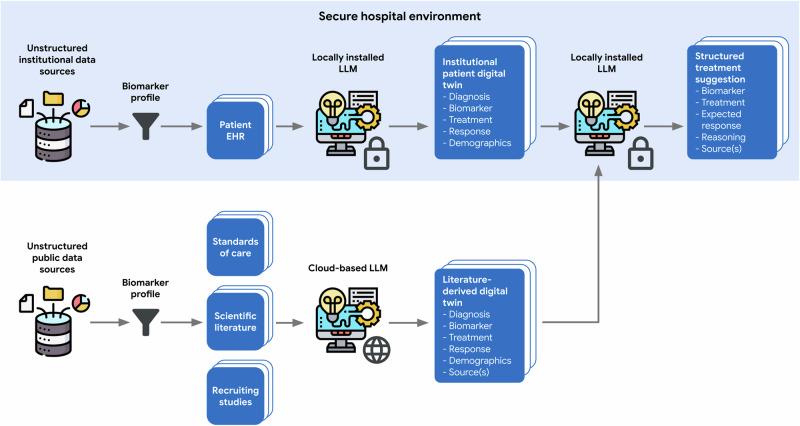
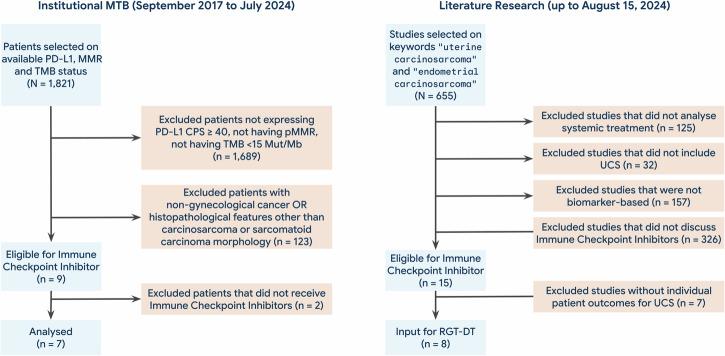
Rare gynecological tumors (RGTs) present major clinical challenges due to their low incidence and heterogeneity. The lack of clear guidelines leads to suboptimal management and poor prognosis. Molecular tumor boards accelerate access to effective therapies by tailoring treatment based on biomarkers, beyond cancer type. Unstructured data that requires manual curation hinders efficient use of biomarker profiling for therapy matching. This study explores the use of large language models (LLMs) to construct digital twins for precision medicine in RGTs. Our proof-of-concept digital twin system integrates clinical and biomarker data from institutional and published cases (n = 21) and literature-derived data (n = 655 publications) to create tailored treatment plans for metastatic uterine carcinosarcoma, identifying options potentially missed by traditional, single-source analysis. LLM-enabled digital twins efficiently model individual patient trajectories. Shifting to a biology-based rather than organ-based tumor definition enables personalized care that could advance RGT management and thus enhance patient outcomes.
罕见妇科肿瘤(RGTs)因其发病率低和异质性而带来重大临床挑战。缺乏明确的指南导致治疗效果欠佳且预后不良。分子肿瘤委员会通过基于生物标志物(而非癌症类型)定制治疗方案,加快了有效治疗的获取。需要人工整理的非结构化数据阻碍了生物标志物分析在治疗匹配中的高效应用。本研究探索使用大语言模型(LLMs)构建数字孪生体,以实现RGTs的精准医疗。我们的概念验证数字孪生体系统整合了来自机构病例和已发表病例(n = 21)的临床和生物标志物数据以及文献衍生数据(n = 655篇出版物),为转移性子宫癌肉瘤制定定制化治疗方案,识别传统单源分析可能遗漏的选项。基于大语言模型的数字孪生体能够有效地模拟个体患者病程。转向基于生物学而非基于器官的肿瘤定义能够实现个性化医疗,这可能推动RGTs的管理,从而改善患者预后。

 Zotero 插件